
 English
  Español

Tips for More Effective Studying
Nihongo Online School > Tips for More Effective Studying

How to manage your IT engineer job interview in Japan
2026/01/23
Preparing for an IT job interview in Japan as a foreign professional requires a good understanding of local hiring practices. This guide walks you through each stage of the Japanese IT interview process, from initial communication to visa procedures after receiving an offer. Whether your interviews are online or in person in Japan, understanding how […] […]

[2026] How to get an IT job as a foreigner in Japan
2026/01/23
In Japan, the IT industry is expected to face a shortage of hundreds of thousands of professionals in the coming years. As a result, getting an IT job as a foreigner in Japan already represents a strong opportunity. Find all the information you need to start your job hunting in Japan and plan concretely for […] […]

Can You Really Measure Your Japanese Speaking Ability?
2026/01/21
Contents1 Can You Really Measure Your Japanese Speaking Ability?1.1 Intro: Why Japanese Proficiency Tests Don’t Tell the Full Story1.2 What Is a Speaking Level Test?1.3 How the Test Works (audio questions → recorded answers)1.4 What It Measures (vocabulary, grammar, fluency, etc.)1.5 Why It Matters for Learners1.6 What You Can Do With Your Score1.7 Next Steps: […] […]

How many Japanese lessons do you actually need to start speaking?
2026/01/20
How many Japanese lessons do you actually need to start speaking? This is one of the most common questions among false beginners. You may have finished hiragana and katakana, studied with apps, or learned some grammar—but still feel that speaking Japanese is hard. So what’s realistic? In this article, we explain how many lessons it […] […]

Udemy Japanese Language Course Online: 5,000 Students Learning JLPT N4 & N3 Worldwide
2026/01/19
Contents1 Udemy Japanese Language Course Online: 5,000 Students Learning JLPT N4 & N3 Worldwide1.1 Why More People Are Choosing a Japanese Language Course Online1.2 JLPT N4 vs JLPT N3: Which Course Is Right for You?1.3 JLPT N4 Online Course on Udemy (Beginner to Elementary Level)1.3.1 ⭐ What Learners Say About Our JLPT N4 Course1.4 JLPT […] […]

How to Get a Japan Visa for Software Engineers: 2026 Requirements
2026/01/19
Working as a software engineer in Japan starts with the right visa. The process is well defined, but knowing which visa fits you and how to qualify is where most applicants get stuck. This guide covers everything you need to get a Japan visa for software engineer roles in 2026, from choosing the right work […] […]

Online Japanese Lessons vs Language Schools in Japan: Which Is Better?
2026/01/18
When people decide to seriously study Japanese, one question almost always comes up: Is it better to take online Japanese lessons, or attend a physical language school in Japan? Both options are often presented in very simplified ways, but in reality, the decision is far more nuanced. Online lessons are sometimes described as “cheap but […] […]

Who Should NOT Take Online Japanese Lessons
2026/01/18
Online Japanese lessons can be a very powerful way to learn the language, especially for people who do not live in Japan or do not have access to in-person schools. They offer flexible schedules, access to native teachers, and the ability to study from anywhere in the world. However, to be completely honest, online Japanese […] […]

The Biggest Problems with Online Japanese Lessons (And How to Avoid Them)
2026/01/18
Online Japanese lessons have become one of the most popular ways to study the language. They offer flexibility, access to native teachers, and the ability to study from anywhere in the world. For many learners, they are the only realistic option. However, if we are honest, a large number of learners feel frustrated after a […] […]
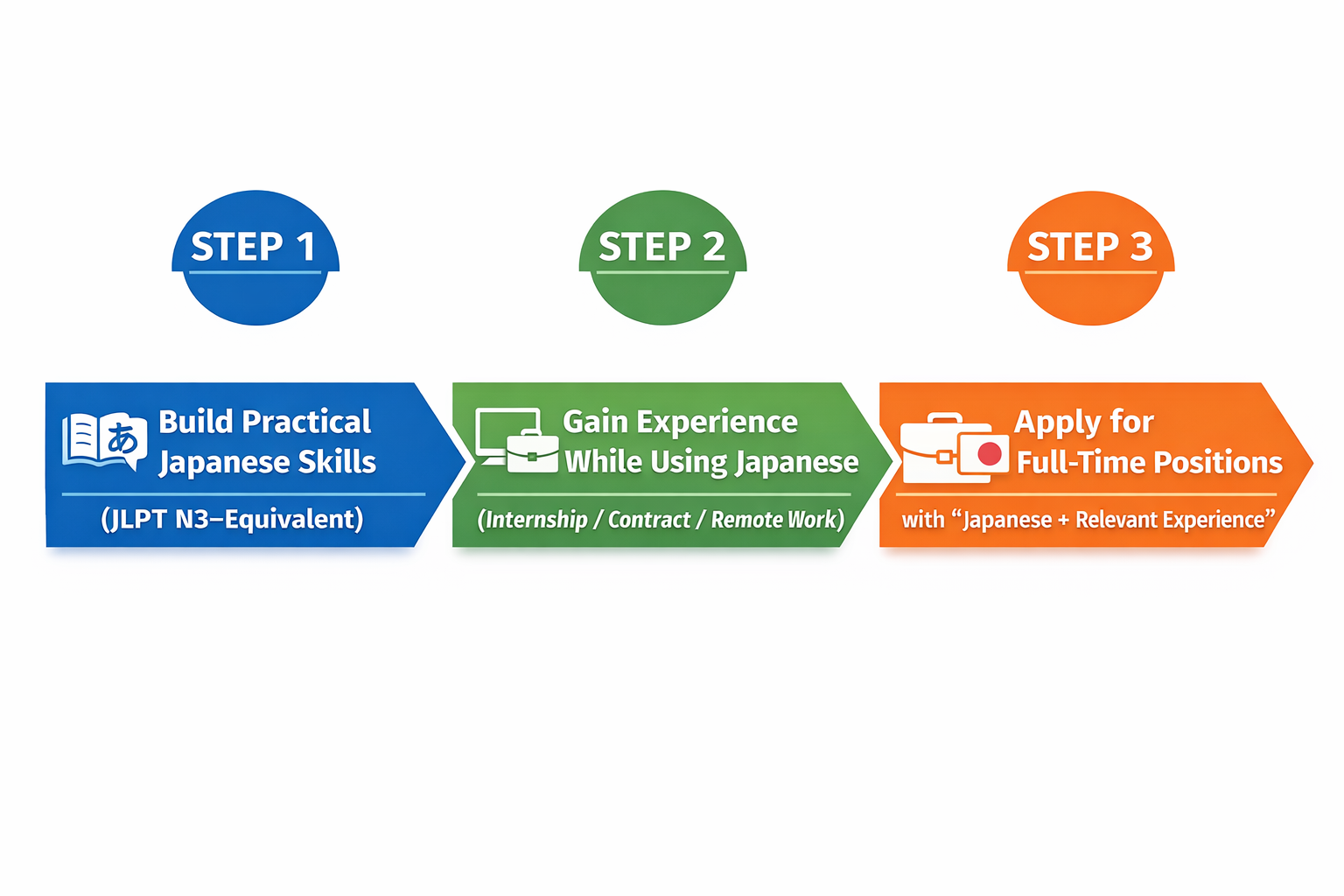
Learning Japanese as a Strategic Investment A 3-Step Path to a Full-Time Job in Japan for Overseas Professionals
2026/01/18
Contents1 From Learning Japanese to Building a Global Career: How to Prove Your Japanese Skills Beyond JLPT Scores1.1 Certificates and Proof of Completion: What They Are (and What They Are Not)1.2 Why JLPT Scores Alone Are Often Not Enough1.3 Practical Tip: Using Video to Demonstrate Your Japanese Skills2 Learning Japanese as a Career Strategy2.0.1 Step […] […]

How to learn Japanese while working full-time
2026/01/18
If you’re working full time, you’ve probably told yourself that you don’t have time to learn Japanese while working. The real problem isn’t a lack of time, it’s the lack of a system to use the time you already have during commutes, lunch breaks, mornings, and all those small moments throughout the day. Contents1 Can […] […]

How to move to Japan as a software engineer: what to know
2026/01/18
Moving to Japan as a software engineer is appealing, but there is no single ‘right’ path. This guide breaks down the realistic ways to move to Japan, where to find software engineering jobs, how to choose the option that fits your profile, and what life actually looks like once you’re there. Contents1 Is Japan a […] […]
