
 English
  Español

Tips for More Effective Studying
Nihongo Online School > Tips for More Effective Studying > What Can You Actually Do in Japanese After 12 Months? A Realistic Guide for False Beginners
What Can You Actually Do in Japanese After 12 Months? A Realistic Guide for False Beginners
2026/01/17

Director: Kotaro Muramoto
Principal of Nihongo Online School
In September 2019, he founded "Nihongo Online School". Since then, has been teaching Japanese online lessons, with a total of over 1,000 students.
He has designed an individualized curriculum based on student’s needs and study goal. And is conscious of making the classes speech-centered in order to improve students’ speaking skills.
The school asks students to submit homework assignments worth 2 hours per lesson to improve faster. By supporting students with these features, students are able to efficiently improve Japanese language skills.
After 6 months, many learners realize one thing:
“I can manage daily conversations—but Japanese still feels difficult at work.”
So the next natural question becomes:
“What actually changes after 12 months of studying Japanese?”
In this article, we give a realistic answer based on learning data from over 1,000 learners, measured with a 10-level conversation scale focused on real communication—not test scores.
Contents
- 1 Short Answer: Yes—but Not Perfectly
- 2 Where Most Learners Are After 12 Months
- 3 What You Can Do at Conversation Level 6
- 4 What Is Still Difficult After 12 Months
- 5 Why 12 Months Is a Turning Point
- 6 From Daily Conversation to Work Communication
- 7 Who Reaches Level 6 in 12 Months?
- 8 Why Some Learners Stop at Level 5–6
- 9 A Realistic Timeline After 12 Months
- 10 Is Level 6 Realistic for You in 12 Months?

Short Answer: Yes—but Not Perfectly
After 12 months of consistent study, many false beginners can finally start using Japanese as a working tool.
This does not mean speaking like a native. But it often means:
- ✅ You can explain your job and tasks in Japanese
- ✅ You can participate in meetings with preparation
- ✅ You can handle follow-up questions and clarifications
For many learners, this is the first time Japanese feels genuinely useful at work.
Where Most Learners Are After 12 Months
When progress is measured correctly, conversation ability improves at a fairly predictable pace.
With consistent study (for example, two 60-minute one-on-one lessons per week with review), many learners improve by about one conversation level every six months.
The chart below shows an average learning trajectory from Conversation Level 3 to Level 6.
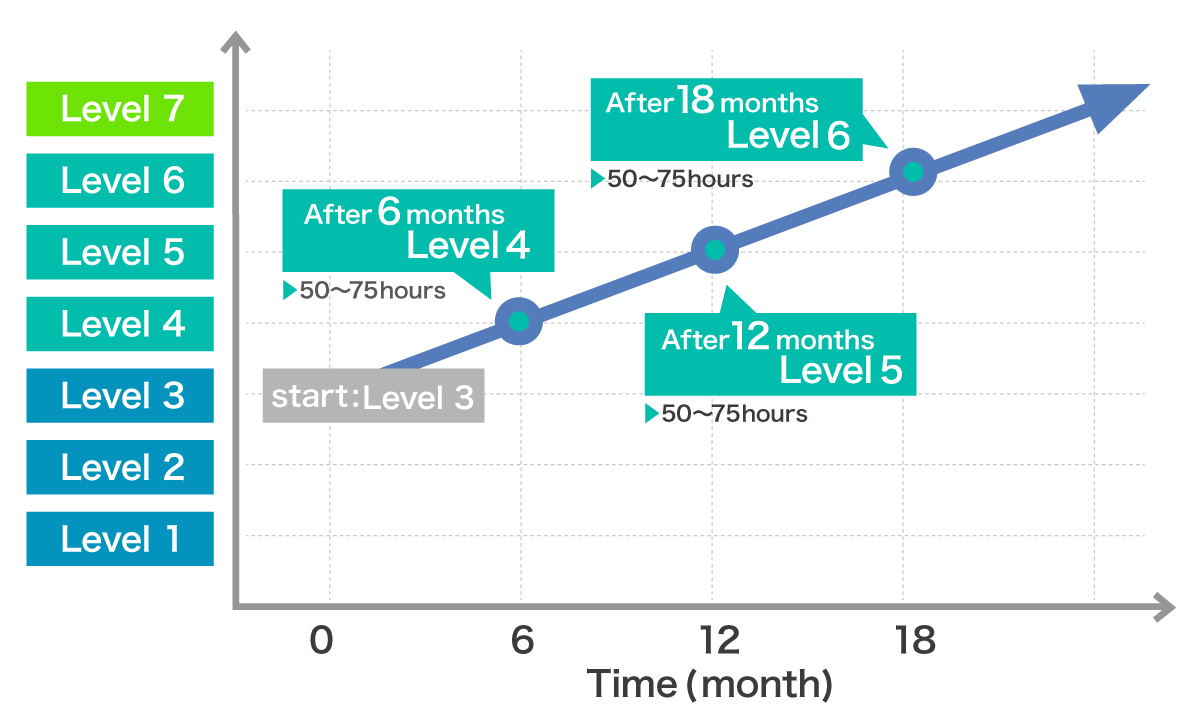
This means that after 12 months, many learners reach:
- Conversation Level 5–6 (from Level 3–4)
- Conversation Level 6 (ideal but realistic case)
Level 6 is a key milestone—it’s where Japanese starts working in professional settings.
What You Can Do at Conversation Level 6
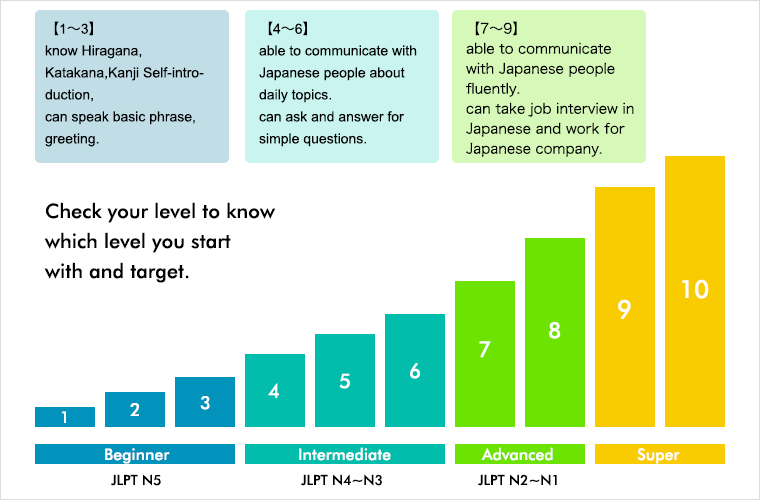
At Conversation Level 6, many learners can:
- understand about 60–70% of meeting discussions
- explain their role and responsibilities in detail
- share background information before giving an opinion
- ask for clarification and rephrase when misunderstood
The image below shows the full scale and where “work-ready” typically begins.
This is often when learners say:
“I’m not fluent—but I can finally work in Japanese.”
What Is Still Difficult After 12 Months
Even after a year, some challenges usually remain:
- leading complex discussions or negotiations
- responding instantly to unexpected topics
- handling subtle nuance, humor, or implicit expectations
This is why many learners aim next for Conversation Level 7, where communication becomes more stable and independent.
Why 12 Months Is a Turning Point
Reaching this stage is not about talent. It happens because:
- you’ve accumulated enough speaking experience
- you’ve repeated the cycle of mistakes and feedback
- you’ve started thinking and organizing ideas in Japanese
At this point, Japanese shifts from “something you study” to “something you use.”
From Daily Conversation to Work Communication
After 6 months, many learners become aware of the gap between daily conversation and Japanese for work.
After 12 months, many learners begin to cross that gap—by learning how to explain, structure, and confirm information clearly.
This transition is explained in detail here:
From Daily Conversation to Japanese for Work: What Changes, and How Long It Takes
Who Reaches Level 6 in 12 Months?
Learners who reach this level within a year usually share a few conditions:
- they speak Japanese at least twice a week
- they receive clear, specific feedback on their speaking
- they practice using their own job and real situations
These conditions are learnable and repeatable.
Why Some Learners Stop at Level 5–6
Many learners plateau not because Japanese is “too hard,” but because:
- their goal becomes unclear
- they feel “good enough” to survive
- they stop measuring progress objectively
Clear goals and structured feedback are what push learners toward Level 7.
A Realistic Timeline After 12 Months
- 0–6 months: build conversation foundations
- 6–12 months: start using Japanese at work
- 12–18 months: stabilize communication (Level 7)
This long-term view helps avoid frustration and unrealistic expectations.
Is Level 6 Realistic for You in 12 Months?
It depends on your current conversation level, your work environment, and how you practice.
A short conversation level check can help you see:
- your current level
- whether Level 6 in 12 months is realistic
- what kind of practice would get you there
A level check is included in our Free Trial Lesson. We’ll propose a learning plan based on your goals and situation.