
 English
  Español

Tips for More Effective Studying
Nihongo Online School > Tips for More Effective Studying > Can You Use Japanese at Work After 6 Months? A Realistic Answer for False Beginners
Can You Use Japanese at Work After 6 Months? A Realistic Answer for False Beginners
2026/01/17

Director: Kotaro Muramoto
Principal of Nihongo Online School
In September 2019, he founded "Nihongo Online School". Since then, has been teaching Japanese online lessons, with a total of over 1,000 students.
He has designed an individualized curriculum based on student’s needs and study goal. And is conscious of making the classes speech-centered in order to improve students’ speaking skills.
The school asks students to submit homework assignments worth 2 hours per lesson to improve faster. By supporting students with these features, students are able to efficiently improve Japanese language skills.
Can you use Japanese at work after 6 months?
If you’ve studied Japanese with apps or self-study, you’ve probably seen promises like “Business Japanese in 6 months.” It sounds hopeful—but also a little suspicious.
This article gives a realistic answer based on real learning data from over 1,000 learners, measured with a 10-level conversation scale focused on real communication—not test scores.
Short answer: For most false beginners, no—not yet. But that doesn’t mean the first 6 months are wasted.
Contents
- 1 The Honest Answer
- 2 Why “6 Months” Is Often Misunderstood
- 3 What Most Learners Can Do After 6 Months (Based on Data)
- 4 What Level Is “Work-Usable Japanese”?
- 5 Is Studying for 6 Months a Waste of Time?
- 6 Who Improves Faster in the First 6 Months?
- 7 A Realistic Roadmap From Here
- 8 Not Sure Where You’ll Be in 6 Months?

The Honest Answer
If you start around Conversation Level 2–4 (roughly JLPT N5–N4), then after 6 months of consistent study, most learners will not be able to use Japanese independently in professional situations like meetings.
In most cases, after 6 months you will:
- ✅ handle basic daily conversations at work
- ✅ understand slow, simple explanations with familiar words
- ✅ communicate with support (rephrasing, confirmation, short follow-ups)
But most learners still cannot:
- ❌ lead meetings or discussions in Japanese
- ❌ explain complex tasks logically on their own
- ❌ handle unexpected questions smoothly and quickly
Why “6 Months” Is Often Misunderstood
Reason 1: JLPT doesn’t measure workplace conversation
JLPT is useful for grammar, vocabulary, and reading. However, it does not measure real-time speaking, interaction skills, or how well you communicate in meetings.
Reason 2: “Speaking Japanese” means different things
Some people mean “I can greet people.” Others mean “I can explain a problem and propose a solution.” Without a shared definition, expectations become unrealistic.
What Most Learners Can Do After 6 Months (Based on Data)
When progress is measured correctly, conversation growth follows a relatively predictable pattern.
Based on learning data from 1,000+ learners, students studying consistently (for example, two 60-minute lessons per week with regular review) often improve by about one conversation level in roughly six months.
The chart below shows an average learning trajectory from Conversation Level 3 to Level 6.
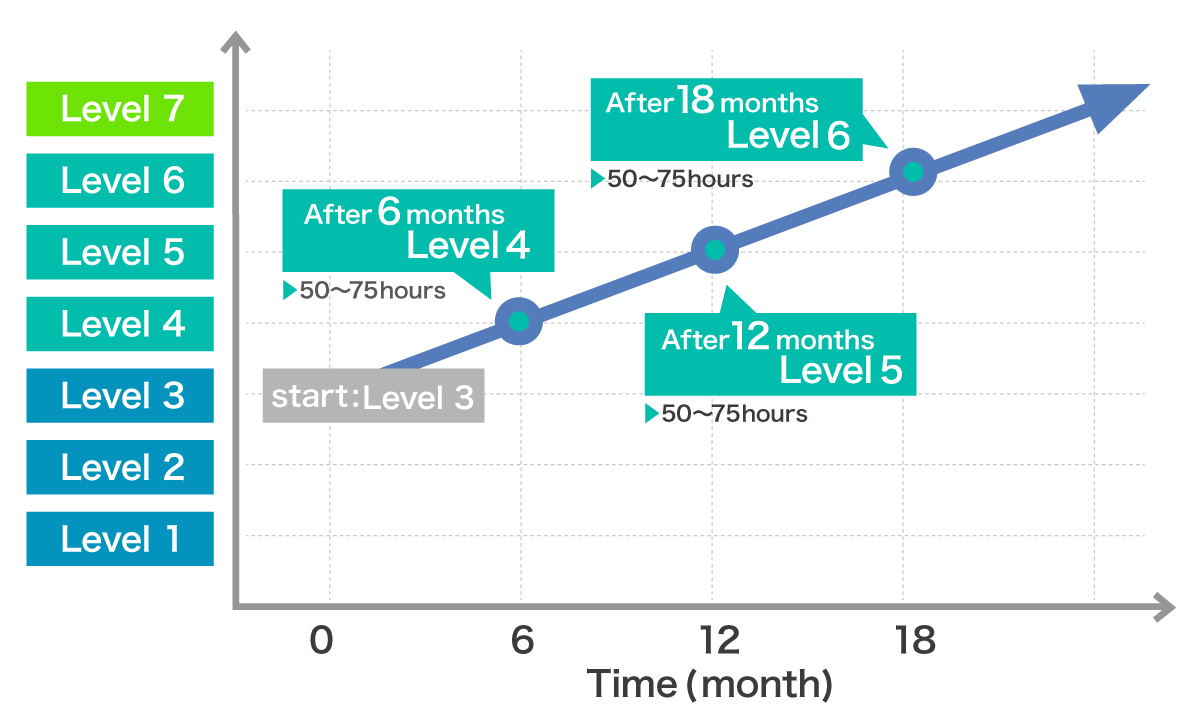
So if your current level is around Level 2–4, a realistic outcome after 6 months is often:
- Level 3 → Level 4 (common)
- Level 4 → Level 5 (faster learners)
What Level Is “Work-Usable Japanese”?
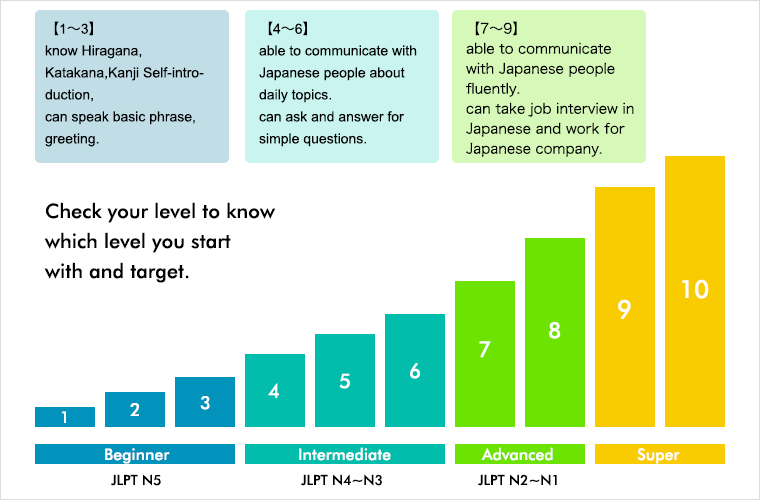
In many workplaces, the turning point is around Conversation Level 6–7:
- Level 5: communication often works with support
- Level 6: explanations become more structured and detailed
- Level 7: you can explain ideas logically, share background, and participate actively in meetings
The image below shows the full scale and where “work-ready” typically begins.
Is Studying for 6 Months a Waste of Time?
Absolutely not.
The first 6 months are critical for:
- reducing fear of speaking Japanese
- building basic sentence flow and response speed
- creating a sustainable study routine
Think of 6 months as building the foundation—not reaching the final destination.
Who Improves Faster in the First 6 Months?
This is not about talent. Progress depends on training conditions. Learners tend to improve faster when they:
- speak Japanese at least twice a week
- receive clear feedback on their speaking
- focus on communication, not perfection
A Realistic Roadmap From Here
- 0–6 months: Level 2–4 → Level 3–5
- 6–12 months: Level 4–5 → Level 5–6
- 12–18 months: Level 6 → Level 7 (work-usable)
If you want a realistic view of what becomes possible after one year, read our next article:
What Can You Actually Do in Japanese After 12 Months?
Not Sure Where You’ll Be in 6 Months?
Most learners misjudge their current conversation level. A short level check can help you understand:
- your current conversation level
- what 6 months will realistically change
- the most effective next step for you
A conversation level check is included in our Free Trial Lesson. We’ll also propose a learning plan that fits your goals and situation.
Related articles:
-
How many hours does it take to reach each JLPT level?
If you’re wondering whether this is realistic, here’s a detailed breakdown. -
From daily conversation to Japanese for work: what changes and how long it takes
Here’s what actually changes when you move from daily Japanese to Japanese for work.