
 English
  Español

Tips for More Effective Studying
Nihongo Online School > Tips for More Effective Studying > How Many Study Hours Do You Need for Each JLPT Level?
How Many Study Hours Do You Need for Each JLPT Level?

2026/01/12

Director: Kotaro Muramoto
Principal of Nihongo Online School
In September 2019, he founded "Nihongo Online School". Since then, has been teaching Japanese online lessons, with a total of over 1,000 students.
He has designed an individualized curriculum based on student’s needs and study goal. And is conscious of making the classes speech-centered in order to improve students’ speaking skills.
The school asks students to submit homework assignments worth 2 hours per lesson to improve faster. By supporting students with these features, students are able to efficiently improve Japanese language skills.
This article explains the estimated study time required to reach each JLPT level and what learners can realistically do in daily life or at work at each stage.
For learners who want to communicate in Japanese, work at a Japanese company, or live in Japan in the future, understanding Japanese proficiency levels is essential.
The Japanese-Language Proficiency Test (JLPT) is the most widely used and standardized measure of Japanese ability. It is commonly used by Japanese companies when hiring or training foreign employees.
Based on general learning data and real-world study patterns, this article provides an overview of JLPT levels, estimated study hours, and the practical Japanese ability typically expected at each stage.
Contents

JLPT levels and estimated study time
The JLPT consists of five levels, from N5 (beginner) to N1 (advanced). The table below shows the estimated total study hours required to reach each level from beginner, as well as the approximate duration when studying about one hour per day.
👉swipe right to view the full table.
| JLPT Level | Total Study Hours (from beginner) | Additional Hours from Previous Level | Estimated Duration (1 hour/day) | Expected Practical Japanese Ability |
|---|---|---|---|---|
| N5 | 150–300 hours | — | 5–10 months | Basic greetings, self-introductions, very simple daily conversations |
| N4 | 300–400 hours | 150–250 hours | 5–8 months | Understanding simple instructions and basic daily communication |
| N3 | 450–600 hours | 150–200 hours | 5–7 months | Basic workplace communication and everyday conversations |
| N2 | 600–800 hours | 300–400 hours | 10–13 months | Handling work instructions, reports, and written materials |
| N1 | 900–1200 hours | 300–400 hours | 15–20 months | Professional-level Japanese, discussions and reports comparable to native speakers |
Reference: Japanese-Language Proficiency Test (JLPT)
How long does it usually take to move up one JLPT level?
Based on our students’ learning data, most learners move up one JLPT level with approximately six months of consistent study.
Each 60-minute lesson typically includes about two hours of homework for review and practice. Progress depends on lesson frequency and self-study time, but structured study and regular review are key factors.
Example: Students starting from JLPT N5 can typically reach JLPT N3 in about 12 months with regular lessons and consistent review, when studying consistently with two 60-minute lessons per week.
| Current Level → Target Level | Lesson Hours | Homework | Estimated Duration |
|---|---|---|---|
| Beginner → N5 | 50–75 hours | About 2 hours per lesson hour | 6 months |
| N5 → N4 | 50–75 hours | About 2 hours per lesson hour | 4–6 months |
| N4 → N3 | 50–75 hours | About 2 hours per lesson hour | 4–6 months |
| N3 → N2 | 75–100 hours | About 2 hours per lesson hour | 6–9 months |
| N2 → N1 | 75–100 hours | About 2 hours per lesson hour | 6–9 months |
JLPT level vs. real conversation ability
Passing a JLPT level does not automatically mean you can speak Japanese fluently. The JLPT focuses on reading, listening, vocabulary, and grammar, but it does not directly test speaking ability.
The following videos show real lessons with real students. Individual progress varies, but they provide realistic reference points for conversation ability at each stage.
This equivalence is provided as a practical reference based on our internal conversation-level criteria. Actual JLPT results and speaking ability may vary.
JLPT N4 equivalent — based on our Conversation Level 4
At Conversation Level 4, learners begin to participate in basic daily conversations. Communication is still limited, but meaningful interaction becomes possible when the listener speaks slowly and clearly.
Real lesson example:
- Answer simple questions about daily life and work
- Use basic sentence patterns with frequent pauses
- Rely on teacher support to continue the conversation
Typical timeframe: Around 6 months of consistent study from Conversation Level 3.
JLPT N3 equivalent — based on our Conversation Level 5
At Conversation Level 5, learners can maintain daily conversations more independently. While misunderstandings still occur, they can usually recover and continue without constant support.
Real lesson example:
- Talk about experiences, routines, and simple opinions
- Ask basic follow-up questions
- Maintain a conversation for several minutes
Typical timeframe: About 12 months of total study from Conversation Level 3.
JLPT N2 equivalent — based on our Conversation Level 7
Conversation Level 7 marks a major transition. Learners can explain ideas, provide background information, and handle unexpected questions in professional or semi-formal settings.
Real lesson example:
- Explain opinions logically and with structure
- Handle misunderstandings and self-correct while speaking
- Participate actively in meetings and discussions
Typical timeframe: Around 18 months of consistent study from Conversation Level 3.
How to balance JLPT study and conversation practice
Focusing only on JLPT preparation or only on conversation practice often leads to unbalanced results. The most effective approach is to study for the JLPT while practicing real conversations in parallel.
Our 10-Level Japanese Conversation Scale
Understanding your current level—and what you can realistically do in daily life—helps you set clear goals and stay motivated.
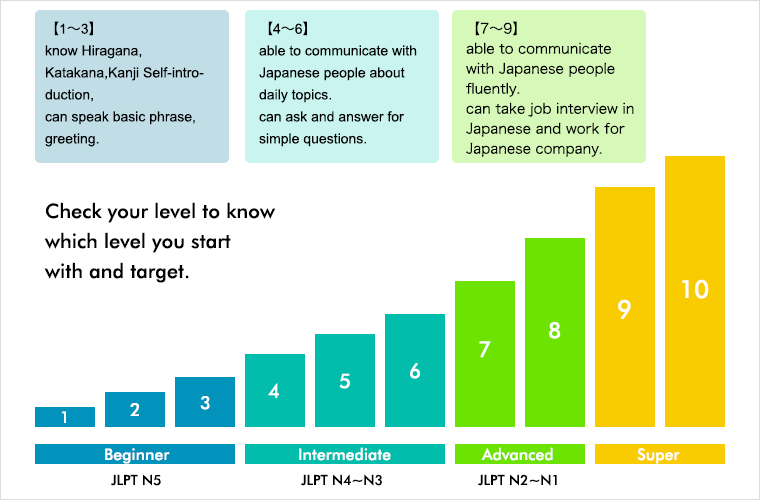
*Based on OPI-style performance criteria, we evaluate conversational ability on a scale of 10.
If your goal is to actually speak Japanese, we recommend reading this related article:
How many hours does it take to improve Japanese conversation skills?
Summary: how long does it really take?
Reaching each JLPT level takes time, consistency, and a realistic study plan. While individual progress varies, having a clear timeline helps learners stay motivated and make informed decisions.
Understanding both JLPT levels and real conversation ability allows you to set practical goals and choose a learning approach that truly matches your needs.
Rather than focusing only on passing exams, building sustainable study habits is the key to long-term progress.