
 English
  Español

Tips for More Effective Studying
Nihongo Online School > Tips for More Effective Studying > What’s the Next Step After Hiragana and Katakana?
What’s the Next Step After Hiragana and Katakana?
2026/01/15

Director: Kotaro Muramoto
Principal of Nihongo Online School
In September 2019, he founded "Nihongo Online School". Since then, has been teaching Japanese online lessons, with a total of over 1,000 students.
He has designed an individualized curriculum based on student’s needs and study goal. And is conscious of making the classes speech-centered in order to improve students’ speaking skills.
The school asks students to submit homework assignments worth 2 hours per lesson to improve faster. By supporting students with these features, students are able to efficiently improve Japanese language skills.
Contents
- 1 What’s the Next Step After Hiragana and Katakana?
- 1.0.1 You are not a beginner anymore — but you’re not fluent yet
- 1.0.2 Why many learners get stuck after hiragana and katakana
- 1.0.3 A practical learning flow after hiragana and katakana
- 1.0.4 What you should focus on after hiragana and katakana
- 1.0.5 What you should be able to do at this stage
- 1.0.6 Conversation Levels: where you are after hiragana and katakana
- 1.0.7 Why the next six months matter
- 1.0.8 What to do next
What’s the Next Step After Hiragana and Katakana?
After learning hiragana and katakana, many Japanese learners feel unsure about what to do next. You are no longer a complete beginner, but jumping straight into advanced study or test preparation often feels overwhelming.
This stage is extremely important. The choices you make after hiragana and katakana can strongly influence whether you build real speaking skills or get stuck as a false beginner.
You are not a beginner anymore — but you’re not fluent yet
At this point, many learners can read basic Japanese, recognize common words, and understand simple grammar explanations. However, they still struggle to communicate smoothly in real-life situations.
This gap between knowledge and speaking ability is what defines a false beginner. It does not mean you are learning incorrectly — it simply means your study focus needs to shift.
Why many learners get stuck after hiragana and katakana
After mastering kana, many learners fall into one of these patterns:
- Endless vocabulary memorization without using words in conversation
- Grammar study without applying patterns in real situations
- Relying only on apps and self-study
- Focusing on tests instead of communication
The issue is not effort. The issue is that speaking requires practice that goes beyond recognition and memorization.
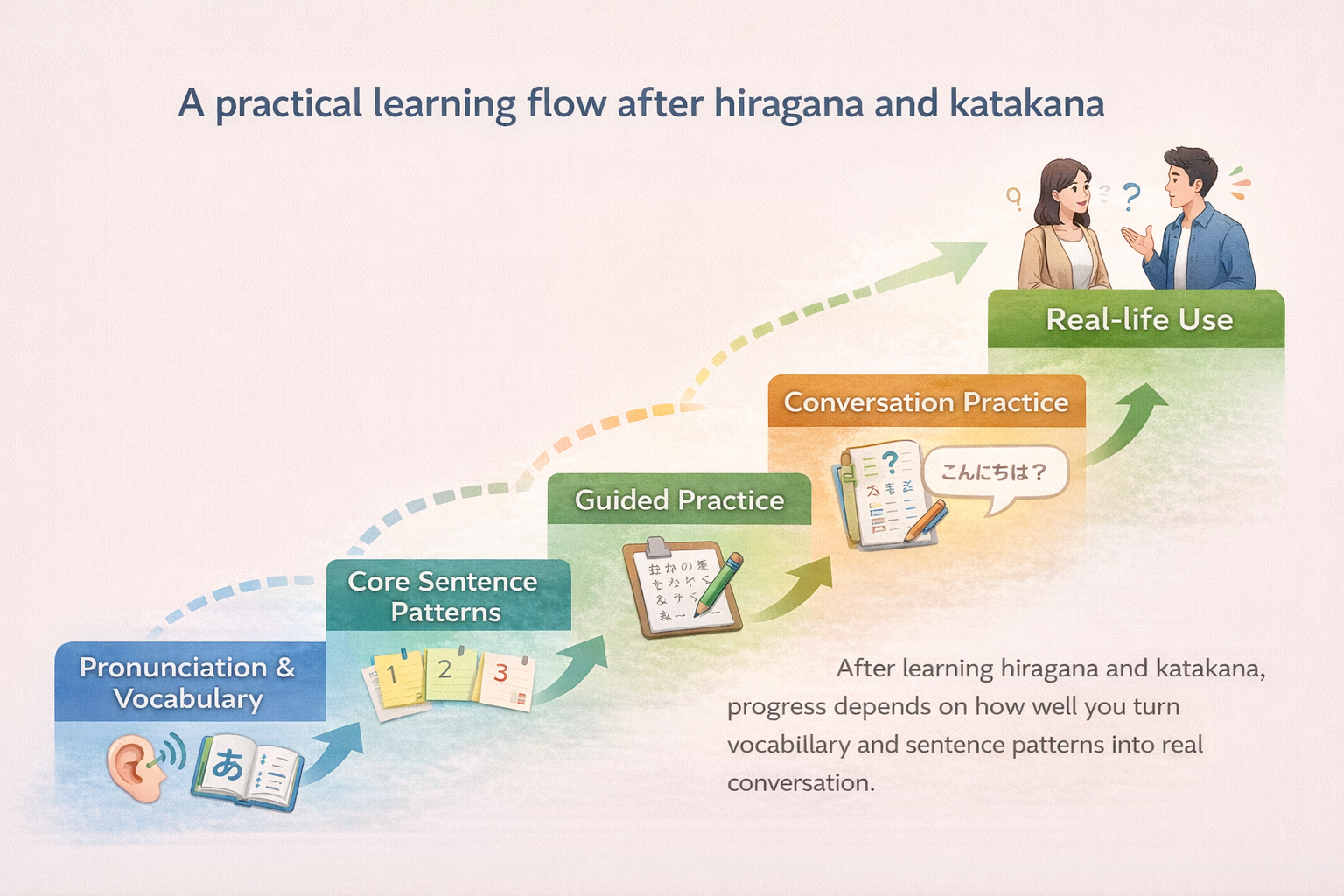
A practical learning flow after hiragana and katakana
After learning hiragana and katakana, progress depends on how well you turn vocabulary and sentence patterns into real conversation. This is best done by following a clear learning flow.
What you should focus on after hiragana and katakana
| Focus area | What to do | Why it matters for speaking |
|---|---|---|
| Pronunciation | Learn correct sounds and rhythm from the beginning | Clear pronunciation builds confidence and helps listeners understand you |
| Vocabulary | Build practical words used in daily life and work | Words are the foundation of real conversation |
| Sentence patterns | Practice core grammar structures repeatedly | Patterns help you respond without translating |
| Guided practice | Use drills and controlled practice with feedback | This bridges the gap between knowing and using Japanese |
| Conversation practice | Apply what you learned in real-life situations | This is where study becomes communication |
What you should be able to do at this stage
By following this approach, learners aim to handle basic daily communication tasks such as:
- Greeting people and introducing yourself
- Describing everyday objects and their location
- Explaining ownership and simple situations
- Shopping for basic items
- Asking for directions
This stage is especially suitable for learners who need to communicate in Japanese at work or in daily life as soon as possible.
As a general reference, this level corresponds to the completion of Beginner Level I and roughly aligns with JLPT N5.
Conversation Levels: where you are after hiragana and katakana
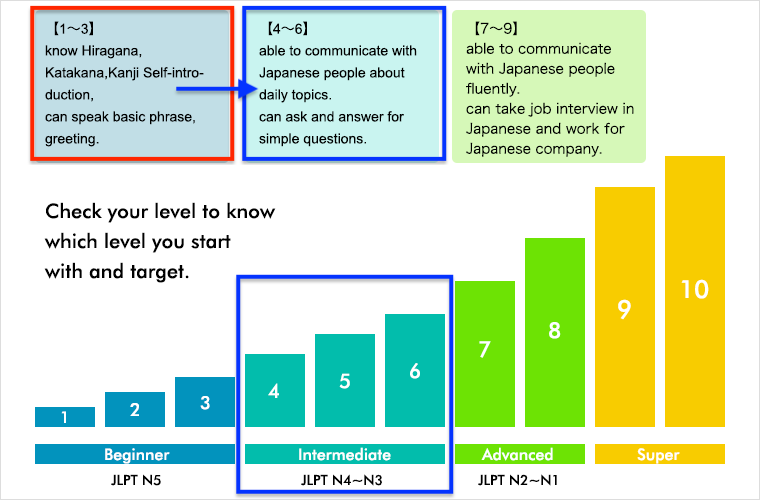
To help learners understand and track real speaking ability, we use a 10-level Japanese conversation scale. After learning hiragana and katakana, many learners start around Conversation Levels 1–3 — the stage where you build pronunciation, vocabulary, and core sentence patterns and begin using them in simple conversations.
From there, many learners naturally aim for Conversation Levels 4–6, where they can communicate more independently through regular conversation practice.
If you are wondering what realistic conversation progress looks like after this stage, this article explains how learners typically move from basic speaking ability to more independent conversation skills. How many hours does it take to improve Japanese conversation skills?
Our conversation levels are defined based on practical speaking ability, following OPI-style criteria such as comprehension, response accuracy, fluency, and the ability to sustain real-life conversations.
Why the next six months matter
For many learners, the period after hiragana and katakana is critical. Rather than rushing ahead, spending the next six months building a solid foundation can prevent long-term frustration.
These six months are not about speed. They are about developing habits that turn study into usable speaking skills and preparing for more complex communication later.
What to do next
If you have finished learning hiragana and katakana and want to move toward real conversation, the most important step is understanding your current speaking level.
A level check can help you see where you are now, what you should focus on next, and how to build a learning plan that fits your goals.
Our free trial lesson includes a conversation level check and personalized guidance for your next step in Japanese learning.
