
 English
  Español

Tips for More Effective Studying
Nihongo Online School > Tips for More Effective Studying > How Long Does It Take to Go From JLPT N3 to N2 ?
How Long Does It Take to Go From JLPT N3 to N2 ?
2026/08/15

Director: Kotaro Muramoto
Principal of Nihongo Online School
In September 2019, he founded "Nihongo Online School". Since then, has been teaching Japanese online lessons, with a total of over 1,000 students.
He has designed an individualized curriculum based on student’s needs and study goal. And is conscious of making the classes speech-centered in order to improve students’ speaking skills.
The school asks students to submit homework assignments worth 2 hours per lesson to improve faster. By supporting students with these features, students are able to efficiently improve Japanese language skills.
Going from JLPT N3 to N2 takes around 300 to 400 additional study hours. The gap between the two levels is the widest in the JLPT, which is why the jump takes longer than the previous ones.
This article covers the realistic timeframe to reach N2, what actually changes between the two levels and a six-month preparation plan.
Key takeaways
- Passing N2 after N3 requires 300 to 400 extra study hours
- N2 is the steepest jump in the JLPT, because it tests formal written Japanese at a reading speed two to three times faster than N3
- A structured plan gets you from N3 to N2 in six months to a year, as long as each phase has a clear focus
Contents

What’s a realistic timeframe to pass JLPT N2 after N3 ?
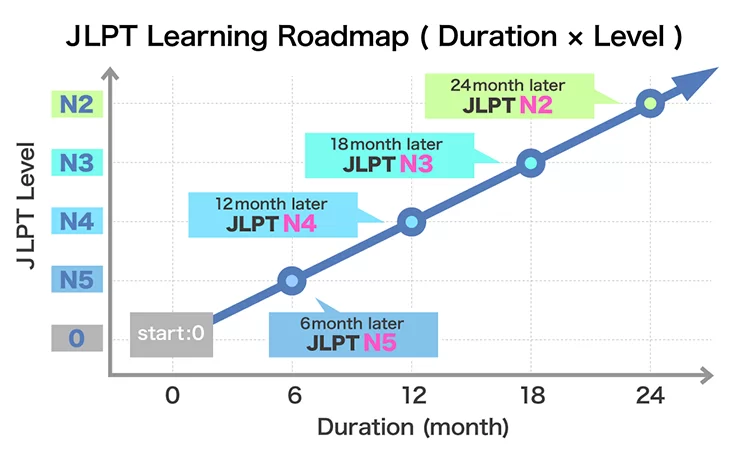
A realistic timeframe to pass N2 after N3 is 6 to 9 months with structured lessons following Nihongo Online School’s method, and 10 to 13 months if you study on your own for about an hour a day.
| Study setup | Study volume | N3 to N2 |
| Self-study (1 hour a day) | 300-400 additional hours | 10-13 months |
| Structured lessons with Nihongo Online School | 75-100 lesson hours + 2 hours of homework per lesson hour | 6-9 months |
You can see the full hour estimates for every level in our guide to how many hours it takes to reach each JLPT level. If you are still working through the earlier levels, we cover those steps separately in our articles on going from N5 to N4 and reaching N3 from N5.
How hard is JLPT N2 compared to N3?
JLPT N2 is significantly harder than N3, and a strong N3 score predicts very little. The reason is that N2 tests formal written Japanese at a reading speed two to three times faster.
| N3 | N2 | |
| Kanji | ~650 | ~1,000 |
| Vocabulary | ~3,750 | ~6,000 |
| Grammar patterns | ~200 | ~300 |
| Reading | Everyday situations, short notices | Editorials, business documents, essays |
| Listening | Near-natural speed | Full native speed, played once |
| Pass mark | 95/180 | 90/180 |
Four major changes come with the jump from N3 to N2:
- Vocabulary becomes abstract and formal, built on compound verbs and set expressions from news and business contexts.
- Grammar tests register, with written patterns that almost never appear in conversation.
- Reading asks for the writer’s intent rather than an explicit detail, on far longer passages.
- Listening adds integrated comprehension, where the answer comes from combining several parts of a conversation.
How to bridge the gap between JLPT N3 and N2

Bridging the gap between N3 and N2 means fixing five things in order, starting with where you actually stand.
Measure your true N3 level
A comfortable N3 pass needs around 300~400 additional hours. A borderline one can need twice that. Sit a timed N3 mock test before planning anything else.
Protect your rhythm
One hour a day is the working minimum at this level. Two hours daily produces more than fourteen hours crammed into a weekend, because retention breaks down in the gaps.
Build your vocabulary and kanji
Reading practice stays frustrating while you only know a fraction of the words, so cover the new vocabulary quickly, then use reading to consolidate it.
- Learn kanji inside words with a full example sentence
- Learn transitive and intransitive pairs together with their object and particle
- Write meanings in Japanese. Dictionaries give near-identical translations for patterns that differ in register.
Train reading speed under time pressure
Reading speed is trained by two different exercises, and most learners only do the first one.
- Active reading: you stop at every unknown word and look it up. This builds vocabulary.
- Timed reading: you never stop, even when you only understand part of the text. This is the one that builds exam speed.
Do both every week.
Then apply three techniques that save real minutes on test day:
- Read the question first : You will know whether you are looking for a reason, an explanation or a person before you start the passage.
- Follow the connectors : でも, しかし, 実は and なお tell you where the argument turns, so you can skip ahead to what matters.
- Read the opening and closing lines first on long passages. The main idea usually sits there, and you rarely need everything in between.
Get daily listening input

Learner podcasts are slowed down and will not prepare you for exam speed, so move to native material as soon as you can follow it.
Practise taking notes while listening, since integrated comprehension questions are hard to answer from memory.
During the exam, scan the printed answer options before the audio starts to know what you are listening for.
JLPT N3 to N2 intensive preparation strategy: a 6-month plan
Nihongo Online School offers a structured JLPT N3 to N2 intensive preparation strategy, tested and refined with our students. Our N3 to N2 study plan includes two one-to-one lessons a week with a teacher, plus two hours of homework per lesson hour:
| Lessons | What you learn to do |
| 1-7 | Express impressions and surprise, state intention and determination, explain the reasons behind a result, describe an ongoing process |
| 8-14 | Explain things in logical sequence, mark time and specific points, partially negate a statement, use contrast effectively |
| 15-20 | Make hypotheses and state their consequences, give advice and warnings, assert something with certainty, limit or specify what you mean |
| 21-25 | Review and consolidate everything covered so far |
Three features of the method make the six-to-nine-month timeline realistic:
- A personalized level check before the N2 study plan is set
- Homework is worth about two hours per lesson hour, which is where most of the actual acquisition happens.
- One-on-one speech-centred lessons, so you produce the patterns out loud in every class instead of only recognising them on paper.

Our student Paul-san started at N5 level and studied with us twice a week. By the time he had worked through the N3 to N2 material, he could read N2 long texts independently and follow Japanese spoken at native speed.
His speaking kept progressing through the same lessons, which is what allowed him to move on to N1 content while still gaining confidence in conversation.