
 English
  Español

Tips for More Effective Studying
Nihongo Online School > Tips for More Effective Studying > Is JLPT N5 enough to live in Japan ?
Is JLPT N5 enough to live in Japan ?

2026/02/24

Director: Kotaro Muramoto
Principal of Nihongo Online School
In September 2019, he founded "Nihongo Online School". Since then, has been teaching Japanese online lessons, with a total of over 1,000 students.
He has designed an individualized curriculum based on student’s needs and study goal. And is conscious of making the classes speech-centered in order to improve students’ speaking skills.
The school asks students to submit homework assignments worth 2 hours per lesson to improve faster. By supporting students with these features, students are able to efficiently improve Japanese language skills.
You’ve just passed the JLPT N5, or you’re currently preparing for it, and you may be wondering whether it’s enough to live in Japan.
This article outlines the opportunities N5 can realistically open, its limitations, and the level you should aim for to live and work comfortably in Japan as a foreigner.
Contents
- 1 What is the Japanese N5 equivalent to ?
- 2 Is N5 enough to travel to Japan ?
- 3 Is it legally possible to live in Japan with JLPT N5 level Japanese ?
- 4 How hard is it to survive in Japan with N5 ?
- 5 What JLPT Level Do You Actually Need to Live in Japan ?
- 6 How to Navigate Daily Life in Japan with JLPT N5

What is the Japanese N5 equivalent to ?
JLPT N5 is the lowest level of the five-level JLPT scale. It corresponds to A1 on the CEFR international framework, absolute beginner territory. Getting there typically requires 150 to 200 hours of study.
At this level, you can read hiragana, katakana, and around 100 basic kanji, handle very simple introductions and questions, and follow slow, clearly articulated sentences.
To put it in perspective a Japanese sixth-grader would comfortably pass N2. N5 is closer to kindergarten level, a solid foundation, but nowhere near functional fluency.
Is N5 enough to travel to Japan ?

For a short trip, JLPT N5 is enough to travel to Japan. Major cities like Tokyo or Osaka are built for tourists, and even zero Japanese gets you by.
Where JLPT N5 actually earns its value is outside tourist hubs. Being able to read hiragana, katakana, and basic kanji makes a real difference. Any attempt to speak the language, however basic, is appreciated by locals.
For comfortable, independent travel across Japan, N4 is the realistic sweet spot.
Is it legally possible to live in Japan with JLPT N5 level Japanese ?
For most work visas in Japan, Japanese proficiency is not a formal requirement.
There are two exceptions worth knowing :
- The Specified Skilled Worker visa requires at least JLPT N4 depending on the sector, and N2 for caregiving roles.
- The Engineer/Specialist visa now requires proof of N2-level Japanese but only for roles involving Japanese-language communication, at smaller unlisted companies.
For permanent residency and naturalization, JLPT is not mandatory but N2 is a clear advantage.
How hard is it to survive in Japan with N5 ?
Surviving in Japan with N5 is possible, and plenty of people have done it. But there’s a real gap between getting by and actually living comfortably. Basic interactions are manageable enough, but the friction starts showing up fast : administrative tasks, unexpected situations, anything that goes off-script.
Here’s what N5 actually looks like in practice.
Handling Daily Life Interactions
With JLPT N5, you can handle a surprising number of daily situations in Japan:
- Greet people and get someone’s attention with basic phrases (sumimasen, arigatou)
- Order food by pointing at a menu
- Use self-checkout kiosks, cashless payments, and picture menus without speaking
Once you step outside these comfort zones, though, JLPT N5 comes with real limitations in daily life:
- Translation apps help, but longer inputs tend to give unreliable outputs
- If you pre-learned a question, understanding the answer can be a whole other challenge
- Anything administrative goes well beyond JLPT N5: opening a bank account, setting up a phone plan, visiting a doctor
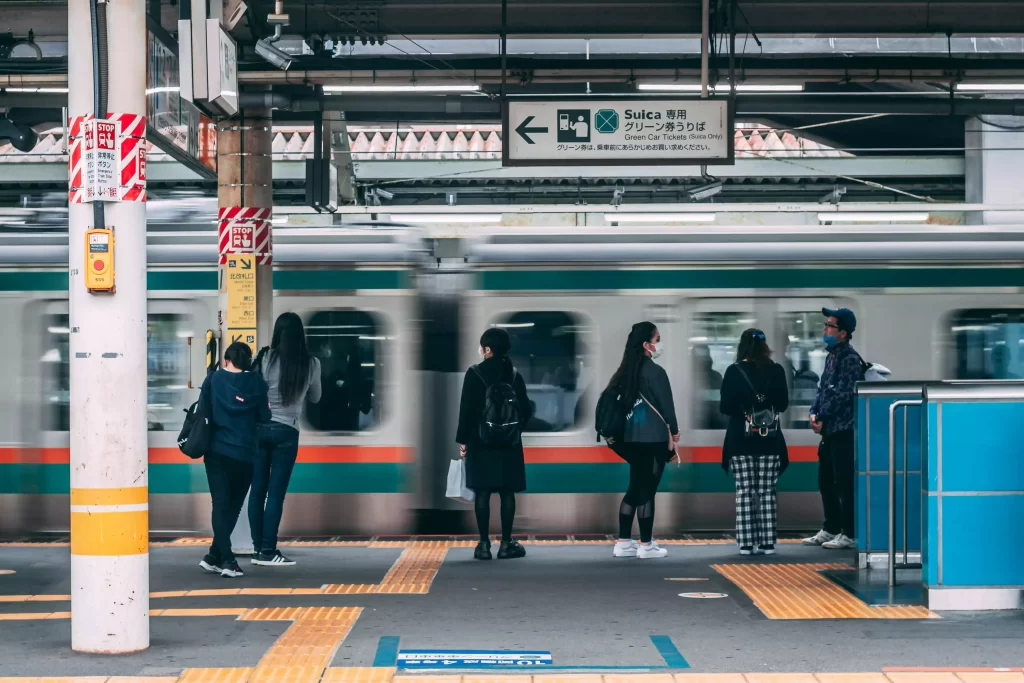
Japan’s train system is one of the most efficient in the world, and at JLPT N5 level, the language barrier is rarely an issue. Major stations display signs in English, and announcements on most lines cycle through Japanese and English.
The easiest move as a beginner is to get a Suica or Pasmo IC card, as it removes most of the friction around buying tickets.
For route planning, the best apps for navigating Japan’s trains as a beginner are:
- Google Maps : reliable for daily use, shows platform numbers, car positions, and exit recommendations
- Navitime Japan Travel : more precise for complex transfers, works better in rural areas
When you struggle to navigate the train system, station staff are genuinely helpful and usually manage basic English. Don’t hesitate to show them your destination on your phone.
Finding a Job with Low Japanese Proficiency

With JLPT N5, your options on the Japanese job market are severely limited.
The only realistic exceptions are:
- Highly skilled professionals in tech or finance, where strong expertise can offset weak Japanese at international companies.
- English teaching roles where Japanese is not required
- Manual or warehouse work where on-site communication is minimal
If you’re actively searching for a job with JLPT N5, your best approach is to target English-friendly job boards and bilingual recruitment agencies for foreigners in Japan:
- Job boards: GaijinPot Jobs, CareerCross, Daijob, all allow filtering by Japanese level
- Recruitment agencies: Robert Walters, Michael Page, or Hays Japan specialize in placing foreigners in international companies and can match your profile to roles that don’t require fluent Japanese
See what JLPT level you need to work in Japan here
Renting an Apartment with a JLPT N5 Level

Technically, foreigners in Japan with a JLPT N5 level can rent an apartment, but it makes an already complex process significantly harder. Foreign nationals already face a lower tenant approval rate than Japanese nationals, and 27% of landlords cite language barriers as their primary reason for refusing foreign tenants.
The best alternative is to use housing platforms designed for foreigners in Japan, which work well at N5 level. GaijinPot Housing, Sakura House, and Leopalace all offer English support and simplified procedures.
With JLPT N5, your most realistic options remain shared houses or furnished short-term apartments. Standard long-term leases are manageable but require either an English-speaking agent or significant external support.
Generally, JLPT N5 is enough to handle the basics of Japan’s health insurance system. If your employer doesn’t manage the enrollment, you’ll need to register yourself at your local ward office. The process is mostly in Japanese, though staff are increasingly used to dealing with foreigners and can often handle basic English.
The real difficulty shows up when you actually need care. Most clinics have little to no English-speaking staff, even in major cities, and medical terminology goes well beyond N5 vocabulary. In those situations, it’s recommended to use large hospitals with international departments, carry a translated medical history, and bring a Japanese-speaking friend to appointments when dealing with anything complex.
What JLPT Level Do You Actually Need to Live in Japan ?
JLPT is a valuable benchmark but it says nothing about your ability to actually speak or interact at work in Japan.
This is why at Nihongo Online School, we evaluate conversation ability separately from JLPT, using a 10-level conversation scale. Each level reflects what you can realistically do in daily life and at work. Because when it comes to working in Japan, conversation skills matter more than test scores.
Here is the JLPT level recommended to live and work in Japan as a foreigner, mapped against our conversation scale::
| JLPT Level | Conversation Level | What it gets you |
| N5 | Level 1-2 | Basic phrases, minimal daily autonomy |
| N4 | Level 3 | Simple interactions, entry-level part-time work |
| N3 | Level 4-5 | Comfortable daily living, basic workplace interactions |
| N2 | Level 6-7 | Professional opportunities, most full-time positions |
| N1 | Level 8+ | Full career access, senior and specialized roles |
JLPT N3 is where daily life starts to feel manageable. But if you’re serious about working in Japan as a foreign employee, JLPT N2 is where things get real : more job opportunities and a much stronger profile in the eyes of Japanese employers.

Best Apps for Daily Interactions at JLPT N5 Level
At JLPT N5 level, having the right apps makes daily life in Japan significantly easier.
The most essential app for a non-Japanese speaker living in Japan is Google Translate. Its camera function lets you point your phone at any Japanese text and get an instant translation. For longer texts like contracts or official letters, DeepL produces more natural and accurate results, especially when nuance matters.
For communication, LINE is non-negotiable. It’s Japan’s default messaging platform, used by landlords, doctors, and coworkers alike. Setting it up in your first week saves a lot of friction down the line.
For payments and transport, these tools are easy to use even at JLPT N5 level:
- PayPay : Japan’s dominant QR payment app, accepted at convenience stores, restaurants, taxis, and most local shops. It removes most cash-handling friction from daily life
- Suica or Pasmo app : load your IC card directly on your phone and tap in and out of train gates without touching a ticket machine
- Google Maps : reliable for daily commutes, combined with Navitime for more complex transfers
At N5, you won’t be reading contracts or following fast conversations, but with these tools you can handle most of daily life independently.
Best Books to Understand Japanese Culture Before Moving
For N5 learners preparing for their move, understanding Japanese culture is just as important as learning the language.
Among the most recommended books for understanding Japanese culture before moving to Japan, two stand out:
- The Chrysanthemum and the Sword by Ruth Benedict unpacks the social codes and values that still shape daily life today
- The Japanese Mind by Roger Davies and Osamu Ikeno covers more contemporary attitudes toward work, hierarchy, and daily interactions in a practical, accessible way
Neither requires any Japanese. Both are written specifically for readers coming from outside the culture, which makes them ideal books about Japanese daily life for N5 learners.
Check out our top JLPT N5 book list to improve your Japanese language skills.
Services to Help You Learn Practical Japanese Beyond JLPT N5

Nihongo Online School provides a full online Japanese learning service for learning practical Japanese at JLPT N5 level and beyond.
Our curriculum is built around practical Japanese you can actually use from day one in Japan: asking for directions, navigating the workplace, handling basic administrative tasks, and communicating in your community. The content is fully customized based on your needs, goals, and availability.
Lessons are one-on-one, built around your schedule, with 2 hours of structured homework after each session to accelerate retention. Progress is regularly assessed through mock tests and practical speaking evaluations.
The 150-hour Nihongo Kick-off course combines 50 hours of online lessons with 100 hours of homework, and delivers a certificate of completion that can support applications to study or work in Japan.