English
  Español

Tips for More Effective Studying
Nihongo Online School > Tips for More Effective Studying > How Many Hours to Reach Each CEFR Level in Japanese?
How Many Hours to Reach Each CEFR Level in Japanese?

2026/05/24

Director: Kotaro Muramoto
Principal of Nihongo Online School
In September 2019, he founded "Nihongo Online School". Since then, has been teaching Japanese online lessons, with a total of over 1,000 students.
He has designed an individualized curriculum based on student’s needs and study goal. And is conscious of making the classes speech-centered in order to improve students’ speaking skills.
The school asks students to submit homework assignments worth 2 hours per lesson to improve faster. By supporting students with these features, students are able to efficiently improve Japanese language skills.
Japanese is one of the hardest languages for English speakers. Before committing months or years to it, you deserve real numbers.
Here is exactly how many hours you need to reach each CEFR level, from A1, B1 to C1, in Japanese.
Contents

The CEFR Scale for Japanese Learning: A Quick Reminder
The CEFR scale for Japanese divides proficiency into six levels:
- A1, A2 : Basic User: survival situations, simple interaction
- B1, B2 : Independent User: daily life, work, living in Japan
- C1, C2 : Proficient User: near-native fluency
Since December 2025, the JLPT officially includes a CEFR Japanese reference on score reports, from N5 = A1 up to N1 = C1.
For a deeper look at what A1 level means, see our article on CEFR A1 in Japanese.
How Long Does It Take to Reach Each CEFR Level in Japanese?

In official CEFR documentation, reaching B1 level takes around 350 hours, 600 for B2. But those figures were designed for European languages. Japanese is an FSI Category IV language, the hardest tier. Applying European benchmarks here understates the real effort.
Here are the estimated study hours to reach A1, A2, B1, B2 and C1 CEFR level in Japanese.
| CEFR Level | JLPT equivalent | Cumulative hours | Real-life benchmark |
| A1 | N5 | ~150-350 h | Self-introduction, ordering food |
| A2 | N4 | ~480 h | Daily conversation, travel |
| B1 | N3 | ~720 h | Living in Japan, expressing opinions |
| B2 | N2 | ~1,320 h | Working in Japanese, complex texts |
| C1 | N1 | ~2,200 h | Academic, professional, near-native |
The curve steepens sharply from intermediate onward. Going from A2 to B1 costs around 240 hours. The estimated number of hours to reach CEFR B2 from B1 in Japanese is 600. Most learners underestimate this gap.
From Zero to A1
Reaching CEFR A1 level takes around 150 to 350 hours to cover:
- Hiragana and Katakana learning
- 800 words of vocabulary
- 100 kanji
- Basic interactions
For a full picture of what this level certifies, our article on CEFR A1 vs JLPT N5 breaks it down in detail.
From A1 to B1
The number of hours to reach CEFR B1 in Japanese totals around 720 cumulative hours from zero, or around 240 hours from A2.
At A2 level in, you handle routine daily exchanges. At B1 CEFR level in Japanese, you express opinions, navigate unfamiliar situations, and start consuming some media without constant dictionary lookups.
This is the target level for anyone planning to live in Japan.
From B1 to B2

The number of hours to reach CEFR B2 in Japanese totals around 1,320 cumulative hours from zero, or around 600 hours from CEFR B1. At two hours per day, expect around 10 months of focused work to cross from B1 to B2.
At B2, you can work in Japanese, read newspapers, follow university lectures, and interact with native speakers without strain. Getting there requires:
- Intermediate grammar at JLPT N3–N2 level
- A vocabulary approaching 6,000 words
- Heavy reading and listening exposure to complex material
Learners who push through almost always have a concrete external goal: a job in Japan, a JLPT N2 exam date, or a Japanese-speaking partner.
From B2 to C1
The number of hours to reach CEFR C1 in Japanese totals around 2,200 cumulative hours from zero, or around 880 hours from CEFR B2. At two hours per day from zero, C1 takes roughly three years. At one hour per day, closer to six.
What changes at this stage is the nature of the work. You are no longer learning Japanese as a subject. You are learning everything else (accounting, literature, engineering…) through Japanese. Progress is measured in comprehension depth, not new rules learned.
Note that JLPT N1 maps to either B2 or C1 depending on your score: C1 requires 142 points or above out of 180.
Best Apps to Track Your Study Hours for Japanese CEFR Goals

Knowing your target Japanese CEFR hours is only useful if you track what you actually accumulate. Here are 4 apps to track your Japanese study hours.
- Toggl Track lets you create a project per language, name sessions by activity, and add skill tags. The calendar view shows immediately whether your time is balanced across skills.
- Forest App gamifies focus sessions with a minimum 10-minute commitment, which discourages distracted pseudo-study. It generates monthly charts by category, useful for spotting imbalances.
- Lingotrack was built specifically for language learners. It tracks both time and media consumed, and visualizes cumulative progress toward long-term hour targets.
- aTimeLogger keeps it simple: custom categories, color-coded charts, and a clean time log. Its main value is separating active study hours from passive immersion, a distinction that matters because most Japanese CEFR hour benchmarks refer to active study only.
Japanese language course with detailed study hour report
Nihongo Online School is an online Japanese school with over 1,000 students trained. It is one of the few Japanese language courses with detailed hour reports, giving learners a clear picture of how their study time translates into progress.
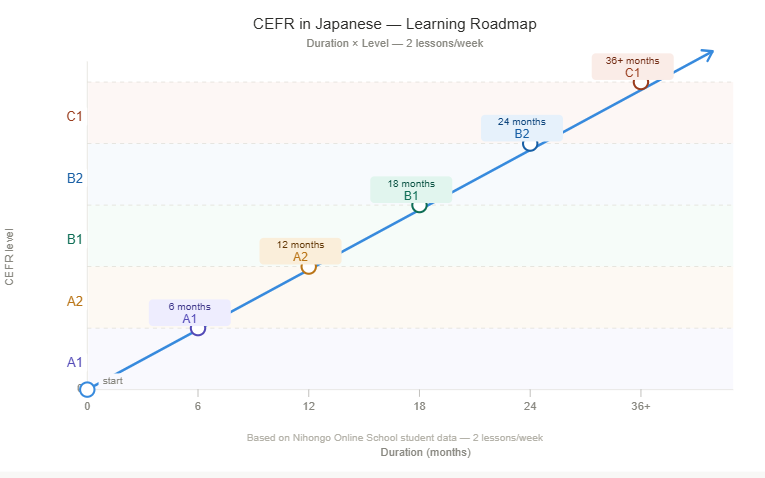
As one of the few programs that provide language learning time estimates, Nihongo Online School tracks both study hours and conversational progress throughout the course.
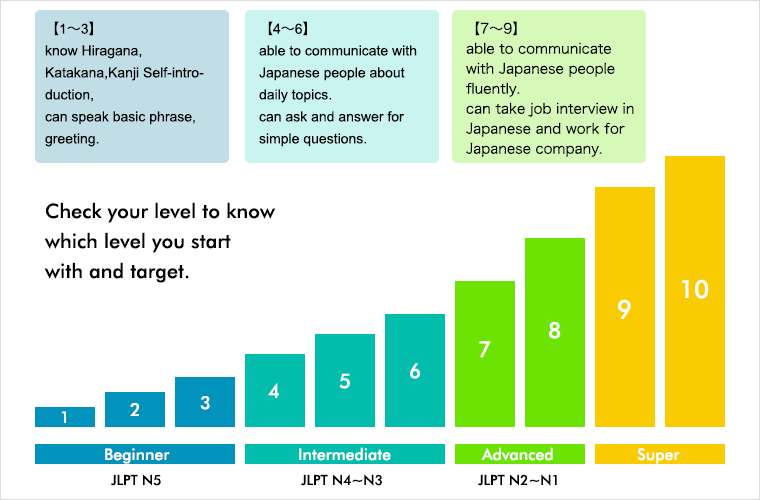
Conversational ability is assessed regularly through a 10-step conversation level test. Mock JLPT tests measure reading and listening at every stage. You always know where you stand and what needs work.