
 English
  Español

Tips for More Effective Studying
Nihongo Online School > Tips for More Effective Studying > What Is CEFR A1 Level in Japanese?
What Is CEFR A1 Level in Japanese?

2026/05/23

Director: Kotaro Muramoto
Principal of Nihongo Online School
In September 2019, he founded "Nihongo Online School". Since then, has been teaching Japanese online lessons, with a total of over 1,000 students.
He has designed an individualized curriculum based on student’s needs and study goal. And is conscious of making the classes speech-centered in order to improve students’ speaking skills.
The school asks students to submit homework assignments worth 2 hours per lesson to improve faster. By supporting students with these features, students are able to efficiently improve Japanese language skills.
CEFR A1 is the first level of the Common European Framework of Reference for Languages. In Japanese, it marks the point where a complete beginner starts being able to use the language in simple situations.
This article covers what CEFR is, how to assess your current CEFR level for Japanese language, and what you can concretely do once you reach CEFR A1 in Japanese.
Contents

Understanding the Common European Framework Levels
The Common European Framework of Reference for Languages was created by the Council of Europe in 2001 as a shared international standard for measuring language proficiency. Rather than testing what you know about a language, CEFR focuses on what you can do with it, through what are called Can-Do statements.
The Common European Framework spans six levels across three groups:
| Group | Levels | Profile |
| Basic User | A1, A2 | Beginner |
| Independent User | B1, B2 | Intermediate |
| Proficient User | C1, C2 | Advanced to Mastery |
CEFR evaluates all four language skills : listening, reading, speaking, and writing. This is a meaningful distinction when it comes to Japanese-specific tests, which we’ll address below.
Is CEFR Actually Used for Japanese Language Learning?

Although it was originally designed for European languages, CEFR is now a standard for Japanese language learning. Official Japanese institutions are even integrating it:
- Japan’s Agency for Cultural Affairs released the Framework of Reference for Japanese Language Education, mirroring the same six-level structure from A1 to C2
- The Marugoto textbook series, used worldwide, is structured entirely around CEFR language levels
- Since December 2025, the JLPT includes a CEFR reference for Japanese level on official score reports, following a rigorous linking process conducted by international experts
How to Find Out Your CEFR Language Level in Japanese
The most straightforward way to assess your CEFR Japanese level is to take one of the official Japanese language proficiency tests :
- JLPT (Japanese-Language Proficiency Test) : the most widely recognized exam globally, offered in five levels from N5 (beginner) to N1 (advanced).
- JFT-Basic (Japan Foundation Test for Basic Japanese) : a computer-based test targeting A1 and A2 levels, primarily designed for foreign nationals seeking to work or live in Japan.
- JLCT (Japanese Language Capability Test) : a structured Japanese language test with a direct CEFR correspondence table, from A1 (JCT5) to C1 (JCT1).
| CEFR Level | JLPT | JFT-Basic | JLCT |
| A1 | N5 | ✓ | JCT5 |
| A2 | N4 | ✓ | JCT4 |
| B1 | N3 | — | JCT3 |
| B2 | N2 | — | HCT2 |
| C1 | N1 | — | JCT1 |
| C2 | — | — | — |
For a full breakdown of how each JLPT score maps to a specific CEFR level for Japanese, see our dedicated article on CEFR and JLPT correspondence.
What Can You Do With CEFR A1 Japanese Proficiency?

The official Council of Europe defines CEFR A1 level as follows:
“Can understand and use familiar everyday expressions and very basic phrases aimed at the satisfaction of needs of a concrete type. Can introduce him/herself and others and can ask and answer questions about personal details such as where he/she lives, people he/she knows and things he/she has. Can interact in a simple way provided the other person talks slowly and clearly and is prepared to help.”
In concrete terms, at CEFR A1 in Japanese you can:
| Skill | What you can do | Example |
Speaking | Introduce yourself and others (name, nationality, age, where you live, occupation) | “はじめまして、マリアです。フランスからきました。としは28さいです。エンジニアです。どうぞよろしく。” |
Daily interactions | Greet, thank, apologize, and make simple requests | “おはようございます” “ありがとうございます” “すみません、これをみっつください” “おてあらいはどこですか?” |
Reading | Read hiragana, katakana, and simple signs or menus written in kana | Reading “ラーメン 800えん” on a restaurant menu Understanding “いりぐち” (entrance) and “でぐち” (exit) signs at a station Reading “おてあらい” on a door sign |
Listening | Follow simple conversations on familiar topics when the speaker talks slowly and clearly | “おなまえは?” “どこからきましたか?” “これはいくらですか?” |
Reading comprehension | Extract basic information from short texts, schedules, or forms, especially with visual support | Reading a train timetable showing “とうきょう 9じ15ふん” Understanding a short message like “あしたは10じにきてください” |
Describing | Talk about your immediate environment (people you know, things you have, daily facts) | “わたしのへやにテレビとパソコンがあります”“あにはとうきょうにすんでいます” “まいにちコーヒーをのみます。” |
How to Reach the A1 CEFR Level in Japanese
Reaching Japanese CEFR A1 requires a combination of good materials, a structured study plan, and live instruction.
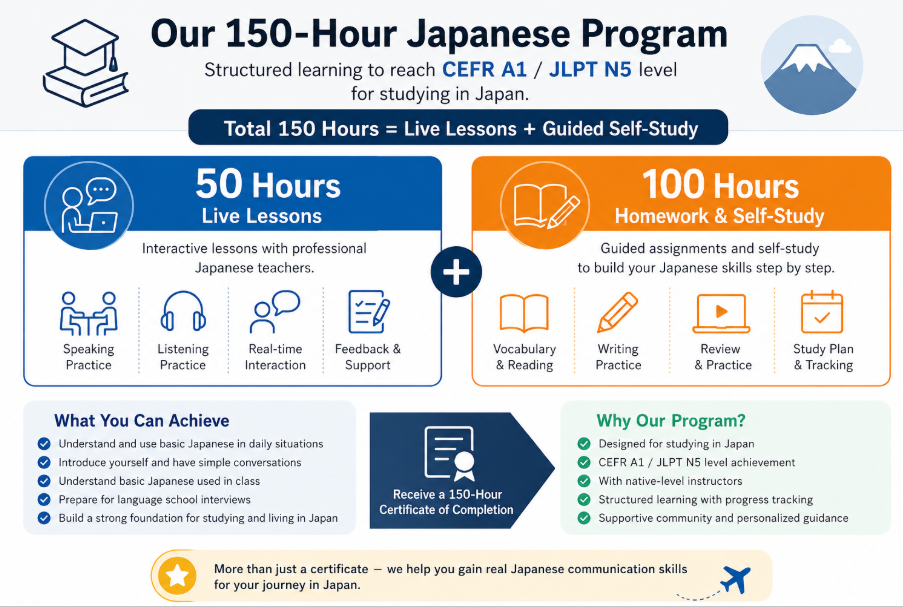
At Nihongo Online School, our CEFR A1 Japanese course develops all four skills simultaneously: speaking, listening, reading, and writing. Depending on the student’s goals, the instructor selects the most appropriate CEFR A1 textbook: Marugoto (fully CEFR-oriented textbook) or Minna no Nihongo (widely used in Japanese language schools worldwide).
The program totals 150 hours (50 hours of live lessons with a professional teacher and 100 hours of guided self-study) and covers 25 progressive lessons. Active speaking practice and listening comprehension are at the center of every session, to build Japanese skills usable in daily life.
Example of CEFR A1 Japanese curriculum for beginners
| Lesson | Topic | What you’ll be able to do |
| 1 | Hiragana & Katakana | Read, write, and pronounce both phonetic scripts |
| 2 | Hello | Exchange greetings, give a simple self-introduction |
| 3 | What is it? | Ask about things and express ownership |
| 4 | Please give me this one | Ask for locations, do basic shopping |
| 5 | What time is it? | Talk about schedules, days, and times |
| 6 | Do you go to Japan? | Get around using transport |
| 7 | Shall we go together? | Make plans, talk about daily routines |
| 8 | Excuse me | Ask how to say something in Japanese |
| 9 | How are you? | Talk about your daily life |
| 10 | I like Japan! | Express likes, dislikes, and preferences |
Discover our full article about how many hours it takes to reach each CEFR level in Japanese.