
 English
  Español

Tips for More Effective Studying
Nihongo Online School > Tips for More Effective Studying > How many Japanese lessons do you actually need to start speaking?
How many Japanese lessons do you actually need to start speaking?

2026/01/20

Director: Kotaro Muramoto
Principal of Nihongo Online School
In September 2019, he founded "Nihongo Online School". Since then, has been teaching Japanese online lessons, with a total of over 1,000 students.
He has designed an individualized curriculum based on student’s needs and study goal. And is conscious of making the classes speech-centered in order to improve students’ speaking skills.
The school asks students to submit homework assignments worth 2 hours per lesson to improve faster. By supporting students with these features, students are able to efficiently improve Japanese language skills.
How many Japanese lessons do you actually need to start speaking?
This is one of the most common questions among false beginners.
You may have finished hiragana and katakana, studied with apps, or learned some grammar—but still feel that speaking Japanese is hard.
So what’s realistic?
In this article, we explain how many lessons it typically takes to start speaking Japanese, based on real learning data and a conversation-focused level system—not hype or shortcuts.
Contents
- 1 First, What Does “Start Speaking” Mean?
- 2 Short Answer: How Many Lessons?
- 3 Lessons vs. Conversation Level
- 4 How Many Lessons Per Week Actually Work?
- 5 What Does “50 Lessons” Really Mean?
- 6 Lessons vs. Self-Study: Time Efficiency
- 7 Why “50 Lessons in 6 Months” Works Well
- 8 What Happens After You Start Speaking?
- 9 Want to Know How Many Lessons You Need?
First, What Does “Start Speaking” Mean?
Before talking about numbers, we need to define “start speaking.”
In this article, start speaking does NOT mean fluency.
It means:
- you can answer with more than yes or no
- you can respond without freezing or long silence
- you can say short sentences about familiar topics
This corresponds roughly to Conversation Level 3–4.
Short Answer: How Many Lessons?
For most false beginners, a realistic answer is:
Based on learning data from our students, improving by one conversation level typically requires around 50 lessons of consistent, conversation-focused practice.
However, learners often start noticing changes earlier:
- 20–30 lessons: responses start coming out more quickly
- 30–40 lessons: silence decreases and short sentences feel easier
- Around 50 lessons: the new conversation level becomes stable
This assumes:
- conversation-focused lessons
- clear feedback on your speaking
- basic review between lessons
Lessons vs. Conversation Level
The image below shows how lesson numbers relate to conversation levels.
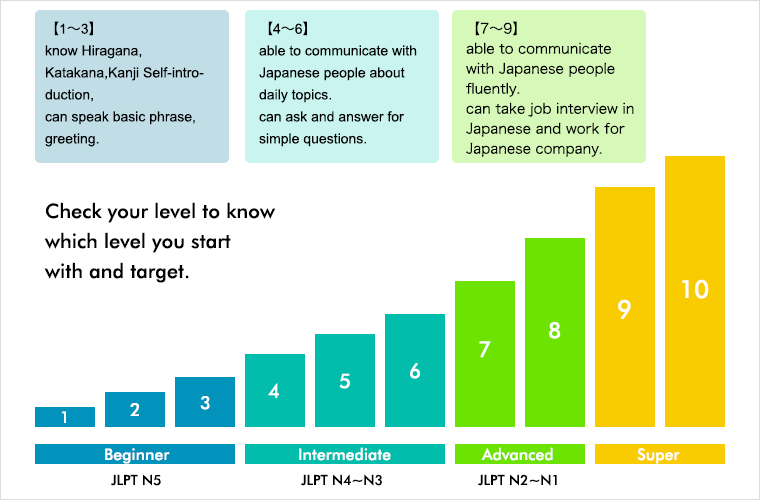
In many cases, learners start noticing changes before a level is fully completed:
- Around 20–30 lessons: responses come out faster
- Around 30–40 lessons: silence decreases and short sentences feel easier
However, based on our learner data, it typically takes around 50 lessons for one conversation level to become stable.
How Many Lessons Per Week Actually Work?
The total number of lessons matters—but frequency matters even more.
- Once a week: progress is slow, and fear of speaking tends to stay longer
- Twice a week: your mouth and brain start working together more naturally
- Three times a week: effective in theory, but difficult to maintain for most people
One important factor many learners overlook is homework time.
For each lesson, effective review and homework usually take an additional 1–2 hours. When you factor this in, taking three lessons per week often becomes unrealistic in terms of total time commitment.
This is why, for long-term consistency, most learners realistically choose one or two lessons per week.
Among our students, the most common and sustainable pattern is two lessons per week for about six months. This schedule balances steady progress with a workload that fits into busy lives.
When choosing your lesson frequency, it’s important to consider your own schedule, energy level, and how much time you can realistically spend on review and practice.
What Does “50 Lessons” Really Mean?
Fifty lessons is not a magic number.
It simply represents the point where many learners:
- stop freezing when asked a question
- can recover from mistakes and continue speaking
- feel that Japanese is “coming out” more naturally
In other words, 50 lessons is where speaking becomes more stable, not perfect.
Lessons vs. Self-Study: Time Efficiency
Self-study is important—but it is not very efficient for speaking.
Why?
- self-study focuses on input (reading, watching, memorizing)
- speaking requires output and real-time feedback
For many learners:
- 1 lesson (60 minutes) ≈ 3–4 hours of self-study in speaking experience
This is why learners who rely only on apps often feel stuck when it comes to conversation.
Why “50 Lessons in 6 Months” Works Well
Two lessons per week for about six months results in roughly 50 lessons.
This time frame works well because:
- your fear of speaking decreases gradually
- your response speed improves
- you start noticing patterns in your own mistakes
It’s long enough to change habits—but short enough to stay realistic.
What Happens After You Start Speaking?
Conversation Level 3–4 is only the starting point.
If you want to understand what typically happens after six months of this kind of practice, this article explains it in detail:
Can You Use Japanese at Work After 6 Months?
And if you’re thinking longer-term, this article shows what many learners can realistically do after one year:
What Can You Actually Do in Japanese After 12 Months?
Want to Know How Many Lessons You Need?
Everyone starts at a different conversation level.
A short conversation level check can help you estimate:
- your current level
- how many lessons you may need to start speaking
- what kind of practice fits your goal
A conversation level check is included in our Free Trial Lesson. We’ll propose a learning plan that matches your situation.
