
 English
  Español

Tips for More Effective Studying
Nihongo Online School > Tips for More Effective Studying > Learn Japanese for Travel: What to Study Before Your Trip to Japan
Learn Japanese for Travel: What to Study Before Your Trip to Japan
2026/09/30

Director: Kotaro Muramoto
Principal of Nihongo Online School
In September 2019, he founded "Nihongo Online School". Since then, has been teaching Japanese online lessons, with a total of over 1,000 students.
He has designed an individualized curriculum based on student’s needs and study goal. And is conscious of making the classes speech-centered in order to improve students’ speaking skills.
The school asks students to submit homework assignments worth 2 hours per lesson to improve faster. By supporting students with these features, students are able to efficiently improve Japanese language skills.
You can travel in Japan without speaking any Japanese. Signs are in English at most stations, and translation apps work well. So why learn Japanese for travel at all?
Here is what we hear from many of our students. They do not want to just “survive” a trip. They want to talk to people. One of our students, Erika, said it simply: “When I travel, I like to be able to speak and interact with local people.”
That is a different goal from memorizing a list of phrases. This article is for people who want to communicate in Japan, even a little, in their own words. We will look at what you should learn, what you can really learn before your trip, and the best way to get there.
Contents
- 1 How Much Japanese Do You Need for a Trip to Japan?
- 2 What Japanese Should You Learn Before Traveling to Japan?
- 3 Don’t Just Memorize Japanese Travel Phrases
- 4 How Much Japanese Can You Learn Before Your Trip?
- 5 Do You Need JLPT N5 for Traveling in Japan?
- 6 Best Way to Learn Japanese for Travel
- 7 Start Learning Japanese Before Your Trip to Japan

How Much Japanese Do You Need for a Trip to Japan?
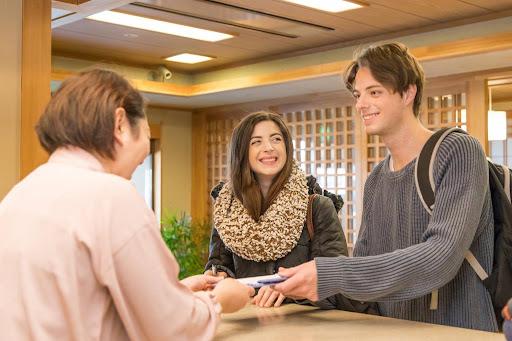
Let’s be honest. You can have a great trip to Japan with zero Japanese. Staff at major stations, hotels, and big restaurants are used to English-speaking visitors.
But a little Japanese changes the small moments. A short chat with the owner of a tiny ramen shop. Asking a local for directions instead of staring at your phone. Saying thank you in a way that makes someone smile.
Dan, one of our students, described his goal this way: “To be able to go to Japan, ask for directions, order food and have a casual conversation.” Notice that last part. He did not stop at “order food.” He wanted a conversation.
So the question is not “Do I need Japanese to travel?” You don’t. The real question is “How much Japanese do I need to have the trip I want?”
Think about where you will actually use it. Big hotels and airports usually have English signs and English-speaking staff. But the small places that make a trip special often do not. A family-run restaurant in a small town. A shopkeeper at a morning market. A grandmother sitting next to you on the train who wants to know where you are from. In those moments, even simple Japanese opens a door.
If you want to connect with people, you need more than a few memorized phrases. You need enough Japanese to say something and understand the reply.
What Japanese Should You Learn Before Traveling to Japan?
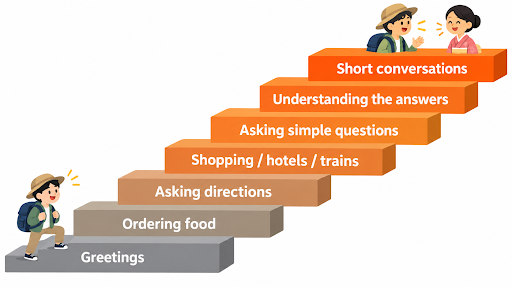
If you are a complete beginner, this is the order that works for most travelers. Each step builds on the one before it.
Start With Greetings and Everyday Politeness
Start with the words you will use fifty times a day. Hello, thank you, excuse me, sorry, goodbye. In Japan, these small words matter a lot. Even if you say nothing else, a clear “arigatou gozaimasu” (thank you very much) is always welcome.
You do not need to read Japanese to do this. Learning hiragana, the basic Japanese alphabet, is helpful later, but you can start speaking before you can read.
Ordering, Asking Directions, Shopping, and Hotels
Next come the situations you will actually be in. Ordering at a restaurant. Asking where the station is. Asking how much something costs. Checking in at a hotel.
For each situation, you need a few key words and one or two simple sentence patterns. For example, “___ o kudasai” means “___, please.” Learn that one pattern, and you can order almost anything by adding the name of the dish.
A few other high-value items at this stage:
- Numbers from 1 to 10,000, so you can understand prices and times
- “Kore” (this) and “sore” (that), so you can point and ask
- “Ikura desu ka?” (How much is it?)
- “___ wa doko desu ka?” (Where is ___?)
- “Eigo no menyuu wa arimasu ka?” (Do you have an English menu?)
You will notice that most of these are questions. That is on purpose. As a traveler, you spend most of your time asking, not explaining. Get good at asking first.
Asking Simple Questions—and Understanding the Answers
This is where many travelers get stuck. You can ask “Where is the station?” perfectly. Then the person answers, and you have no idea what they said.
Learning to ask a question is only half of it. You also need to learn the kinds of answers you will hear. Words like “right,” “left,” “straight,” and “next to” for directions. Numbers for prices and times. Simple yes and no answers.
It also helps to learn two “rescue” phrases early. “Mou ichido onegaishimasu” (One more time, please) and “Yukkuri onegaishimasu” (Slowly, please). Most people are happy to repeat themselves more slowly. These two phrases give you a second chance in almost every conversation.
Once you can ask a simple question and follow the reply, you are ready for the last step: short conversations. Where are you from? How long are you in Japan? Do you like Japanese food? These are the questions local people will ask you. Being able to answer them is what turns “just buying something” into a real conversation.
Don’t Just Memorize Japanese Travel Phrases
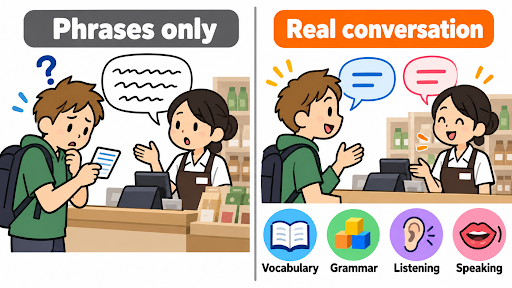
Phrase lists are useful. Keep one on your phone. But phrases alone have their limits, and you hit them fast.
Here is a common scene. You practice “Sumimasen, eki wa doko desu ka?” (Excuse me, where is the station?). You say it well. The person smiles and answers in normal, fast Japanese. You catch nothing. You say thank you and walk away, still lost.
The phrase worked. The conversation did not.
Jackir, who has visited Japan six times, put it this way: “I’ve been to Japan 6 times but feel like there’s always a cap on how much I can improve while studying alone.” That cap often comes from exactly this problem. You can say things, but you cannot yet understand what comes back.
To have even a short conversation, you need four things working together, at a basic level:
- Vocabulary: enough words to understand common answers, not just to ask
- Grammar: a few sentence patterns so you can change a phrase instead of only repeating it
- Listening: practice hearing real Japanese at real speed
- Speaking: practice saying things to a real person and answering what they say back
You do not need a lot of each. But you need all four. Memorizing phrases covers only a small part of one of them.
A simple way to check yourself: for every phrase you learn, ask “What will the other person probably say back?” If you cannot picture the answer, you are not done with that phrase yet.
How Much Japanese Can You Learn Before Your Trip?
This depends on how much time you have and how often you study. Below is an honest picture of what many learners aim for. These are not promises. People learn at different speeds, and studying a few minutes every day matters more than one long session a week.
| Time before your trip | What many learners aim for |
| 1–3 months | Greetings, ordering, asking directions, and a few phrases to say “Sorry, could you say that again?” |
| 3–6 months | Simple questions and understanding simple answers. Short exchanges like where you are from and what you like. |
| 6–12 months | Basic vocabulary and grammar at around JLPT N5 level, and short conversations on everyday topics. |
Eeffie, a complete beginner, wrote that she wanted to “achieve basic conversation N5 when travelling to Japan.” She gave herself about a year. That is a reasonable goal for a beginner who studies regularly.
If you only have a few weeks, do not give up. Even the first row of the table changes your trip. Focus on greetings, ordering, and one or two “please repeat that” phrases. That alone will get you more smiles and more help than you expect.
Whatever your timeline, two habits make the biggest difference. First, study a little every day instead of a lot once a week. Fifteen minutes a day beats two hours on Sunday. Second, say everything out loud from the very first day. Japanese you have only read silently tends to disappear when you need it.
Do You Need JLPT N5 for Traveling in Japan?

The short answer is no. The JLPT (Japanese Language Proficiency Test) is the official test of Japanese for non-native speakers. Nobody in Japan will ask to see your certificate. You do not need to pass any test to travel.
But you will often see “N5” mentioned when people talk about travel Japanese, and there is a good reason. N5 is the first level of the test, and it covers the basic vocabulary and grammar that everyday Japanese is built on. Simple questions, numbers, time, common verbs, and polite forms.
So think of N5 as a useful map, not a must. You do not need the certificate. But the material at that level is very close to what you need for simple conversations while traveling. Many of our students, like Kiku and Eeffie, use “N5” as a way to describe their goal, even though they never plan to take the exam.
One thing to keep in mind: the N5 test does not include a speaking section. So a person can pass N5 on paper and still freeze when someone talks to them. Use N5 material as your guide for what to learn, but make sure you are also practicing out loud.
Best Way to Learn Japanese for Travel
There is no single best way. But there is a pattern in what works.
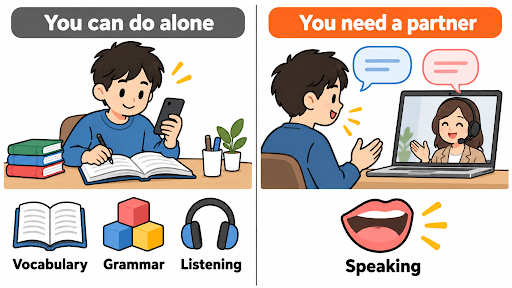
Apps, videos, and textbooks are great for three of the four skills. You can build vocabulary with an app on the train. You can learn grammar from a good textbook. You can train your ear with YouTube videos and podcasts. These tools are cheap or free, and you should use them.
The one skill they do not give you is speaking. Not repeating after a recording, but saying something to a real person and dealing with their real reply. That is the skill that makes a conversation possible, and it is the hardest one to practice alone.
This is why many of our travel-focused students moved from self-study to lessons. Erika tried studying on her own but found it hard to keep going. Group classes did not fit her schedule. What worked for her was regular online lessons with a teacher, where she had to speak every time.
If your goal is to talk to people in Japan, the best way to learn Japanese for travel is a mix. Use apps and videos for words, grammar, and listening. Then add regular speaking practice with a person who can correct you and answer back. Private 1-on-1 lessons are the most direct way to get that practice, because you spend the whole lesson speaking and listening, not waiting for your turn.
A simple weekly plan for a beginner might look like this. Ten to fifteen minutes of vocabulary on an app every day. One or two short videos for listening. And one or two lessons a week where you actually speak. You do not need to spend hours. You need to keep going, and you need someone to talk to.
Start Learning Japanese Before Your Trip to Japan
If you want to communicate in Japan, start before you go. Even a few months of regular study makes a difference, and speaking practice makes the biggest difference of all.
Jeremy, one of our students, said his goal was simple: “I would like to be able to have conversations with people when I visit Japan.” That is what most of our travel-focused students want. Not perfect Japanese. Real conversations.
At Nihongo Online School, our Online Japanese Course takes you step by step from complete beginner to intermediate level (around JLPT N3). Lessons are private and 1-on-1, so you speak from day one. Travel is a great reason to start, and what you learn will stay with you long after the trip.
If you are planning a trip to Japan, try a free trial lesson and see how much you can say after just one session.