
 English
  Español

Tips for More Effective Studying
Nihongo Online School > Tips for More Effective Studying > Japanese Learning Order: 6 Steps for Beginners
Japanese Learning Order: 6 Steps for Beginners
2026/06/28

Director: Kotaro Muramoto
Principal of Nihongo Online School
In September 2019, he founded "Nihongo Online School". Since then, has been teaching Japanese online lessons, with a total of over 1,000 students.
He has designed an individualized curriculum based on student’s needs and study goal. And is conscious of making the classes speech-centered in order to improve students’ speaking skills.
The school asks students to submit homework assignments worth 2 hours per lesson to improve faster. By supporting students with these features, students are able to efficiently improve Japanese language skills.
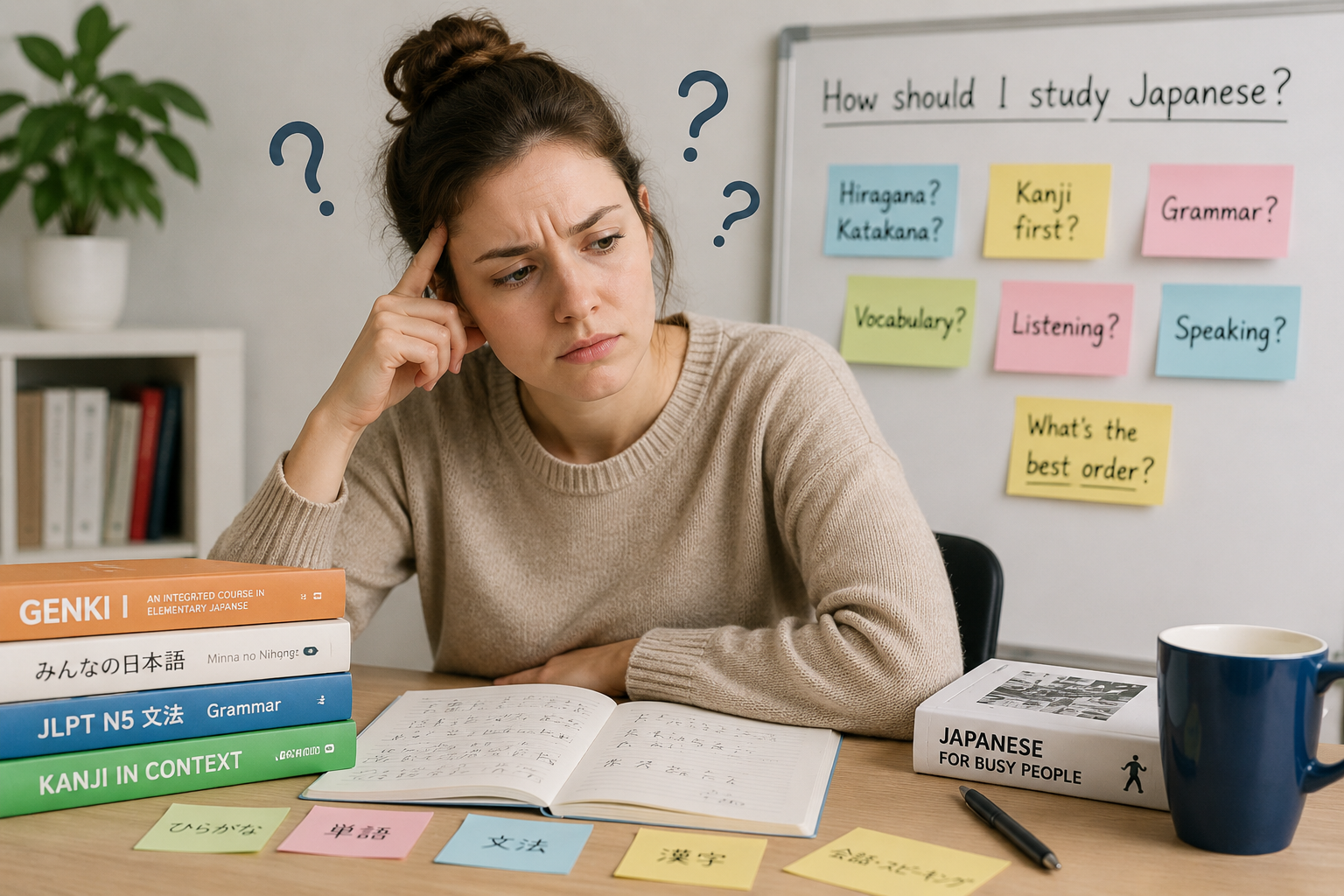
Learning Japanese is exciting, but many beginners do not know where to start. Some learners begin with kanji. Others spend too much time memorizing grammar rules before they can understand simple Japanese sounds.
The best Japanese learning order is simple. Beginners should first learn Japanese sounds and kana, then basic words and phrases, listening, simple grammar patterns, speaking, and kanji with vocabulary.
You do not need to master everything perfectly before moving to the next step. The most important point is to build a strong foundation and use Japanese little by little.
In this article, you will learn:
- The best Japanese learning order for complete beginners
- What beginners should avoid when studying Japanese
- How to build a simple weekly study routine
Contents

What Is the Best Japanese Learning Order?
The best Japanese learning order is not “memorize everything first.” Japanese has several learning areas, including writing, vocabulary, listening, grammar, speaking, and kanji.
Beginners need to study these areas in a practical order. This helps them avoid confusion and continue learning with confidence.
Here is a simple learning order for complete beginners.
| Step | What to Study | Main Goal |
| 1 | Japanese sounds and kana | Read basic Japanese without relying on romaji |
| 2 | Basic words and phrases | Understand simple daily expressions |
| 3 | Listening practice | Get used to Japanese pronunciation and rhythm |
| 4 | Simple grammar patterns | Make short sentences |
| 5 | Speaking practice | Use Japanese in short conversations |
| 6 | Kanji with vocabulary | Learn useful kanji words naturally |
This order helps beginners connect sounds, words, grammar, and communication from the early stage.
Step 1: Learn Japanese Sounds and Kana
The first step is to learn Japanese sounds and kana. Kana means hiragana and katakana. Hiragana is used for many basic Japanese words, particles, and grammar endings. Katakana is often used for foreign names, country names, loanwords, and many daily words.
Many beginners start with romaji because it looks easier. However, relying on romaji for too long can make pronunciation and reading more difficult later. Learning kana early helps you understand Japanese as Japanese, not as English letters.
It is best to learn kana through daily vocabulary. For example, you can learn hiragana with simple words such as あさ(asa, morning), いえ(ie, home), and すし(sushi). You can also learn katakana with familiar words such as コーヒー(kōhī, coffee), タクシー(takushī, taxi), and ホテル(hoteru, hotel).
At this stage, you do not need perfect handwriting. The goal is to recognize kana, read simple words, and understand basic pronunciation.
Step 2: Learn Basic Words and Phrases
After learning Japanese sounds and kana, beginners should study basic words and short phrases. Start with words that appear often in daily life, such as greetings, numbers, days of the week, food, places, and simple verbs.
It is better to learn useful words than to memorize a long word list. For example, words used in self-introduction, shopping, restaurants, and classroom situations are helpful from the beginning.
Short phrases are also important. Expressions such as “よろしくお願いします(Yoroshiku onegai shimasu,Nice to meet you)”, “わたしはカナダから来ました(Watashi wa kanada kara kimashita, I am from Canada)”, and “わたしはコーヒーが好きです(Watashi wa kōhī ga sukidesu, I like coffee)” help learners feel that Japanese is a real communication tool.
The goal is not to memorize many words at once. The goal is to build a small vocabulary that you can actually use.
Step 3: Practice Listening From the Beginning
Listening should start early. Many learners wait until they know more grammar, but listening practice helps you understand Japanese rhythm, pronunciation, and sentence endings.
At first, you may understand only a few words. This is normal. Use short audio, beginner textbook recordings, slow conversations, and videos made for Japanese learners.
Listening with a script is especially useful. First, listen without reading. Next, check the script. Then listen again while reading. This process helps you connect sound and meaning.
Beginners should not try to understand fast native-level content too early. Short and clear audio is better for building confidence and accuracy.
Step 4: Study Simple Grammar Patterns
After learning basic words and getting used to simple Japanese sounds, start learning grammar patterns. Japanese grammar becomes easier when you learn it through short sentence patterns, not long explanations.
Beginners should first learn patterns such as “AはBです(A wa B desu, A is B)”, “わたしはAが好きです(Watashi wa A ga sukidesu, I like A)”, “わたしはAへ行きます(Watashi wa A e ikimasu, I go to A),” and “わたしはAをします(Watashi wa A wo shimasu, I do A)”. These patterns help you make short sentences with the words you already know.
For example, after learning the verb “飲みます(nomimasu, drink)”, you can make a sentence such as “わたしはコーヒーを飲みます(Watashi wa kōhī wo nomimasu, I drink coffee)”. After learning the word “学校(gakkou,school)”, you can say “わたしは学校へ行きます(I go to school)”.
This step is important because vocabulary alone is not enough. Grammar helps you connect words and express your thoughts. Start with simple sentences and increase patterns little by little.
Step 5: Start Speaking Before You Feel Ready
Speaking practice should begin before you feel completely ready. Many beginners wait until their grammar is perfect, but speaking helps you notice what you can and cannot say.
Start with a short output. Practice self-introduction, answering simple questions, reading sentences aloud, and repeating useful phrases. You can also practice short role plays, such as ordering food or asking simple questions.
Speaking does not mean having a long conversation from the beginning. It means using the Japanese you already know.
Early speaking practice is very important. Repeating the process of trying, making mistakes, and correcting them leads to real growth.
Step 6: Learn Kanji With Vocabulary
Kanji is important, but beginners should not start by memorizing many characters alone. Kanji becomes easier when you learn it with useful vocabulary.
For example, instead of memorizing the character 学 by itself, learn words such as 学生(gakusei, student), 学校(gakkou, school), and 日本語学習(nihongogakushū, learning Japanese). This method helps you understand the meaning, reading, and usage together.
Beginners should start with common kanji used in daily life, such as numbers, days, people, places, and school-related words. You do not need to write every kanji perfectly at first. Reading and recognizing useful words is the first goal.
Kanji study should continue gradually. When you learn kanji with vocabulary and example sentences, it becomes part of your communication skill, not just a memory task.
What Should Beginners Avoid When Learning Japanese?
Many beginners lose motivation because they study in the wrong order. Japanese has many learning areas, so it is important to avoid studying too much at once.
In this section, we will look at three common mistakes.
Avoid Starting With Too Much Kanji
Kanji is necessary, but studying too much kanji first can overwhelm beginners. Japanese also requires sounds, kana, grammar, listening, and speaking.
When learners focus only on kanji, they may know many characters but still cannot make simple sentences. This creates an imbalance.
A better approach is to learn kanji gradually with words and short sentences. Start with the kanji you need for beginner vocabulary. This keeps kanji study practical and connected to communication.
Avoid Memorizing Words Without Sentences
Vocabulary is important, but memorizing words without context is not very effective. Words are easier to remember when you use them in sentences.
For example, instead of only memorizing “coffee,” practice a sentence such as “I drink coffee” or “I like coffee.” This helps you learn the word, the verb, and the sentence pattern together.
Beginners should connect vocabulary with grammar from the early stage. This makes study more efficient and helps learners use Japanese in real situations.
Avoid Waiting Too Long to Speak
Many beginners believe they should speak Japanese only after studying enough grammar. However, speaking is part of learning, not only the result of learning.
Short speaking practice helps you find weak points. For example, you may notice that you know a grammar rule but cannot use it quickly. You may also notice pronunciation habits that need correction.
You do not need perfect Japanese to start speaking. Simple and short practice is enough at the beginning.
How to Build a Weekly Japanese Study Routine
After you understand the basic Japanese learning order, the next step is to turn it into a weekly routine. Beginners do not need to study for many hours every day. Short and regular study is more effective than irregular long study.
A good routine should include kana review, basic vocabulary, listening, grammar, and speaking practice. The important point is to study a little every day and review what you have learned regularly.
If you want to see a more detailed daily schedule and weekly study plan, please check the article below.
[Read more: JLPT N5 Study Plan for Beginners: Daily Schedule and 6-Month Roadmap]
By following a clear routine, beginners can avoid confusion and continue learning Japanese step by step.
When Should Beginners Start JLPT N5 Study?
JLPT N5 is a useful goal for beginners. However, it is better to start N5 study after building a small foundation.
N5 study becomes easier when you already know basic kana, vocabulary, listening, and grammar patterns.
Start N5 After Learning Basic Kana and Grammar
Beginners can start JLPT N5 study after learning kana, basic vocabulary, simple listening, and basic sentence patterns.
At this stage, N5 materials help you organize what you have learned. You can review vocabulary, grammar, reading, and listening in a structured way.
However, N5 preparation should not replace communication practice. Test study and real Japanese practice should support each other.
Use JLPT N5 as a Checkpoint
JLPT N5 is a good checkpoint for beginners. It shows whether you understand basic Japanese grammar, vocabulary, reading, and listening.
However, N5 is not the final goal. Some learners pass N5 but still feel nervous when speaking. This happens because JLPT does not directly test speaking.
Use N5 as one step in your learning journey. At the same time, continue practicing listening and speaking so that you can use Japanese in real situations.
Learn Japanese Efficiently With Teacher Support
Self-study is useful, but many beginners struggle to decide what to study next. A teacher can help you check your level, correct mistakes, and build a study plan.
For beginners, the right learning order is especially important. Teacher support helps learners avoid wasting time and stay motivated.
Check Your Current Conversation Level First
Many beginners do not know their exact level. They may know some words but cannot make sentences. They may understand grammar but feel nervous when speaking.
A conversation level check helps clarify your current ability. It also shows what you should study first.
This is especially helpful for learners who have studied alone for a while but feel stuck.
Combine Lessons, Homework, and Motivation Support
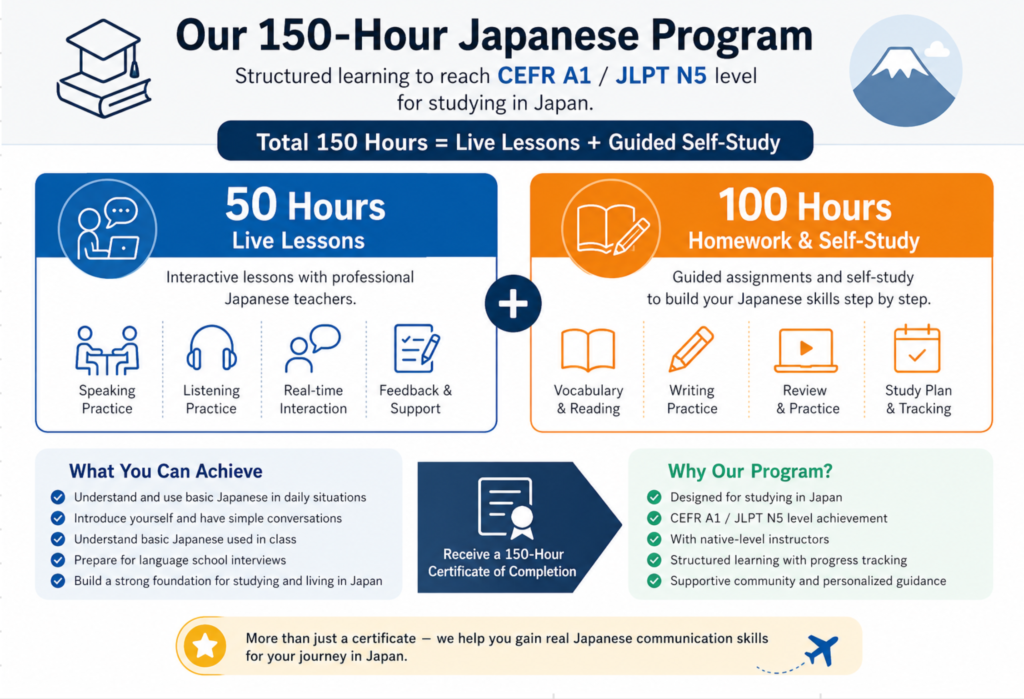
Nihongo Online School offers a unique curriculum that combines “Conversation Level Check,” “Lessons,” “Homework,” and “Motivation Management.”
The 150-hour course includes 50 hours of online lessons and 100 hours of homework. This curriculum helps students complete their first 150 hours of Japanese learning in 3–6 months.
- Conversation Level Check: A 10-step conversation level test to check your speaking ability
- Lesson: Conversation-oriented lessons given by qualified and experienced teachers
- Homework: Students submit 2 hours of assignments for each lesson
- Motivation Management: Lessons are designed based on each student’s level, goals, and personality
With these 4 features, students can improve their Japanese skills efficiently with teacher support.
Start With a Free Level Check and Trial Lesson
For beginners who want to learn Japanese in the right order, teacher support can make the first steps much clearer.
Nihongo Online School helps students study Japanese through conversation-oriented lessons, structured homework, and motivation support. This approach helps learners continue studying and improve step by step.
Please feel free to contact us for a free Japanese level check and trial lesson.
Summary: Follow the Right Japanese Learning Order
The best Japanese learning order is not to study everything at once. Beginners should start with Japanese sounds and kana, then move to basic words and phrases, listening, simple grammar patterns, speaking, and kanji with vocabulary.
You do not need to be perfect before moving forward. The key is to study in a clear order and use Japanese little by little.
With the right learning order and teacher support, beginners can build a strong foundation and continue learning Japanese with confidence.