
 English
  Español

Tips for More Effective Studying
Nihongo Online School > Tips for More Effective Studying > Can I live in Japan with zero Japanese as a student?
Can I live in Japan with zero Japanese as a student?

2026/02/22

Director: Kotaro Muramoto
Principal of Nihongo Online School
In September 2019, he founded "Nihongo Online School". Since then, has been teaching Japanese online lessons, with a total of over 1,000 students.
He has designed an individualized curriculum based on student’s needs and study goal. And is conscious of making the classes speech-centered in order to improve students’ speaking skills.
The school asks students to submit homework assignments worth 2 hours per lesson to improve faster. By supporting students with these features, students are able to efficiently improve Japanese language skills.
Many foreign students wonder: can I live in Japan without knowing Japanese?
It’s a fair question and one that deserves an honest answer before you book your flight.
This article covers the concrete limitations you’ll face as a student without Japanese and the most effective ways to prepare before you arrive.
Contents

Is it easy to live in Japan without knowing Japanese?
Living in Japan without knowing Japanese as a student is possible, but it’s not easy.
There are areas where not speaking Japanese won’t immediately cause problems : navigating major train networks, eating out in tourist-friendly areas, shopping at big chains
But step outside the tourist-facing infrastructure, and the challenges pile up fast. The main friction points for a student:
- Administrative tasks : signing leases, opening bank accounts, registering at the ward office
- Academic life : keeping up with coursework taught in Japanese
- Part-time work : options are much more limited without the language
- Social life : the risk of staying in an English-speaking bubble
Do people in Japan speak English?
Japan has a reputation for being difficult to navigate without knowing the language, but in reality, the experience varies greatly depending on where you are.

In Tokyo and big cities
In major cities like Tokyo and Osaka, English is available but unevenly distributed. In areas such as Shibuya or Minato, where international companies and expat communities are concentrated, it is genuinely possible to manage daily life in English.
However, outside these pockets, the situation changes quickly. Local shops, city offices, real estate agencies, and neighborhood clinics often offer little to no English support. Although younger generations have had more exposure to English in school since 2011, many still feel too self-conscious to use it actively, even when they have basic proficiency.
In the countryside
In rural areas, daily life can become significantly more challenging without knowing Japanese. Signs are often written only in Japanese, restaurant menus may be entirely handwritten in kanji, and finding someone who speaks English can be largely a matter of chance.
For students placed at universities in smaller cities or towns, this is something we regularly see among learners. Some describe struggling to tell cooking sake from vinegar at the supermarket, or having to take photos of their washing machine and send them to someone just to understand the settings. While these situations may sound amusing in retrospect, they reflect a constant dependence that can gradually become tiring in everyday life.
Limitations of living in Japan without knowing Japanese as a student
For students staying for several months or years, the limitations of living in Japan without knowing Japanese quickly become tangible, affecting essential aspects of daily life.
Types of student jobs available
For international students, combining studies with part-time work is common. However, most accessible student jobs require at least basic Japanese to communicate with customers and coworkers. Without it, options are usually limited to English teaching or certain types of manual or back-of-house work.
| Job Type | Japanese required? | Accessible without Japanese |
| Convenience store / retail | Yes | Rarely |
| Restaurant / café | Yes | Rarely |
| English teaching | No | Yes |
| Manual / factory work | Minimal | Varies |
| English customer support | No | Yes |
Limitations at school
At school, the absence of Japanese creates a compounding problem. Even if your program has English-taught courses, surrounding academic life (emails from administration, interactions with professors, group projects with Japanese classmates) often happens in Japanese. You end up spending time catching up rather than getting ahead, which leaves less room to actually enjoy being there.
Looking further ahead, most Japanese companies expect at least JLPT N3, often N2, for any meaningful role. Japanese proficiency acts as a credibility signal, it shows employers you’ve invested in your life here, something a strong CV alone can’t replace.
Daily Life
Living in Japan without knowing Japanese means dealing with a daily administrative system that operates almost entirely in the local language.
| Task | Difficulty Without Japanese |
| Opening a bank account | High, some banks require a Japanese-speaking companion |
| Signing a rental lease | High, contracts are often in Japanese with complex clauses |
| Phone contract | Medium to High |
| Ward office registration | Medium, some offices offer limited English support |
| Doctor / hospital visit | High outside major city centers |
Without Japanese, you rely on others for things you’d handle alone without thinking back home, which creates friction in friendships and gradually chips away at your independence.
Social life and local connections
Social life is often the most underestimated limitation, and the one students tend to regret the most. Without Japanese, building genuine friendships with local students becomes difficult, as the language barrier naturally creates distance. As a result, many international students end up socializing mainly with other English speakers, sometimes referred to locally as the “gaijin bubble,” living in Japan without fully feeling part of it.
In practice, the richest friendships, unexpected opportunities, and deeper cultural understanding usually come through the language. Even a basic level of conversational Japanese can significantly improve the quality of daily interactions and help students feel more connected to their environment.
How to improve your Japanese before leaving
The limitations covered above all share the same root cause: arriving in Japan without knowing any Japanese. The good news is that none of this is inevitable. A few months of focused preparation before departure can bridge a significant part of that gap.
Make Japanese friends online

Making friends before arriving in Japan is one of the smartest steps you can take. Platforms like Tandem and HelloTalk allow you to connect with Japanese speakers who want to practice English, creating natural exchanges from the start.
The relationships you build before departure often become your first real anchors once you arrive, making friends in Japan much easier.
Surround yourself with Japanese content
Immersing yourself in Japanese content before arriving can significantly accelerate your progress. Replacing one Netflix series with a Japanese anime, listening to Japanese podcasts during your commute, or reading manga in its original form are simple but effective habits.
The goal is to train your brain to become familiar with the sounds, rhythms, and sentence structures of the language, so they feel more natural once you are in Japan.
Take online conversation courses
Apps and passive content won’t prepare you for a student job interview, a conversation with your landlord, or residence card registration. To avoid the limitations mentioned earlier, you need to be able to actively speak Japanese before you arrive, which requires structured, conversation-focused practice.
This is where many students struggle. They spend months studying grammar and vocabulary, yet rarely practice speaking. However, oral fluency is what truly determines whether you simply get by or genuinely thrive in Japan.
Nihongo Online School is designed around this exact need. Our one-on-one online lessons are entirely speech-centered, with a curriculum built around real-life situations students are likely to face in Japan.
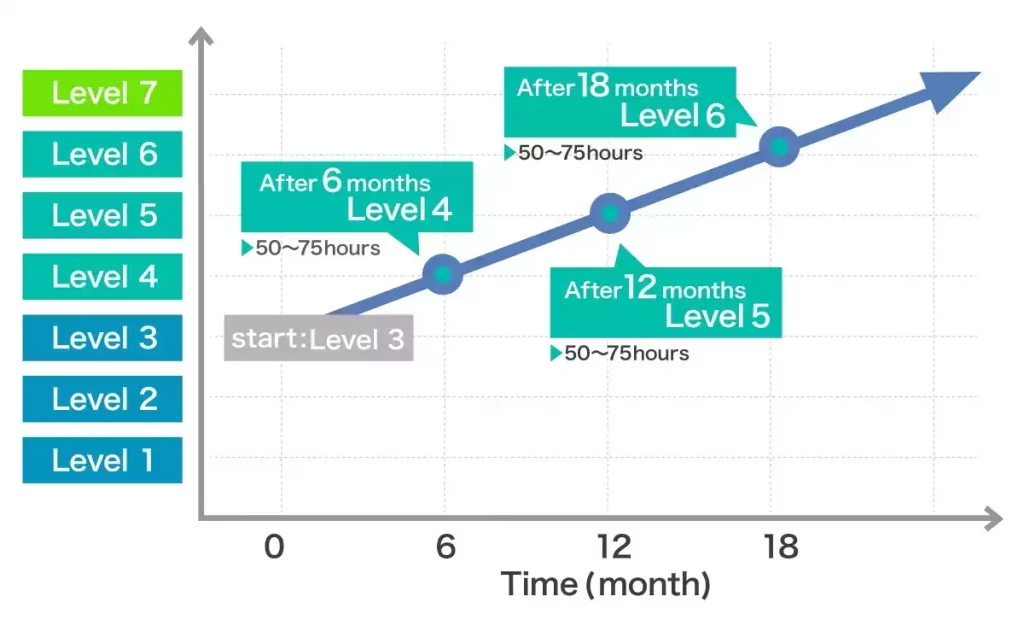
Based on our conversation-first methodology, the timeline below provides a realistic overview of how long it takes to improve your conversational skills before arrival. Each level follows our internal scale, with JLPT equivalents for reference.
| Target Level | What You Can Do | Study Time Needed | When to Start |
| Level 3 (N5) | Use basic daily phrases and introduce yourself simply | 100~150 hours total | 6~12 months before departure |
| Level 4 (N4) | Handle basic daily conversations and answer simple questions at work | +50~75 hours | ~12 months before departure |
| Level 5 (N3) | Maintain conversations independently, explain your job, and manage daily life | +50~75 hours | ~18 months before departure |
This kind of conversational foundation directly leads to better part-time job opportunities, smoother administrative procedures, and more meaningful social connections from day one.