
 English
  Español

Tips for More Effective Studying
Nihongo Online School > Tips for More Effective Studying > How to write an IT engineer resume for jobs in Japan
How to write an IT engineer resume for jobs in Japan

2026/01/24
Director: Kotaro Muramoto
Principal of Nihongo Online School
In September 2019, he founded "Nihongo Online School". Since then, has been teaching Japanese online lessons, with a total of over 1,000 students.
He has designed an individualized curriculum based on student’s needs and study goal. And is conscious of making the classes speech-centered in order to improve students’ speaking skills.
The school asks students to submit homework assignments worth 2 hours per lesson to improve faster. By supporting students with these features, students are able to efficiently improve Japanese language skills.
When applying for IT roles in Japan, your resume is often your first chance to show that you’re a good fit for the position.
This guide walks you through the key rules for creating a strong IT engineer resume tailored to the Japanese job market, one that local hiring managers will actually take the time to read.
Contents
- 1 What is the recommended resume format for IT jobs in Japan?
- 2 How to write an IT professional resume
- 3 Creating your IT engineer resume with our support
- 4 Frequently asked questions

What is the recommended resume format for IT jobs in Japan?
In Japan, there are two main types of resumes, and the format you should use depends largely on the type of company you’re applying to.
Traditional japanese resume (Rirekisho)
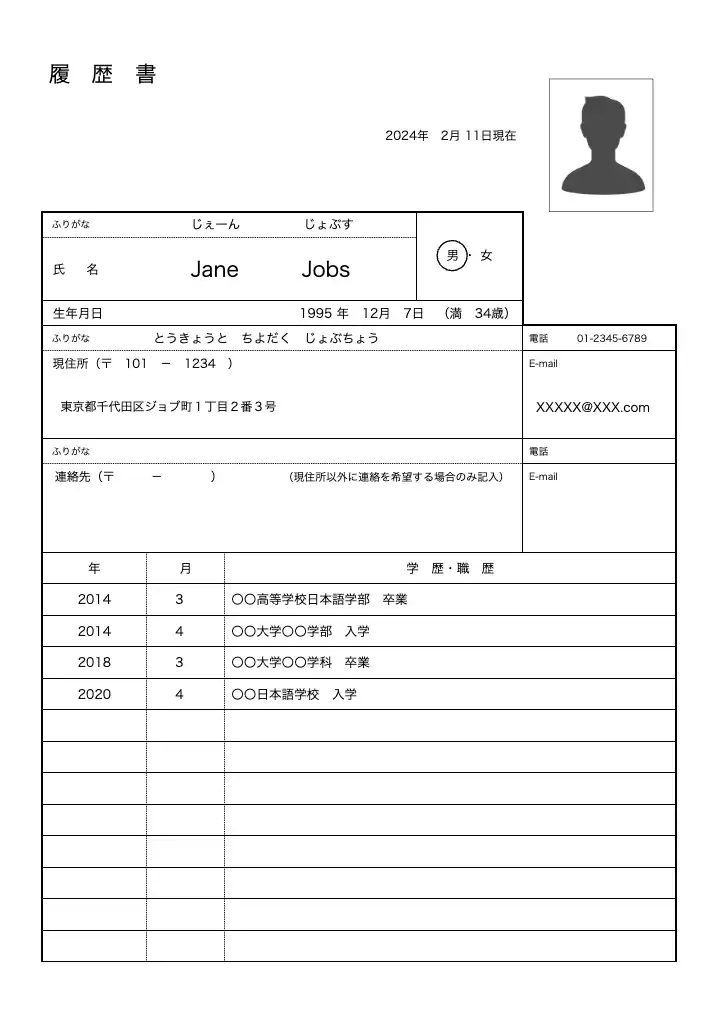
The Rirekisho (履歴書) is a standardized, form-based document expected by traditional Japanese companies. It follows strict formatting rules and includes basic personal information, educational background, work history, certifications, and your motivation for applying.
The Rirekisho is intentionally concise and factual. Its purpose is to show that you understand Japanese business etiquette and can present your background clearly and professionally. Many foreign candidates overlook this requirement, which is why applications are often rejected before anyone reviews the actual substance of their experience.
English resume for tech companies
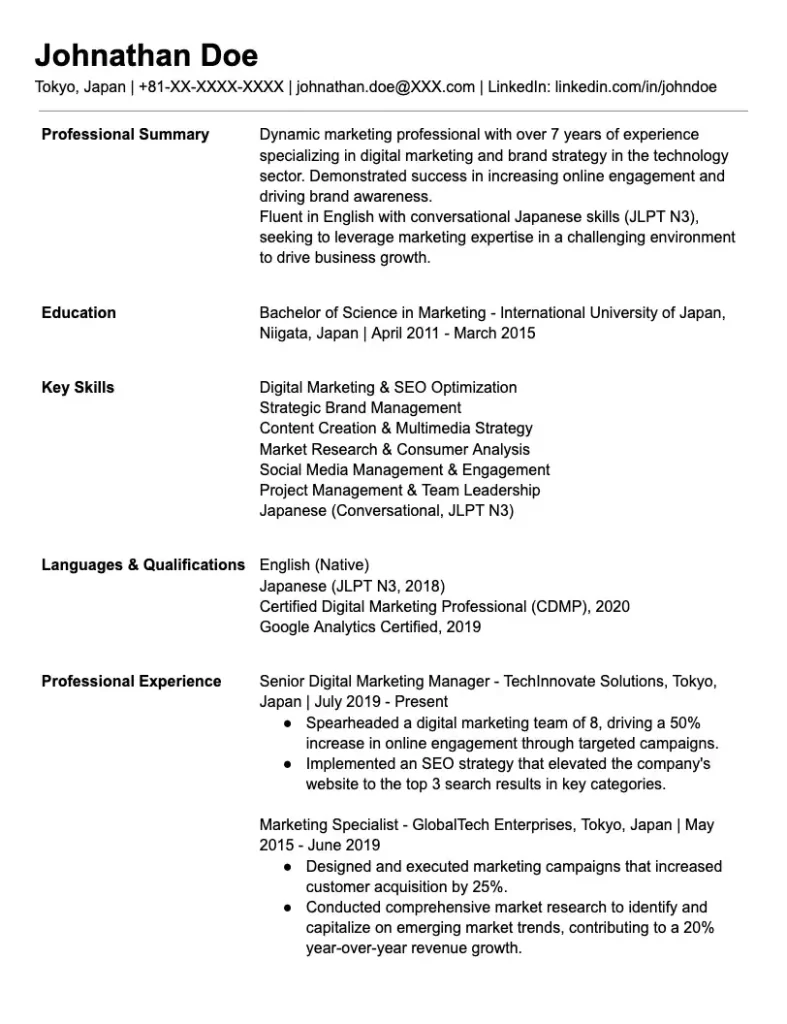
If you’re applying to a tech startup, an international company, or a modern tech firm with English-language job postings, you will most likely need a Western-style English resume. This format allows much more flexibility and gives you room to highlight achievements, projects, and technical expertise in detail.
As a general rule, if the job description is written in English, submit an English resume. If it’s written in Japanese, prepare a Rirekisho. When in doubt, submitting both is often a safe option, especially for roles that require business-level Japanese.
How to write an IT professional resume
Creating a strong summary / profile
Japanese resume format
In the Rirekisho, this section is called 志望動機 (Reason for Application).
Write 3-5 lines explaining why you are interested in this specific company and position. Be explicit about what attracts you to the company, how your experience aligns with their needs, and what value you can contribute. This section should always be written in formal, polite Japanese (keigo).
English resume format
Your summary is prime real estate, hiring managers often spend only a few seconds scanning it. Keep it clear, specific, and role-focused. Mention your years of experience, core technical skills, and why you’re interested in the position.
Limit this section to 3–5 sentences.
Example:
“Backend engineer with 6 years of experience building scalable systems in Java and Go. Seeking to relocate to Japan to work on innovative fintech projects, leveraging strong cloud infrastructure expertise.”
IT experience section
Japanese resume format
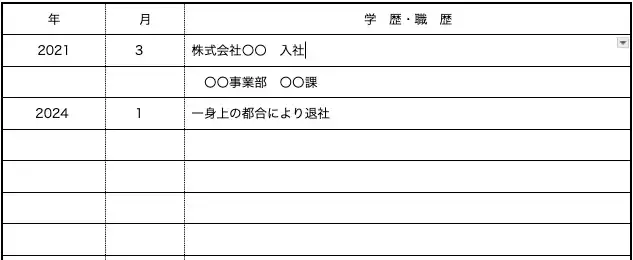
In the Rirekisho, work history appears in the 職歴 (Work History) section and follows a strict structure.
List companies in chronological order (oldest to newest), with the company name, department, and position written on separate lines. Use separate lines for “Entered” (入社) and “Left” (退職) dates, formatted as YYYY年MM月. The section must end with 以上 (“that’s all”), aligned to the right.
Do not include detailed descriptions of your responsibilities or achievements here, those belong in the separate 職務経歴書 (Shokumukeirekisho).
English resume format
List positions in reverse chronological order (most recent first) and focus on concrete achievements. For each role, clearly describe what you built or improved, the technologies you used (e.g., Java, Python, AWS, Docker, React), measurable results, and your role within the team.
Use one concise line per bullet point, and always include your tech stack so recruiters can immediately assess your relevance.
IT skills section
Japanese resume format
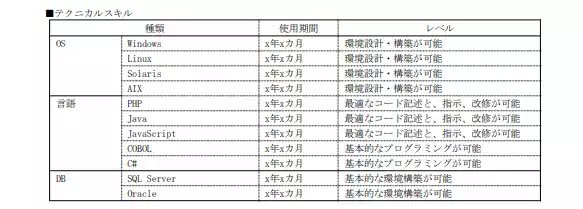
Include a 免許・資格 (Licenses and Qualifications) section listing certifications with their official names and dates (YYYY年MM月). This should cover both technical certifications (AWS Certified Solutions Architect, Google Cloud Professional, Oracle, LPIC, IT Engineering Examinations) and language certifications (JLPT N2, TOEIC 800, etc.).
If you have many technical skills, it’s common to write:
“For detailed technical skills, please refer to my 職務経歴書 (Shokumukeirekisho).”
English resume format
Organize skills by category for readability, such as:
- Programming Languages: Go, Java, Python, TypeScript
- Frameworks: Spring Boot, React, Vue.js
- Infrastructure: AWS, GCP, Docker, Kubernetes
- Databases: PostgreSQL, MySQL, MongoDB
- Tools: Git, CI/CD pipelines, Jira
Resume photo rules in Japan
Japanese resume format
A professional photo is mandatory. Photos should be taken at a studio or a photo booth (commonly found in train stations). Requirements include a 4cm × 3cm photo taken within the last three months, business attire, a plain background, direct eye contact, and a neutral or pleasant expression. Hats, sunglasses, and excessive accessories are not allowed. A suit or formal business clothing is expected.
English resume format
A photo is optional. If you choose to include one, make sure it is professional and recent. Avoid selfies or casual photos.
Education & academic background
Japanese resume format
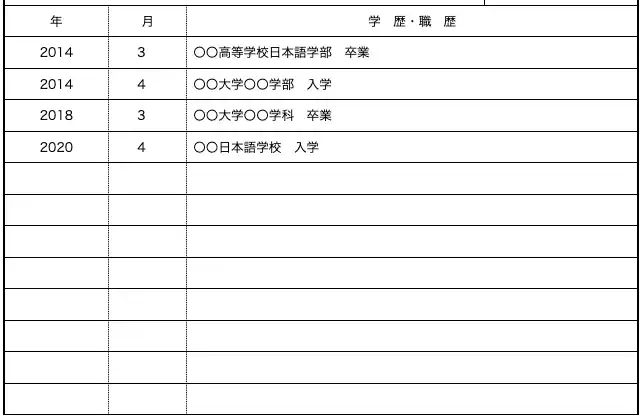
In the 学歴 (Academic Background) section, list schools from high school onward in chronological order. Use full official names (e.g., 〇〇高等学校, 〇〇大学〇〇学部) and include enrollment and graduation dates in YYYY年MM月 format on separate lines. For university education, mention your major or field of study (e.g., 情報工学科). End the section with 以上, aligned to the right. Precision and consistency are essential.
English resume format
List your highest level of education. For IT professionals, this usually means your college or university degree, including field of study and graduation date. High school education is not necessary.
If you are a recent graduate with a strong GPA, you may include it (e.g., “Graduated with Honors, GPA 3.8”). If you have several years of work experience, GPA can be omitted. Relevant certifications (AWS, Google Cloud, bootcamps) can be listed either here or in a separate Certifications section.
Creating your IT engineer resume with our support

Writing a resume for IT jobs in Japan can feel overwhelming, especially when navigating local formats and expectations. Our Career Support Program helps IT professionals prepare effectively for job hunting in Japan.
With our support, you can:
- Build a resume that fully meets Japanese standards, in both English and Japanese
- Practice interviews with expert feedback
- Receive career coaching from a team that has supported over 120 successful IT placements since 2021
Frequently asked questions
Is it okay if my resume is two pages?
Yes, absolutely. In fact, two pages is standard in Japan. While North American resume culture emphasizes one-page resumes, Japanese employers expect more detail.
For professionals with more than five years of experience, three pages can also be acceptable, as long as all content is relevant.
Should I use acronyms on my resume?
It’s best to avoid acronyms when possible. Write out “Amazon Web Services” instead of “AWS” and “JavaScript” instead of “JS.” Acronyms can confuse both ATS systems and human reviewers who may not be familiar with technical shorthand. That said, if an acronym appears in the job description, using it is acceptable and can even help with keyword matching.
Is it necessary to include my address on my resume?
For a Rirekisho, yes, address information is required by the standardized format.
For English resumes, it is not necessary. Simply listing your city or prefecture (e.g., “Tokyo” or “Osaka”) is sufficient.
If you are applying from overseas, clearly stating your current location and your intention to relocate can be a positive signal to employers.
Is it okay not to include all employment history?
You should aim to present a complete employment timeline. However, for older roles or positions that are not directly related to IT engineering, you can limit the information to job title and dates. The main focus should be on your most recent and relevant experience, particularly from the past five years.