
 English
  Español

Tips for More Effective Studying
Nihongo Online School > Tips for More Effective Studying > How to Say “Finished doing …” in Japanese | 〜してしまいました (…shite shimaimashita – completion) | JLPT N4 Grammar
How to Say “Finished doing …” in Japanese | 〜してしまいました (…shite shimaimashita – completion) | JLPT N4 Grammar
2025/12/27

Director: Kotaro Muramoto
Principal of Nihongo Online School
In September 2019, he founded "Nihongo Online School". Since then, has been teaching Japanese online lessons, with a total of over 1,000 students.
He has designed an individualized curriculum based on student’s needs and study goal. And is conscious of making the classes speech-centered in order to improve students’ speaking skills.
The school asks students to submit homework assignments worth 2 hours per lesson to improve faster. By supporting students with these features, students are able to efficiently improve Japanese language skills.
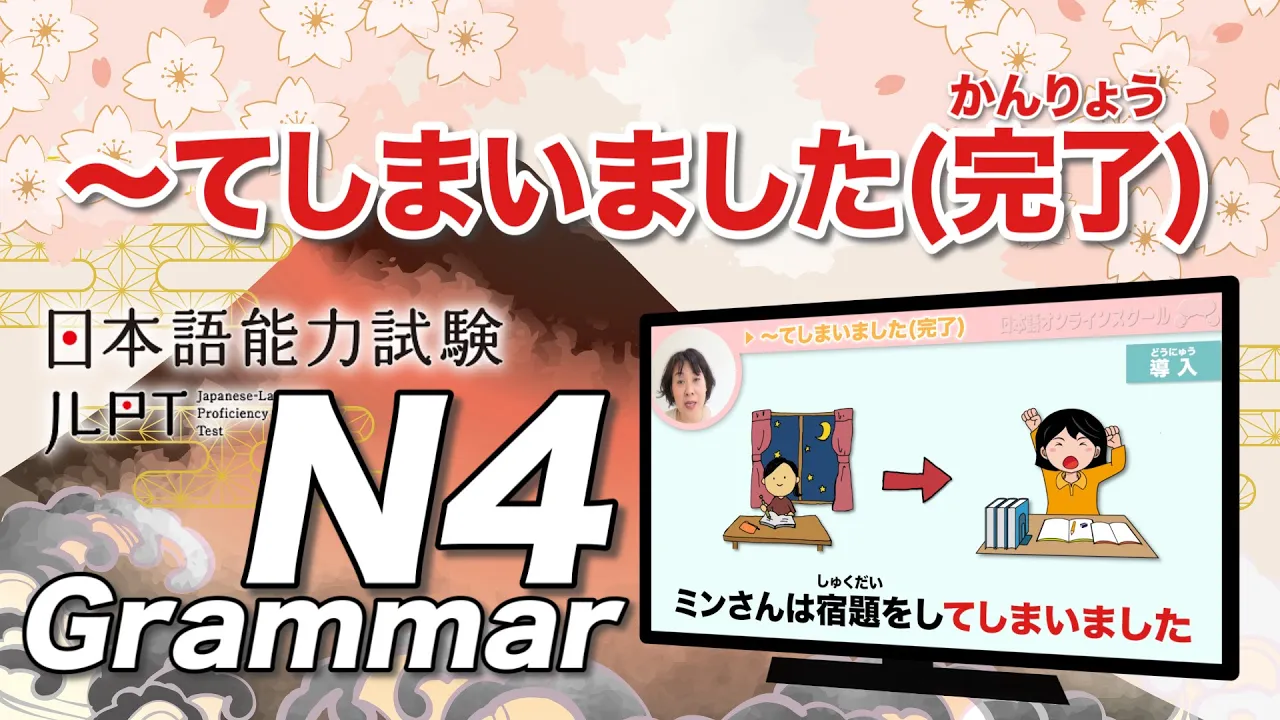
The Japanese grammar pattern ~てしまいました is introduced at the JLPT N4 level and is commonly heard in daily conversation.
This expression is known to have two meanings in Japanese: completion and regret.
In this grammar column, however, we will focus only on its use to express completion, without any nuance of regret, apology, or negative feeling.
Contents

When and How It’s Used
When ~てしまいました expresses completion, it highlights that an action has been completed entirely, thoroughly, or to the end.
In this usage, the speaker’s purpose is to:
- Emphasize that something is completely finished
- Report the end of a task or action
- Clarify that there is nothing left to do
There is no emotional judgment involved. The speaker is not expressing regret, surprise, or apology. The sentence simply states that the action is finished.
This use of ~てしまいました often appears in:
- Daily routines
- Study or work progress updates
- Situations where completion itself is important information
For learners, it is helpful to think of this usage as adding the nuance of “done completely” rather than just “did.”
See How it’s used in conversation
This video will help you understand how is used ~てしまいました in everyday Japanese conversations. Watch and repeat to improve your listening and speaking skills!
Sentence Pattern
Verb (て-form) + しまいました
This pattern always attaches to the て-form of a verb.
Examples of verb formation:
- 食べる → 食べてしまいました
- 読む → 読んでしまいました
- 終わる → 終わってしまいました
Grammatically, ~てしまいました is in the past tense, showing that the action has already been completed.
Examples
- レポートはもう書いてしまいました。
Repōto wa mō kaite shimaimashita.
→ I have already finished writing the report. - スピーチはもう覚えてしまいました。
Supīchi wa mou oboete shimaimashita.
→ All the dinner preparations are completely finished. - 今日の仕事は全部してしまいました。
Kyō no shigoto wa zenbu shite shimaimashita.
→ I’ve finished everything I needed to do today. - この本は昨日読んでしまいました。
Kono hon wa kinō yonde shimaimashita.
→ I finished reading this book yesterday.
All of these examples use ~てしまいました to emphasize completion only, without any regret or negative feeling.
In Summary
When used to express completion, ~てしまいました is a neutral and practical grammar pattern that emphasizes that an action has been fully completed.
It is especially useful when reporting progress or confirming that a task is finished. By mastering this meaning first, learners can build a solid foundation before moving on to the regret-related usage in more advanced contexts.
Enhance your JLPT N4 with Nihongo Online School
Mastering the core grammar of JLPT N4 is just one step toward passing the exam. To build a solid foundation, you’ll also need to learn JLPT N4 Grammar List , and also Play List on Youtube for JLPT N4 helps you understand important grammar easily.
At Nihongo Online School, our programs combine vocabulary, grammar, and practical usage in a clear, structured way, designed to help you succeed on the JLPT N4. With our learning system giving you the confidence and preparation you need for the exam. Discover your favorite courses at Nihongo Online School.