
 English
  Español

Tips for More Effective Studying
Nihongo Online School > Tips for More Effective Studying > How to Say “For the purpose of …” in Japanese | ~ために (…tame ni) | JLPT N4 Grammar
How to Say “For the purpose of …” in Japanese | ~ために (…tame ni) | JLPT N4 Grammar
2025/12/13

Director: Kotaro Muramoto
Principal of Nihongo Online School
In September 2019, he founded "Nihongo Online School". Since then, has been teaching Japanese online lessons, with a total of over 1,000 students.
He has designed an individualized curriculum based on student’s needs and study goal. And is conscious of making the classes speech-centered in order to improve students’ speaking skills.
The school asks students to submit homework assignments worth 2 hours per lesson to improve faster. By supporting students with these features, students are able to efficiently improve Japanese language skills.
The Japanese grammar pattern 〜ために (tame ni) is used to clearly express purpose or intention. It explains why someone does something and what goal they are trying to achieve.
This structure is very common in daily conversation, school settings, and work-related situations, especially when talking about plans, efforts, or goals.
At the N4 level, understanding how 〜ために works—and how it differs from similar expressions—is an important step toward sounding more natural and precise in Japanese.
Contents

When and How It’s Used
〜ために is used when the speaker wants to state a deliberate purpose behind an action. It connects a goal with a concrete action taken to achieve that goal.
This pattern is typically used when:
- Talking about personal goals or plans
- Explaining reasons for studying, working, or preparing
- Describing actions done with clear intention
A key feature of 〜ために is that it focuses on intentional actions. The person performing the action has control and makes a conscious decision to act.
At the N4 level, learners should also understand how 〜ために differs from another purpose expression, 〜ように.
Important differences between 〜ために and 〜ように:
① Verb type
- Before 〜ために, you use an intentional verb (意志動詞), such as 勉強する(Benkyou suru), 行く(Iku), 買う(kau).
- Before 〜ように, you use a non-intentional verb (無意志動詞), such as 分かる(Wakaru), 聞こえる(Kikoeru), できる(Dekiru).
② Subject (agent) relationship
- With 〜ために, the subject of the purpose action and the main action must be the same.
- With 〜ように, the subjects do not have to be the same, and the sentence can still be grammatically correct.
Because of these rules, 〜ために cannot be used for results outside the speaker’s control or when the agent changes.
See How it’s used in conversation
This video will help you understand how is used ~と伝えていただけませんか in everyday Japanese conversations. Watch and repeat to improve your listening and speaking skills!
Sentence Pattern
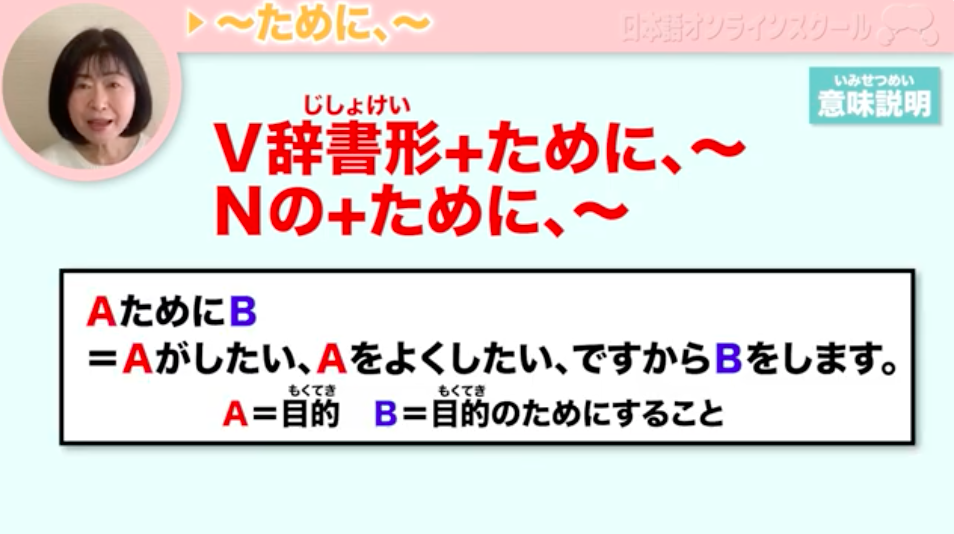
Verb (dictionary form / intentional verb) + ために
Noun ₊ の ₊ ために
The verb or noun before ために expresses the goal, and the main clause shows the action taken to reach that goal.
Both actions are performed by the same person.
Examples
- 日本語を勉強するために、毎日ニュースを見ています。
Nihongo o benkyō suru tame ni, mainichi nyūsu o mite imasu.
I watch the news every day in order to study Japanese.
- 家族に会うために、有給を取りました。
Kazoku ni au tame ni, yūkyū o torimashita.
I took paid leave in order to see my family.
- 健康のために、タバコをやめました。
Kenkō no tame ni, tabako o yamemashita.
I quit smoking to become healthier.
- 旅行のために貯金します。
Ryokō no tame ni, chokin shimasu.
I save the money for a trip.
In Summary
The grammar pattern 〜ために is a clear and effective way to express purpose based on intention.
The clauses before and after ‘~ために’ must have the same subject, which distinguishes it from 〜ように. By understanding these differences, learners can choose the correct expression and communicate their goals more naturally.
Using 〜ために appropriately makes explanations more logical, intentional, and closer to how native speakers express purpose in Japanese.
Enhance your JLPT N4 with Nihongo Online School
Mastering the core grammar of JLPT N4 is just one step toward passing the exam. To build a solid foundation, you’ll also need to learn JLPT N4 Grammar List , and also Play List on Youtube for JLPT N4 helps you understand important grammar easily.
At Nihongo Online School, our programs combine vocabulary, grammar, and practical usage in a clear, structured way, designed to help you succeed on the JLPT N4. With our learning system giving you the confidence and preparation you need for the exam. Discover your favorite courses at Nihongo Online School.