
 English
  Español

Tips for More Effective Studying
Nihongo Online School > Tips for More Effective Studying > How to put JLPT on your resume and land a job in Japan
How to put JLPT on your resume and land a job in Japan

2025/08/25

Director: Kotaro Muramoto
Principal of Nihongo Online School
In September 2019, he founded "Nihongo Online School". Since then, has been teaching Japanese online lessons, with a total of over 1,000 students.
He has designed an individualized curriculum based on student’s needs and study goal. And is conscious of making the classes speech-centered in order to improve students’ speaking skills.
The school asks students to submit homework assignments worth 2 hours per lesson to improve faster. By supporting students with these features, students are able to efficiently improve Japanese language skills.
Your JLPT certification doesn’t mean much if employers can’t see it clearly on your resume. Too often, job seekers in Japan showcase their Japanese skills so poorly that recruiters overlook them altogether.
This guide will show you how to put JLPT on your resume and on your LinkedIn profile so it actually gets noticed. You’ll learn when to include your certification, how to format it correctly for Japanese and English resumes, and where to place it to make your profile more attractive to recruiters. In short, everything you need to turn your JLPT into a real career asset.
Contents
- 1 Is JLPT certification required to get hired in Japan?
- 2 Golden rules for creating a strong resume in Japan
- 3 When you should add JLPT to your resume
- 4 How to add JLPT to resume using Japanese format
- 5 How to put your JLPT level on a resume in English format
- 6 Should you add JLPT certification to your LinkedIn profile?
- 7 How to add JLPT to LinkedIn profile in 4 steps
- 8 Get support for landing jobs in Japan

Is JLPT certification required to get hired in Japan?
The short answer is : It depends on your target role and industry.
JLPT certification isn’t universally mandatory for working in Japan, but it certainly increases your job opportunities and salary potential. English teaching jobs, tech positions, and multinational companies typically don’t require JLPT certification. However, customer service roles and traditional Japanese companies often expect N2 or N1 level proficiency.
Even when JLPT isn’t explicitly required, having certification gives you a significant advantage. When you’re showing a high JLPT level on your resume, you’re demonstrating your commitment to working in Japan long-term. Understanding the broader job search process for foreigners helps you navigate these language requirements effectively.
Golden rules for creating a strong resume in Japan
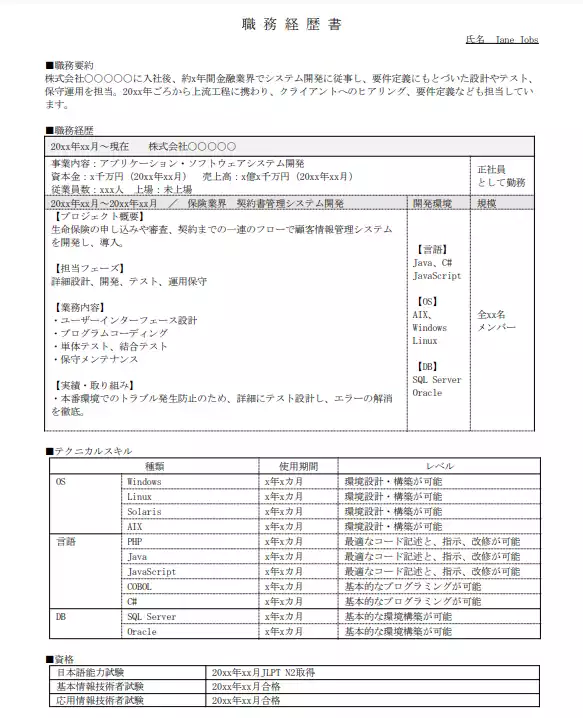
Japanese resumes follow a strict standardized format called Rirekisho that differs from Western resumes.
Essential sections of a Japanese resume include:
- Personal Information : Full name, age, gender, contact details,formal photo
- Education History (学歴) : Listed chronologically from high school onwards
- Work History (職歴) : All employment experience in chronological order
- Qualifications (資格) : Licenses, certifications, and language proficiency levels
- Self-Promotion (自己PR) : Your strengths and how they benefit the employer
- Details : Commute time, dependents and special requirements
Unlike Western resumes, you don’t customize content extensively for each application, but the self-promotion (自己PR) section becomes particularly important when competing with other candidates who may have similar qualifications.
When you should add JLPT to your resume
Knowing when to put your JLPT certification on your resume can make or break your application. The decision depends on your proficiency level, target role, and how it adds value to your candidacy.
Add JLPT to your resume when you have:
- N2 or N1 certification
- Roles requiring Japanese skills
- Competitive advantage potential
- Technical roles (IT, engineering, etc.) with Japanese clients
Don’t include JLPT when you have:
- Beginner levels (N5-N4)
- Failed JLPT exam attempts
- English-focused positions
- Very senior positions
Many Japanese recruiters conduct mini-interviews in Japanese to assess your actual speaking ability, regardless of test scores. Honesty is crucial : exaggerating language skills will backfire during interviews or on your first day.
How to add JLPT to resume using Japanese format
In the Japanese Rirekisho template, your JLPT certification belongs specifically in the Qualifications section (免許・資格). This section appears after your work history and follows a strict chronological format.
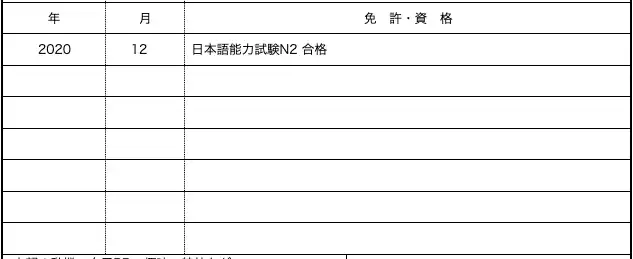
Put your JLPT entry on your resume exactly like this:
年 月 免許・資格
2024年 7月 日本語能力試験2級 合格
2023年 12月 日本語能力試験3級 合格
以上
List qualifications in chronological order (oldest first), use the exact official name 日本語能力試験○級 (not “JLPT N2”), add 合格 (passed) after the certification name, include the exact year and month you passed, and end with 以上 (that’s all) on the right side.
Even without JLPT certification, indicate your level as “日本語 – ビジネス会話可能” (business conversation level).
How to put your JLPT level on a resume in English format
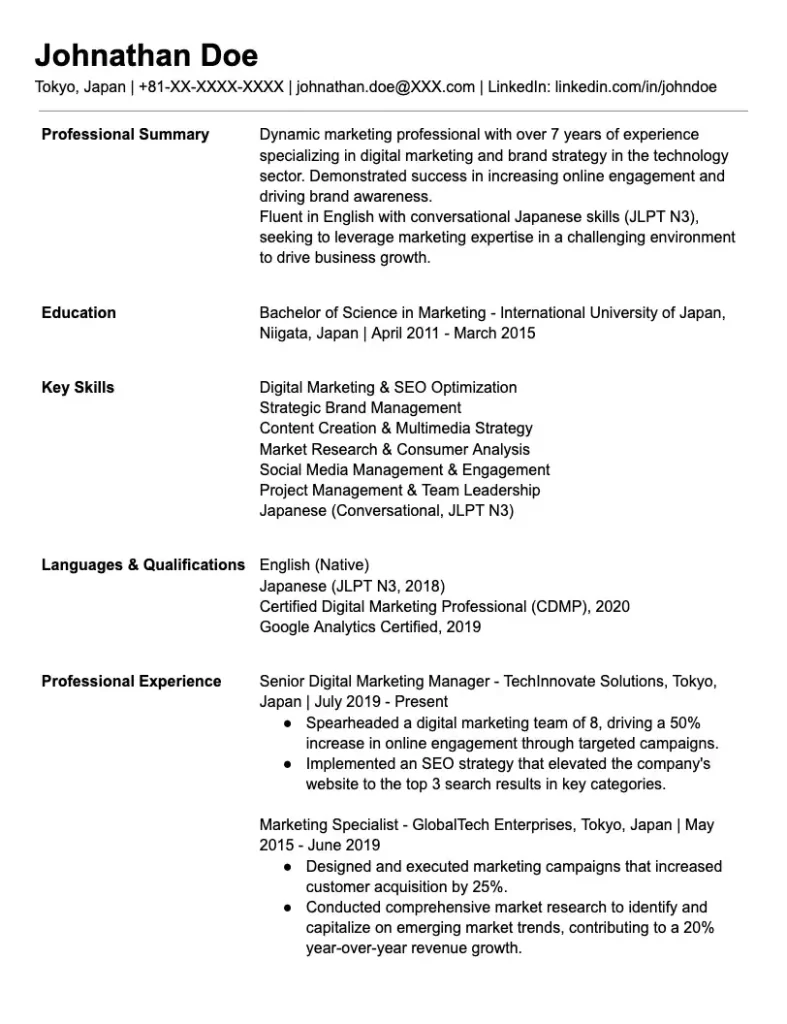
When writing an English resume for Japanese companies, emphasizing language skills prominently signals your ability to bridge cultural gaps and work effectively in Japan’s international business environment.
English resumes offer more flexibility for showcasing your JLPT certification compared to the Japanese format. The key is presenting your Japanese proficiency in terms that hiring managers can immediately understand.
Best placement options to put JLPT on English resumes:
Languages & Qualifications Section:
LANGUAGES
– Japanese: JLPT N2 (Business Level)
– English: Native/Fluent
– Spanish: Conversational
Skills Section (if limited languages):
CORE SKILLS
– Project Management
– Japanese Language (JLPT N2 – Business Level)
– Cross-cultural Communication
Use concrete descriptors like “Business Level” or “Conversational” instead of just test scores, since many Japanese hiring managers don’t understand JLPT terminology. Use compact formats like “Conversational Japanese (JLPT N3)” when space is limited, and always focus on how your Japanese proficiency adds value to the specific role you’re pursuing.
Should you add JLPT certification to your LinkedIn profile?
Adding your JLPT to LinkedIn significantly boosts your professional visibility and opens international opportunities.
Key benefits include:
- Better searchability : International recruiters filter candidates by language capabilities
- Algorithm boost : LinkedIn prioritizes complete profiles with diverse skills
- Networking expansion : Attracts professionals in Japan-related industries and multinational companies
Even when not actively job hunting, visible Japanese skills attract valuable business connections and dedication to professional development. When you know how to add JLPT to LinkedIn, you’re significantly expanding your reach.
How to add JLPT to LinkedIn profile in 4 steps
LinkedIn offers two strategic locations for showcasing your JLPT certification.
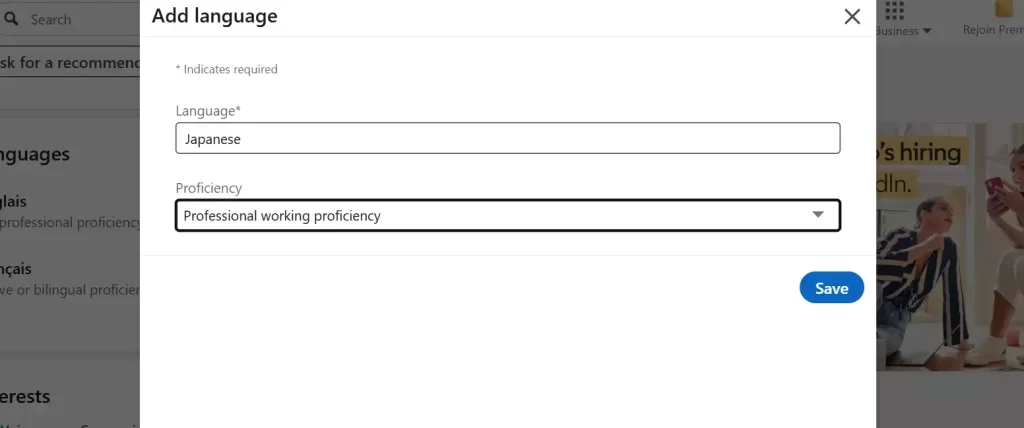
- Click profile picture → “View Profile”
- Scroll down → “Language” section
- Select “Add languages”
Step 2: Configure language settings
- Write “Japanese” and search in language field
- Select proficiency: Elementary = N5/N4, Limited Working = N3, Professional Working = N2, Full Professional = N1.
Step 3: Maximize visibility
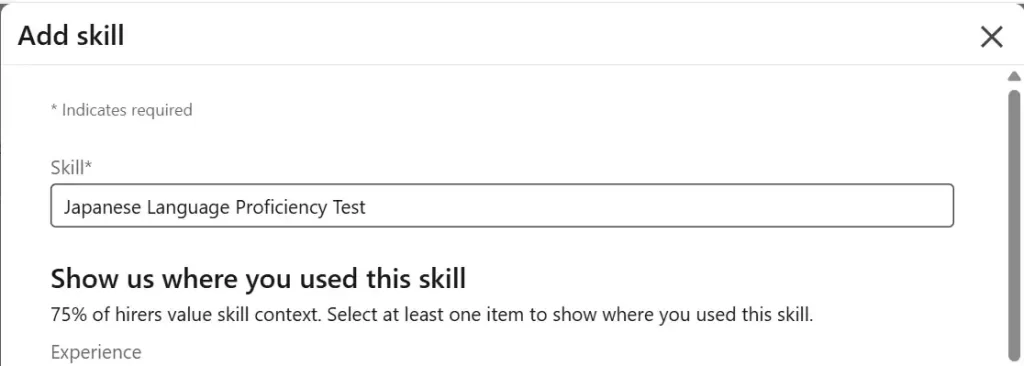
- Add to Languages section AND Skills section
- In Skills, write “Japanese Language (JLPT N2)” for certification specificity
Step 4: Build credibility
- Request endorsements from colleagues/teachers who’ve witnessed your abilities
- Add context in experience descriptions mentioning Japanese usage
Using LinkedIn’s dedicated Languages section ensures you appear in language-specific searches, while adding Japanese to Skills provides additional discoverability. The combination approach maximizes your how to add JLPT to LinkedIn strategy effectiveness.
Get support for landing jobs in Japan
Adding your JLPT on your resume and LinkedIn opens doors, but actually getting hired means understanding how Japan’s job market really works. Most foreigners have trouble writing complete Japanese resumes that follow all the formatting rules and getting through interviews where one keigo slip-up can ruin everything.
Good candidates get turned down for reasons they never understand. Talking about weaknesses too honestly, missing interview signals that Japanese candidates naturally pick up on,… Nihongo Online School’s career support program addresses these specific problems through hands-on coaching that covers resume writing to interview practice, so you understand the cultural expectations that actually get you hired.