
 English
  Español

Tips for More Effective Studying
Nihongo Online School > Tips for More Effective Studying > How to Learn Conversational Japanese – Practical Tips for Real Communication
How to Learn Conversational Japanese – Practical Tips for Real Communication

2025/07/06

Director: Kotaro Muramoto
Principal of Nihongo Online School
In September 2019, he founded "Nihongo Online School". Since then, has been teaching Japanese online lessons, with a total of over 1,000 students.
He has designed an individualized curriculum based on student’s needs and study goal. And is conscious of making the classes speech-centered in order to improve students’ speaking skills.
The school asks students to submit homework assignments worth 2 hours per lesson to improve faster. By supporting students with these features, students are able to efficiently improve Japanese language skills.
Learning conversational Japanese is about building practical speaking skills for real-world interactions: ordering ramen fluently, chatting with locals in Tokyo, or discussing your hobbies naturally.
This guide explains how to practice to become conversational faster, realistic timelines, and the best ways to start speaking confidently in everyday situations.
Contents

What is considered conversational Japanese?
Conversational Japanese means communicating effectively in everyday situations – ordering food, asking directions, or discussing hobbies – without constantly searching for words or using translation apps.
This level doesn’t require perfect grammar. Japanese naturally allows flexible sentences: instead of formal “わたしはコーヒーをのみたいです” (I want to drink coffee), you simply say “コーヒーのみたい” (want coffee), dropping unnecessary words when context is clear.
Conversational competency includes using natural fillers like “あのね” (you know) and “そうですね” (that’s right) that make your speech flow naturally. It’s about functional communication that gets your message across, not textbook perfection.
Conversation levels and what you can do in daily life
Understanding your current level—and what you can realistically do in daily life—helps you set clear goals and stay motivated.
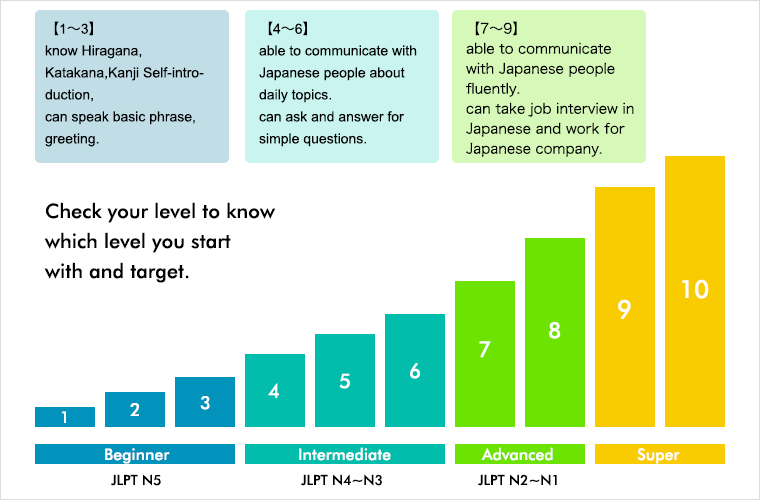
*Based on OPI-style performance criteria, we evaluate conversational ability on a scale of 10.
How long does it take to learn conversational Japanese?
The time it takes English speakers to learn conversational Japanese depends mainly on study intensity: two months of focused daily practice often beats a full year of casual study. But generally, most English speakers reach conversational level in 6 months to 1.5 years with consistent daily practice.
Korean speakers have a significant advantage due to similar grammar structures and reach conversational level 3-6 months faster than English speakers. Chinese speakers benefit from shared vocabulary but face similar grammar challenges as English speakers. However, English speakers excel with katakana words borrowed from English, making modern vocabulary easier to grasp.
The timeline follows clear stages: basic exchanges after 2-3 months, conversations by 6 months, and comfortable communication around one year. Conversational level means practical communication with occasional mistakes, not perfect fluency.
How to practice conversational Japanese

Effective practice bridges the gap between studying Japanese and actually speaking it. Practicing conversational Japanese requires combining multiple methods to build both confidence and real-world communication skills.
Immersion through authentic content
Watch Japanese TV dramas, reality shows, and YouTube channels that match your interests. Reality TV is particularly valuable because it features natural, unscripted conversations. Rewatch content you’ve already seen in English to focus on language patterns without worrying about plot comprehension.
Start speaking from day one
Begin speaking immediately, even with basic greetings, rather than spending months studying grammar first. Speaking activates different neural pathways than reading and builds confidence faster than passive study. Start with simple self-introductions, then expand to describing your routine and expressing preferences.
Recording and self-assessment
Record yourself speaking Japanese regularly and listen back critically. This helps identify pronunciation issues and unnatural patterns. Compare your recordings to native speakers to track progress and adjust your practice focus.
Tips to become conversational in Japanese faster
Becoming conversational in Japanese fast requires strategic choices about what to prioritize. These advanced techniques can significantly reduce your learning time.
Focus on high-frequency vocabulary and phrases
Prioritize the top 1,000 most common Japanese words, which appear in 80% of daily conversations, making them exponentially more valuable than rare vocabulary. Learn essential fillers like “でも” (but), “だから” (so), and “あの” (um) that native speakers use constantly – these buy you thinking time and make your speech sound natural rather than robotic.
Master through shadow speaking and imitation
Copy the exact pronunciation, rhythm, and intonation of native speakers by practicing shadow speaking – repeating phrases immediately after hearing them. Focus on matching the natural flow rather than perfect understanding. This builds muscle memory for Japanese sounds and speech patterns that textbooks can’t teach.
Learn in chunks rather than individual words
Instead of memorizing isolated vocabulary, learn complete phrases and expressions as single units. Master patterns like “_____ がすきです” (I like _____) and substitute different words into the same structure. This approach mirrors how native speakers actually think and speak, making your Japanese sound more natural and fluent.
Learning progress data
The chart below illustrates the average progression from Japanese Conversation Level 3 to Level 6, based on learning data from over 1,000 Japanese language learners. With our one-on-one online Japanese lessons, learners typically improve by one conversation level approximately every six months, when studying consistently with two 60-minute lessons per week.
Our conversation levels are defined based on practical speaking ability, following OPI-style criteria such as comprehension, response accuracy, fluency, and the ability to sustain real-life conversations.
Please note: Individual progress may vary depending on lesson frequency, self-study and review time, and how often Japanese is used in daily work or life.
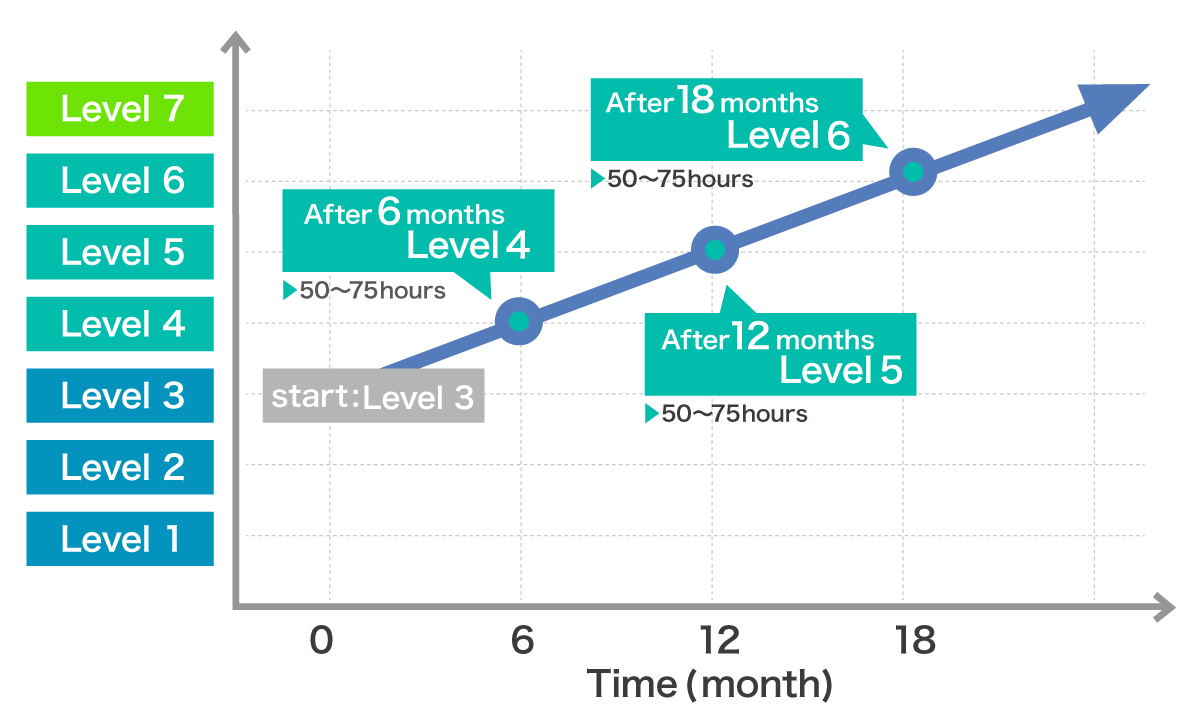
This graph represents an average learning trajectory for learners aiming to progress
from Conversation Level 3 to Level 6.
Below, we explain what learners studying at Nihongo Online School can realistically do at key conversation levels, how long it typically takes to reach each level, and how this looks in real one-on-one lessons.
On mobile, swipe right to view the full table →
| Current Level → Target Level | Lesson Hours | Homework | Duration |
|---|---|---|---|
| Level 1 → 3 | Approx. 100-150 hours (total) | about 2 hours per lesson hour | 6–12 months (total) |
| Level 3 → 4 | 50–75 hours | about 2 hours per lesson hour | 6 months |
| Level 4 → 5 | 50–75 hours | about 2 hours per lesson hour | 4–6 months |
| Level 5 → 6 | 50–75 hours | about 2 hours per lesson hour | 4–6 months |
| Level 6 → 7 | 50–75 hours | about 2 hours per lesson hour | 6–9 months |
In reality, the most effective learning plan depends on several factors:
- Your current Japanese level
- Your specific goals (what you want to be able to do in Japanese)
- Your work environment and communication needs
There is no one-size-fits-all solution.
👉You can find a detailed breakdown with real examples and timelines in this article:
How many hours does it take to improve Japanese conversation skills?Where to learn conversational Japanese
Finding places to learn conversational Japanese depends on your schedule, budget, and learning preferences:
- Traditional language schools : Structured learning with immediate feedback and peer interaction
- Language exchange apps : Free practice with cultural exchange and real friendship potential
- Private tutors : Personalized curriculum, focused attention, and rapid progress
- Online conversation classes : Specialized speaking focus with convenience and affordability
Train your Japanese conversation skills online

Practicing Japanese conversation online eliminates the biggest barrier to fluency: finding native speakers to practice with regularly.
Nihongo School’s conversational classes connect you with native Japanese instructors for regular conversation practice tailored to your specific goals. Whether you want to integrate better into Japanese society, feel confident in workplace meetings, or increase your chances of landing a job in Japan, their instructors adapt each lesson to your real-life needs.
Students practice authentic scenarios based on their objectives – navigating office politics for career advancement, building relationships with Japanese colleagues, or handling daily interactions that help them feel at home in Japan. Each conversation session combines practical vocabulary with cultural insights, teaching not just what to say but the cultural context behind Japanese communication. This personalized approach helps students sound natural and culturally aware, giving them the confidence to thrive in their Japanese environment.