
 English
  Español

JLPT N4 Online Course – Build Your Japanese Foundation
Build a strong foundation in N4-level Japanese through structured video lessons focused on grammar, vocabulary, and listening.
Designed for learners who have completed JLPT N5-level Japanese or equivalent, this self-paced course helps you progress toward N4 while learning Japanese through Japanese.
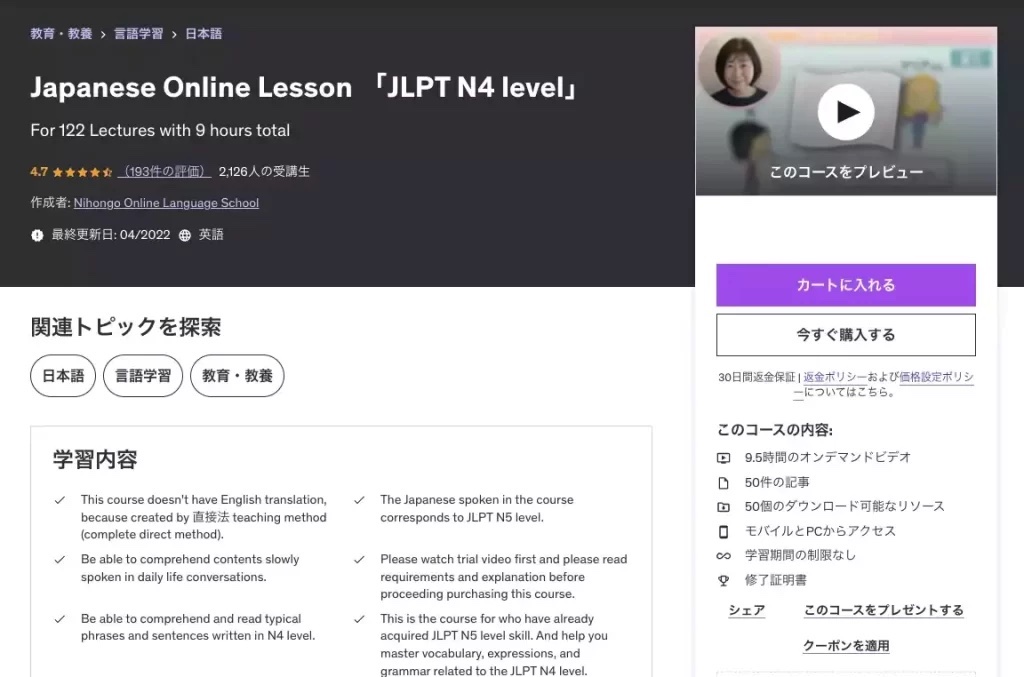
About This JLPT N4 Online Course
This course is designed for learners who have already built a basic foundation in Japanese and are ready to move from N5 toward N4 level.
The lessons focus primarily on N4-level grammar and sentence patterns, while helping you build essential vocabulary and strengthen your listening through Japanese-only instruction.
The curriculum is based on the grammar and sentence patterns covered in Minna no Nihongo Shokyu II, Lessons 26–50. Because each lesson contains several important grammar points, the material is divided into focused video lessons so that you can study each pattern step by step.
You can progress through the course at your own pace and review lessons whenever you need.
Watch Sample Lessons
See how our instructors explain Japanese grammar entirely in Japanese. These sample lessons give you a real look at the teaching style used throughout the JLPT N4 course.
どうして~んですか
~んですか?
What You Will Learn
Build the grammar foundation you need to progress from N5 toward N4 while developing vocabulary and listening skills through structured Japanese-only lessons.
Build a Strong N4 Grammar Foundation
Learn essential N4 grammar and sentence patterns step by step through clear explanations and practical examples.
Expand Your Japanese Vocabulary
Build essential vocabulary while learning how words and expressions are used naturally within sentences and everyday situations.
Strengthen Your Japanese Listening
Because the lessons are taught entirely in Japanese, you can develop your listening skills while studying new grammar and vocabulary.
Understand Japanese Through Japanese
Practice following explanations in Japanese and gradually reduce your reliance on English translation.
JLPT N4 Course Curriculum
The course covers grammar and sentence patterns from Lessons 26–50 of Minna no Nihongo Shokyu II.
Because each lesson contains several important grammar points, the material is divided into focused video lessons so that you can study each pattern step by step.
25 Lessons | 122 Lectures | 25 Lesson Tests
| Minna no Nihongo | Topic | Grammar Focus |
|---|---|---|
| L26 | 旅行(りょこう)に行(い)くんですか Are you going on a trip? | ~んです / ~んですか — Explaining situations and asking for explanations ~んですが / ~ていただけませんか / ~たらいいですか — Giving background, making polite requests, and asking for advice |
| L27 | ピアノが弾(ひ)けます I can play the piano | Potential verbs / ~が見えます / ~が聞こえます — Expressing ability and perception ~ができます / ~しか~ません / ~は~、~は~ — Expressing possibility, limitations, and contrasts |
| L28 | 海(うみ)もきれいだし、料理(りょうり)も好(す)きだし…… The sea is beautiful, and I like the food… | ~ながら / ~ています — Describing simultaneous and habitual actions ~し、~し — Listing qualities and giving multiple reasons |
| L29 | 鍵(かぎ)をなくしてしまったんです I lost my key. | ~が/は~ています — Describing resulting states ~てしまいます / ~てしまいました — Expressing completion and regret |
| L30 | そのままにしておいてください Please leave it as it is. | ~てあります — Describing something intentionally left or prepared in a certain state ~ておきます — Preparing in advance, taking measures, or leaving something as it is |
| L31 | 温泉(おんせん)に行(い)こうと思(おも)っています I’m thinking of going to a hot spring. | Volitional form / ~と思っています — Expressing intentions and plans まだ~ていません / ~つもりです / ~予定です — Talking about future intentions and schedules |
| L32 | 野菜(やさい)を食(た)べたほうがいいですよ You should eat vegetables. | ~ほうがいいです — Giving advice ~でしょう / ~かもしれません — Expressing probability and possibility |
| L33 | あの漢字(かんじ)は何(なん)と読(よ)むんですか How do you read that kanji? | Imperative & prohibitive forms / ~と書いてあります / ~と読みます — Understanding instructions, signs, and written information ~という意味です / ~と言っていました / ~と伝えていただけませんか — Explaining meanings and relaying messages |
| L34 | 地図(ちず)のとおりに、行(い)ってください Please follow the map. | ~とおりに / ~あとで — Following instructions and describing the order of actions ~て / ~ないで — Describing how an action is performed and doing one action without another |
| L35 | どうやって行(い)けばいいですか How should I get there? | Vば / Vなければ — Expressing conditions い-adjective ~ければ / な-adjective・N ~なら / 疑問詞~ばいいですか — Asking for advice and talking about conditions |
| L36 | 毎日新聞(まいにちしんぶん)を読(よ)むようにしています I try to read the newspaper every day. | ~ように / ~ようになりました — Expressing goals and changes in ability or circumstances ~ようにしています / ~ようにしてください — Talking about ongoing efforts and making requests |
| L37 | 2021年(ねん)に東京(とうきょう)オリンピックが行(おこな)われました The Tokyo Olympics were held in 2021. | Passive form ~(ら)れます — Describing actions received from others and personal experiences <物>が/は~(ら)れます — Describing facts and events objectively |
| L38 | 一番(いちばん)大切(たいせつ)なのは家族(かぞく)です The most important thing is family. | ~のは/~のが<形容詞>です — Describing and evaluating actions ~のを忘れました / ~のを知っています / ~のは<名詞>です — Nominalizing actions, stating knowledge, and emphasizing information |
| L39 | もう大丈夫(だいじょうぶ)なので、心配(しんぱい)しないでください I’m fine now, so please don’t worry. | Vて / いAくて / なAで / Nで — Expressing causes and resulting emotions or situations ~ので — Giving reasons and explaining circumstances politely |
| L40 | おいしいかどうか、食(た)べてみます I’ll try it to see if it’s tasty. | 疑問詞~か — Embedding a question within a sentence ~かどうか / ~てみます — Expressing whether something is the case and trying something |
| L41 | 教(おし)えてくださいませんか Would you please tell me? | ~をいただきます / ~をくださいます / ~をやります — Giving and receiving with appropriate social relationships ~ていただきます / ~てくださいます / ~てやります / ~てくださいませんか — Describing favors and making polite requests |
| L42 | 将来(しょうらい)のために、頑張(がんば)っています I’m doing my best for the future. | ~ために — Expressing purpose ~(の)に / ~(の)に~かかります — Describing use, evaluation, time, and cost |
| L43 | 試験(しけん)に合格(ごうかく)できそうです It looks like I can pass the exam. | ~そうです (verbs) — Making predictions based on signs or appearances ~そうです (adjectives) / ~て来ます — Describing appearances and going to do something before returning |
| L44 | 簡単(かんたん)すぎて、はやく次(つぎ)の勉強(べんきょう)がしたくなりました It was so easy that I wanted to move on to the next lesson. | ~すぎます / ~やすい / ~にくい — Expressing excess and ease or difficulty of actions ~く/にします / Nにします — Changing a state and making choices or decisions |
| L45 | 毎日(まいにち)勉強(べんきょう)するのは大変(たいへん)なのに…… Even though studying every day is difficult… | ~場合は — Talking about what to do in a particular situation ~のに — Expressing contrast, disappointment, or an unexpected result |
| L46 | 毎日(まいにち)復習(ふくしゅう)したら、日本語(にほんご)が上手(じょうず)になるはずです If you review every day, your Japanese should improve. | V辞書形 / ~ている / ~たところです — Describing an action just before, during, or just after it happens Vた形+ばかりです / ~はずです — Describing a recent action and expressing an expected conclusion |
| L47 | いろいろな国(くに)の人(ひと)が日本語(にほんご)を勉強(べんきょう)しているようです It seems that people from various countries are studying Japanese. | ~そうです — Reporting information heard from another source ~ようです — Making judgments based on observed information |
| L48 | もう一度(いちど)、説明(せつめい)を聞(き)かせていただけませんか Could you let me hear the explanation once more? | Causative form ~(さ)せます — Expressing making or allowing someone to do something ~(さ)せていただけませんか — Politely asking permission to do something |
| L49 | お待(ま)ちください Please wait. | ~(ら)れます / お~になります — Using respectful language Special respectful expressions / お・ご~ください — Showing respect and making polite requests |
| L50 | どうぞよろしくお願(ねが)いいたします I sincerely appreciate your kind cooperation. | お・ご~します / Special humble expressions — Using humble language for actions involving someone of higher status Special humble expressions — Referring politely to yourself and your own actions |
Who Is This Course For?
This course is designed for learners who already have a basic foundation in Japanese and want to progress toward JLPT N4-level Japanese.
- Learners who have completed JLPT N5 or an equivalent level
- Learners who want to progress from N5 to N4
- Learners who want to strengthen their Japanese grammar foundation
- Learners who want to improve their ability to understand spoken Japanese
- Learners who prefer video-based learning
- Learners who want to become more comfortable learning Japanese through Japanese
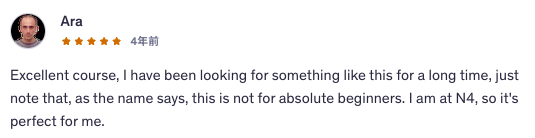
This course is not designed for complete beginners. If you are just starting Japanese, we recommend building an N5-level foundation before taking this course.
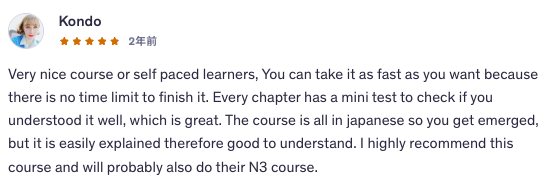
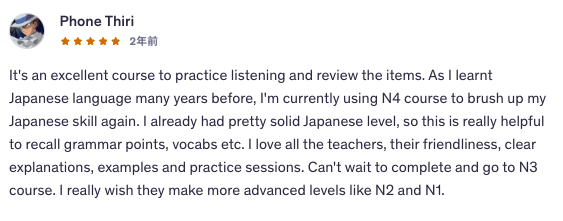
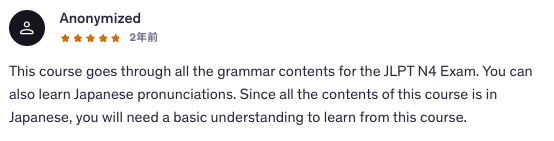
What Our Students Say
See what learners who have taken our JLPT N4 video course say about their experience.
Learn with Experienced Japanese Instructors
The course was created by experienced, qualified Japanese instructors who have taught learners from a wide range of international backgrounds.

After obtaining a Japanese language teaching qualification, Tsuchiya began teaching Japanese to international students in 2008, primarily at Japanese language schools in Fukuoka Prefecture. She has experience in homeroom management, academic counseling, and interview preparation. As a Japanese instructor, she has taught Japanese to over 800 students from 15 different countries.

After earning her Japanese language teaching qualification in 2007, Mori has been engaged in teaching Japanese to international students for over 10 years, mainly at Japanese language schools in Fukuoka Prefecture. She also provides online instruction for technical intern trainees aiming to work in Japan, covering essential daily conversation skills and etiquette necessary for living in Japan.

After obtaining a Japanese language teaching qualification in 2014, Hoshino has been teaching Japanese to corporate employees and technical intern trainees at Japanese language schools in Fukuoka Prefecture. She has taught Japanese to over 1,000 students. Leveraging her practical experience in Japanese companies, she also provides training on business etiquette unique to Japanese culture.
Frequently Asked Questions
What Japanese level do I need before taking this course?
This course is designed for learners who have completed approximately JLPT N5-level Japanese and are ready to progress toward N4. It is not designed for complete beginners.
Is this course taught entirely in Japanese?
Yes. The video lessons are taught entirely in Japanese. The explanations use relatively simple Japanese so that learners with an N5-level foundation can follow the lessons while gradually strengthening their listening comprehension.
Is this course specifically for JLPT N4 exam preparation?
The course covers grammar, vocabulary, and expressions at approximately the JLPT N4 level. Rather than focusing mainly on exam strategies or practice questions, it is designed to help you build a solid foundation in N4-level Japanese.
Do I need Minna no Nihongo Shokyu II?
No. The textbook is not required to take the course. However, if you already have Minna no Nihongo Shokyu II, we recommend using it alongside the video lessons to make your study more effective.
What does the course include?
The course includes 122 lectures with approximately 9 hours of video content. It covers Lessons 26–50 and includes a test for each lesson to help you check your understanding as you progress.
Can I study at my own pace?
Yes. The course is available on Udemy, allowing you to progress through the video lessons at your own pace and review lessons whenever needed.
Not sure whether the N4 or N3 course is right for you? Compare our Japanese courses on Udemy →
Start Building Your N4 Japanese Foundation
Move beyond N5 and build a stronger foundation in Japanese grammar, vocabulary, and listening through structured video lessons taught entirely in Japanese.
