
 English
  Español

Tips for More Effective Studying
Nihongo Online School > Tips for More Effective Studying > How to Learn to Speak Japanese for Beginners
How to Learn to Speak Japanese for Beginners

2026/06/22

Director: Kotaro Muramoto
Principal of Nihongo Online School
In September 2019, he founded "Nihongo Online School". Since then, has been teaching Japanese online lessons, with a total of over 1,000 students.
He has designed an individualized curriculum based on student’s needs and study goal. And is conscious of making the classes speech-centered in order to improve students’ speaking skills.
The school asks students to submit homework assignments worth 2 hours per lesson to improve faster. By supporting students with these features, students are able to efficiently improve Japanese language skills.
Most guides on how to speak Japanese for beginners bury you in kanji for months.
If your goal is conversation, learning to speak Japanese turns out to be one of the more achievable parts of the language.
This guide takes a speaking-first approach: what to learn, what to skip, and where to practice.
Contents
- 1 Is Japanese Hard to Learn Just for Speaking?
- 2 How Do I Start Speaking Japanese as a Complete Beginner?
- 3 How to Learn Conversational Japanese for Beginners at Work
- 4 Common Pitfalls When Learning to Speak Japanese
- 5 A Structured Path to Speaking Japanese
- 6 Best Resources to Practice Speaking Japanese as a Beginner

Is Japanese Hard to Learn Just for Speaking?
Japanese is hard to learn if you count every kanji and every layer of formal speech, but just for speaking it’s far more approachable.
The spoken language is phonetic and has fewer sounds than English, verbs use a single form with fewer tenses than European languages, and nouns have no gender and rarely need plurals.
What actually makes speaking tricky is pitch and the polite-versus-casual registers. The U.S. Foreign Service Institute counts around 2,200 hours for full professional mastery, but everyday conversational ability comes far sooner, often within the first year of steady practice.
How Do I Start Speaking Japanese as a Complete Beginner?

To start speaking Japanese as a complete beginner, build a small spoken core you can use right away instead of a big vocabulary you only recognize. Follow this order:
- Learn hiragana first : It locks in accurate native sounds and keeps you off romaji, which trains the wrong pronunciation.
- Pick a few high-frequency verbs : Start with everyday ones like taberu (to eat) and iku (to go). A small set goes a long way.
- Add everyday nouns : Pull from a focused list like the top 100 Japanese words for beginners so you only learn words you’ll actually say.
- Learn four core particles : Wa (topic), o (object), ni (“to”), and kara (“from”) are enough to build real sentences.
- Combine and speak : With one verb and a particle you can already say watashi wa pan o tabemasu (I eat bread). Say it aloud, mimic the intonation like an echo, and record yourself to catch what’s off.
How to Learn Conversational Japanese for Beginners at Work
Learning conversational Japanese for work as a beginner is about narrowing your focus, not widening it. Full business Japanese takes years because of keigo, the layered polite speech used in professional settings, but you can hold useful work conversations long before mastering all of it. Concentrate on four things:
- Map your real situations : Greetings with colleagues, meetings, recurring email phrases. List what you actually face each week and start there.
- Learn your field’s vocabulary : Master one domain and you’ll sound confident in it well before your general Japanese catches up.
- Pick up just enough keigo : Learn the polite forms your workplace expects, not the entire system.
- Use a tutor on your terms : Tell them you want workplace Japanese, not a textbook curriculum, so every lesson targets what you’ll actually use.
To gauge the commitment involved, it helps to see how many lessons you actually need to start speaking.
Common Pitfalls When Learning to Speak Japanese
Learning to speak Japanese goes wrong in a few predictable ways, and avoiding them saves months.
- The collector trap : Downloading six apps and finishing none. Pick one resource per skill and stick with it for at least 60 days before adding anything new.
- Leaning on romaji : It feels easier but trains the wrong pronunciation and delays real reading. Learn hiragana within your first week or two.
- Fake speaking practice : Reading sentences aloud into an app that accepts almost anything isn’t conversation. Real speaking means producing a response you didn’t plan in advance.
- Chasing the streak : A daily one-minute review just to protect a streak is studying for the app, not the language.
- Waiting for immersion : Living in Japan won’t make you fluent on its own. People will happily switch to English unless you take charge of your own practice.
A Structured Path to Speaking Japanese
A structured path to speaking Japanese keeps input and output moving together. Here’s a simple three-phase version that stays speaking-first:
| Phase | Timeline | Focus | What you produce |
| 1. Foundations | Weeks 1-4 | Hiragana, katakana, greetings, a few core verbs, nouns, and particles | Very short spoken sentences |
| 2. Input | Weeks 5-8 | Most common verbs, ~100 nouns, basic adjectives, plus daily listening | Short answers, a trained ear |
| 3. Output | Weeks 9-12 | Speaking aloud, journaling one sentence a day, getting corrected | Real conversations, longer answers |
Adapt the timeline to your schedule; one to two focused hours a day gets most learners to a basic level in a few months.
Track progress honestly rather than by app points, and here’s how to actually measure your speaking ability.
Best Resources to Practice Speaking Japanese as a Beginner
The best resources to practice speaking Japanese as a beginner combine a structured course, audio you can repeat, and a way to talk with real or AI partners.
Minna no Nihongo vs Genki for Speaking?
Genki is the classroom standard, with clear English grammar explanations, culturally rich dialogues, and partner activities that build speaking, though solo learners may need a partner to use those drills fully. The 3rd edition adds QR-code audio.
Minna no Nihongo takes a more immersion-style approach taught largely in Japanese, which suits learners who want to think in the language earlier.
For speaking specifically, Genki’s dialogue focus and English support make it the gentler starting point for most beginners.
Language Learning Books with Audio for Speaking Practice
For a speaking-focused book with audio, Pimsleur’s audio-first lessons drill listening and pronunciation in 30-minute sessions you can do while commuting.
Genki and Japanese From Zero pair their textbooks with audio and free companion videos.
Earworms Rapid Japanese sets phrases to music so they stick in your head.
Online Platforms for Conversational Japanese
Nihongo Online School takes a conversation-first approach built specifically around speaking.
Rather than grading you on JLPT-style reading and grammar, it starts with a speaking level check: you answer short audio questions out loud and get placed on a 10-level conversation scale based on how you respond in real time.
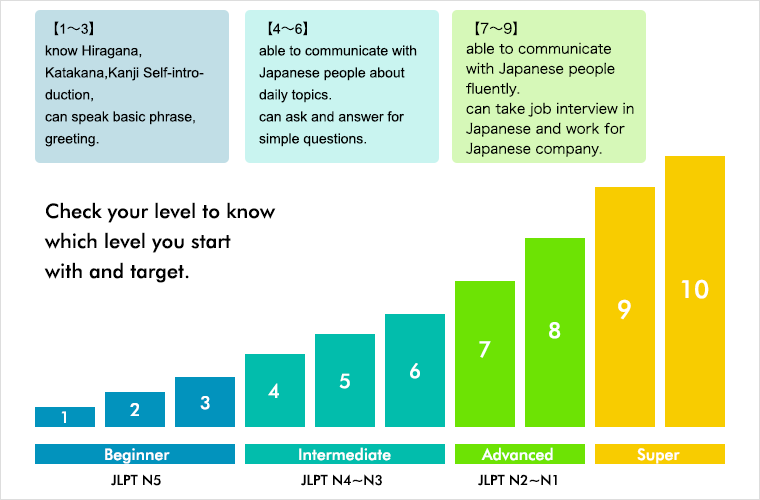
From there, lessons follow a personalized plan focused on the speaking skills you actually need, like turning short answers into natural sentences, building fluency, and repeating common conversational patterns.