
 English
  Español

Tips for More Effective Studying
Nihongo Online School > Tips for More Effective Studying > What JLPT level do you need to work as an IT engineer in Japan?
What JLPT level do you need to work as an IT engineer in Japan?

2026/01/17

Director: Kotaro Muramoto
Principal of Nihongo Online School
In September 2019, he founded "Nihongo Online School". Since then, has been teaching Japanese online lessons, with a total of over 1,000 students.
He has designed an individualized curriculum based on student’s needs and study goal. And is conscious of making the classes speech-centered in order to improve students’ speaking skills.
The school asks students to submit homework assignments worth 2 hours per lesson to improve faster. By supporting students with these features, students are able to efficiently improve Japanese language skills.
The JLPT level needed to work as an IT engineer in Japan depends on several factors.
This article explains which JLPT levels are typically expected, when Japanese is optional, and how language skills influence both hiring and long-term career growth for IT engineers in Japan.
Contents

Can you work as an IT engineer without JLPT ?
On paper, it is possible to work as an IT engineer in Japan without JLPT certification.
Today, Japan faces a critical shortage of engineering talent. This supply constraint has led to a gradual shift in hiring standards. Employers that once strictly required JLPT N1 now increasingly consider candidates with JLPT N2 or even JLPT N3 proficiency.
This does not mean Japanese language skills are no longer important for IT engineers, but rather that the entry barrier has become more flexible.
Career opportunities will still depend on your level of experience, the type of company you are targeting, and, in many cases, stronger language proficiency can further broaden your prospects.
3 factors influencing JLPT requirements for IT roles in Japan

JLPT expectations are not fixed. The more your job involves coordination, stakeholders, or leadership, the more Japanese becomes a hard requirement.
Seniority level
Japanese language expectations tend to evolve with experience. The stronger your technical track record, the more flexible companies become regarding Japanese proficiency.
Early in your career, language plays a much larger role in hiring decisions, as employers have fewer signals to rely on beyond interviews and perceived cultural fit.
0–2 years (Junior) → JLPT expectation: around N3-N2
With limited professional experience, language gaps are harder to offset. HR interviews are often conducted in Japanese, even at companies positioning themselves as “international.”
There are still IT engineering roles available for candidates without Japanese proficiency, but these are limited in number : typically English-only junior positions at foreign-owned startups, mostly concentrated in Tokyo.
3–6 years (Mid-level) → JLPT expectation: around N3–N2
At this stage, demonstrated delivery and problem-solving ability begin to outweigh language concerns. Many companies become comfortable with N3-level Japanese, while N2 significantly expands opportunities, particularly within Japanese companies modernizing their technology stacks.
5+ years (Senior)
Strong technical expertise can compensate for weaker Japanese in hands-on roles. English-first teams, hybrid environments, or remote arrangements often become negotiable.
Progression into leadership or management roles sharply increases language expectations, making higher Japanese proficiency difficult to avoid.
Work Environment
The “company DNA” matters a lot. Two companies in the same industry can have totally different language norms.
| Company type | Day-to-day language | JLPT expectation (typical) | What to expect |
| Foreign-owned / international startups | Mostly English | None → N3 optional | Fewer roles, concentrated in Tokyo |
| Modernizing Japanese companies | Mixed JP/EN | N3-N2 | Supportive tooling (translation, captions), larger job pool |
| Traditional Japanese companies | Mostly Japanese | N2 (often N1) | Business Japanese needed across meetings/docs/clients |
Role Scope
Language requirements increase as soon as a role extends beyond individual technical execution :
- Code-focused IC roles (build, bugs, infrastructure): JLPT N3 is often sufficient, and in English-first teams, Japanese may not be required at all.
- Team lead / cross-team coordination: Mentoring, explaining technical trade-offs, and aligning with stakeholders typically require JLPT N2 as a minimum.
- Management, strategy, or client-facing roles: Negotiations, hiring decisions, budgeting, and executive discussions generally make JLPT N1 close to mandatory.
How learning Japanese can accelerate your IT career in Japan
Language proficiency is not just a skill — it’s a career accelerator. With N2-level Japanese, you unlock leadership opportunities that significantly expand your income potential.
Japanese language skills directly impact both job access and long-term career growth.
Engineers without Japanese are usually limited to a small pool of English-only roles, with starting salaries around ¥4–5M. Reaching a conversational level such as JLPT N3–N2 significantly expands the hiring market and often leads to a 20–30% increase in starting salary.
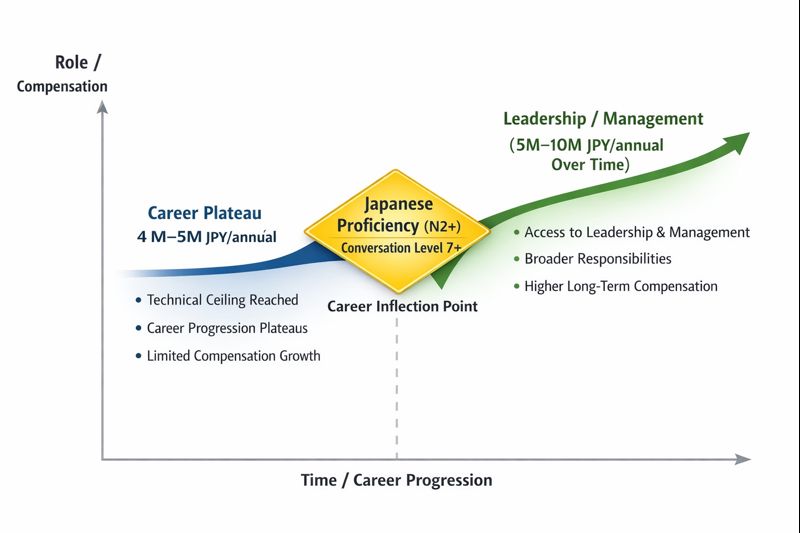
Beyond entry pay, Japanese proficiency shapes career trajectory. Without it, progression often plateaus once technical expertise reaches its ceiling. With stronger language skills, leadership and management paths become accessible, where total compensation can increase by ¥5–10M over time, depending on role and seniority.
Considering that reaching N2 requires roughly 800 hours of study, often spread over two to three years part-time, the return on investment is hard to match. Few skill acquisitions offer that level of long-term payoff.
Related articles:
-
How many hours does it take to reach each JLPT level?
If you’re wondering whether this is realistic, here’s a detailed breakdown. -
From daily conversation to Japanese for work: what changes and how long it takes
Here’s what actually changes when you move from daily Japanese to Japanese for work.
Start learning Japanese that is useful for your (future) IT job

When learning Japanese for professional purposes, it’s important to be strategic to avoid burnout.
Short-term focus: getting ready for the job market
To be fully prepared for the Japanese job market, you should focus on learning IT-related vocabulary, improving spoken communication, and practicing job interviews. Courses such as the business Japanese and career support program are designed to help engineers apply Japanese in professional contexts while preparing for interviews.
For complete beginners, starting with an intensive program to learn the fundamentals can be an effective approach, such as the 150-hour kick-off course designed to build a solid foundation quickly.
Long-Term Focus: Building Your JLPT Skillset for Career Growth
For sustainable career growth as an IT engineer in Japan, preparing for higher JLPT levels step by step remains essential. JLPT certification opens more doors and supports long-term progression, especially when approached in a structured way. JLPT-focused courses help you build this foundation efficiently, without unnecessary overload.