




JLPT N4 Curriculum for Elementary to Lower Intermediate (JLPT N5→N4 level)
Build on your JLPT N5 foundation and progress toward JLPT N4 level through structured private 1-on-1 lessons and guided self-study.
This level is designed for learners who already have a basic foundation in Japanese and want to develop stronger grammar and conversation skills for everyday communication. It helps learners improve speaking, listening, reading, and writing through personalized 1-on-1 lessons and homework provided by their teacher. Using a step-by-step approach, learners progress from simple sentence patterns to more complex expressions and situations.
Key Features:
・Covers grammar and conversation skills needed for everyday communication.
・Develops practical Japanese for situations at work, home, school, and in the community.
・Progresses from simple, concrete situations to more complex and nuanced communication.
・Uses Minna no Nihongo Shokyu II as the main textbook, supported by homework and teacher feedback.
Learning Goals:
By the end of this level, learners will be able to:
・Handle a wider range of everyday situations in Japanese.
・Explain reasons, experiences, plans, opinions, and circumstances with more detail.
・Communicate more appropriately depending on the situation and relationship.
・Build the foundational skills needed to progress toward JLPT N3 level.
Sample Japanese Learning Materials
See examples of the original learning materials used in our N4-level online Japanese lessons. At this level, learners practice asking for more detailed information, explaining reasons, and developing more natural Japanese conversations.
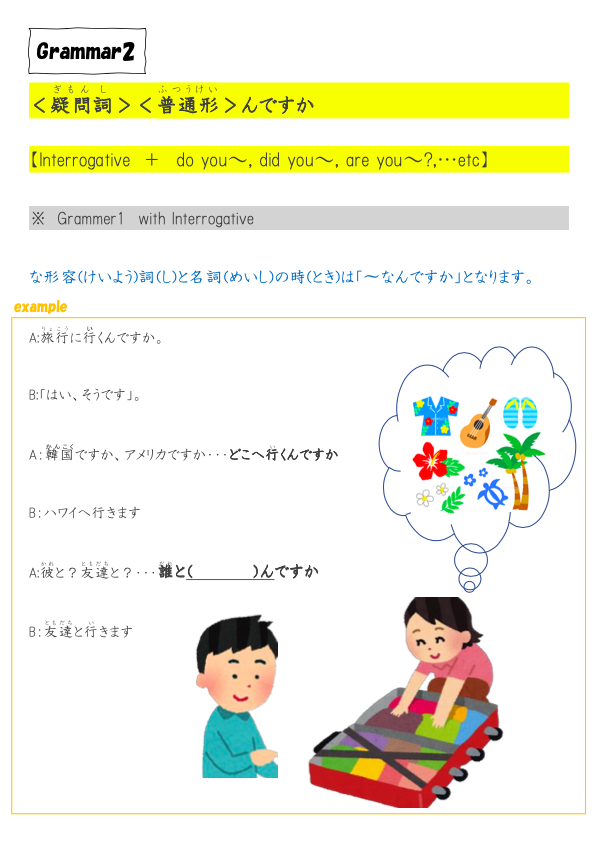
Asking for More Information in Japanese
Learn how to ask for more information using question words and 「〜んですか」 in everyday Japanese conversations.
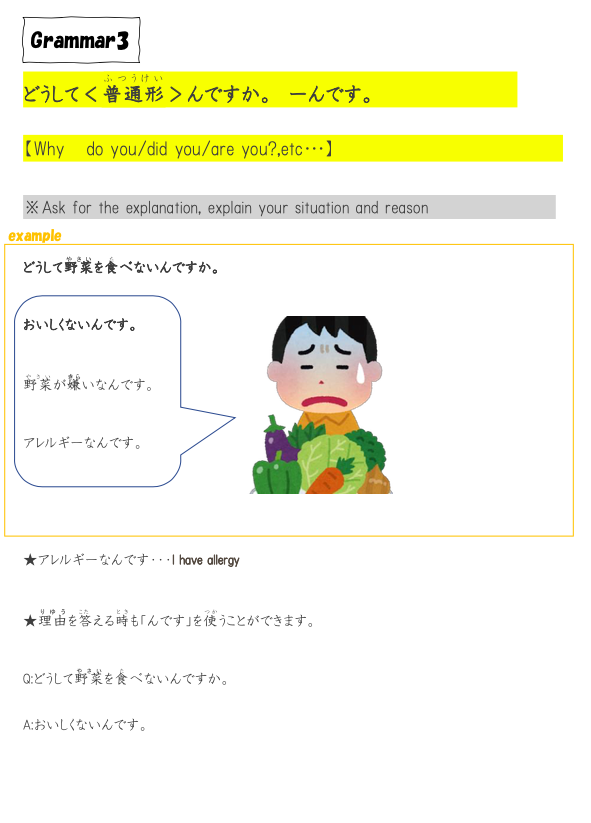
Explaining Reasons in Japanese
Learn how to ask “why” using 「どうして〜んですか」 and explain reasons naturally using 「〜んです」 in Japanese conversations.
By the end of this program, learners will be able to handle a wide range of everyday situations and communicate effectively based on the context. Perfect for advancing your Japanese language skills beyond the basics!
| 課 | Lessons | Topic | What you Can-do |
| 26 | 2~4 | Where should I throw out the garbage?
どこにごみを出したらいいですか |
Ask for the explanation of the other person.
Explain your situation and reason. Explain the reasons and circumstances and make a polite request. Ask advice and instructions. |
| 27 | 2~4 | You can make anything,right.
何でも作れるんですね。 |
Express what you can and cannot do using verbs.
Express the situation what you can see or hear. |
| 28 | 2~4 | Drinking tea…
お茶でも飲みながら… |
Express the continuous actions that are performed at the same time.
Express daily habitual actions. Express several reasons in one sentence. |
| 29 | 2~4 | I left something.
忘れ物をしてしまったんです |
Describe the state of things
Describe the state that has completed. Express regret about the inconvenient situation. |
| 30 | 2~4 | I will reserve a ticket
チケットを予約しておきます |
Explain the state of things using “There is”.
Understand and make Instructions about the things such as preparations should be done in advance for the future. |
| 31 | 2~4 | I think I will start using the Internet.
インターネットを始めようと思っています |
Express your plan, and schedule using Intentional form |
| 32 | 2~4 | You mightbe sick
病気かもしれません |
Give advice
Use conjectural expressions |
| 33 | 2~4 | What does this mean?
これはどういう意味ですか |
Understand instructions and commands.
Give a message or convey the remarks of another person. |
| 34 | 2~4 | Please do as I do
するとおりにしてください |
Describe standards and norms
Express context of the two movements Explain the state of performing in a certain action, or describing daily habitual behavior. |
| 35 | 2~4 | If you go to a travel agency, you can find out
旅行社へ行けば、わかります |
Express the assumptions that is necessary to realize a certain matter.
Make decisions under certain conditions or seek advice or instructions. |
| 36 | 2~4 | I make the effort to use my brain and body
頭と体を使うようにしています |
Mention state goals and endeavors.
Describe changes in human ability and the situation of things. |
| 37 | 2~4 | It is made on reclaimed land
海を埋め立てて造られました |
Use passive expressions to talk about actions received from people and experiences that you feel annoying.
Explain the situation and facts objectively using passive expressions. |
| 38 | 2~4 | I like putting things in order
片付けるのが、好きなんです |
Mention the likes and dislikes of some actions, good and bad points,
Teport that you have forgotten what to do. Confirm if the person have the information or no. Emphasize the part you want to convey. |
| 39 | 2~4 | I’m sorry to be late
遅れて、すみません |
Express the emotion or situation caused by a certain thing together with its cause.
Describe events together with their causes (natural disasters, accidents, etc.). Explain politely the reason, make excuses, and explain the circumstances. |
| 40 | 2~4 | I am worried if my son has made any friends or not
友達ができたかどうか、心配です |
Incorporating a question into a part of the sentence makes it clear that you are wondering.
You can say that you can give it a try. |
| 41 | 2~4 | Could you keep my parcel
荷物を預かっていただけませんか |
Use the expression of giving and receiving that understands the relationship of up and down and intimacy.
You can make a polite request. |
| 42 | 2~4 | What will you spend your bonus on?
ボーナスは何に使いますか |
For can be used to state the purpose.
Describe the application, evaluation, required time, cost, etc. |
| 43 | 2~4 | He looks kind
優しそうですね |
Infer and describe the state from the signs and appearance of changes.
State that you have finished the desired action and returned to the original place. |
| 43 | 2~4 | Do it like in this photo,please
この写真みたいにしてください |
Express undesirable states of motion or degree.
Express the degree of difficulty of an action. |
| 45 | 2~4 | Though I practiced very much
一生懸命練習したのに |
Describe how to deal a certain situation assuming it.
Express the feelings of disappointment and dissatisfaction of the speaker when the expected result is not achieved. |
| 46 | 2~4 | He should be there soon
もうすぐ着くはずです |
Describe the action focusing on each stage of “before”, “in progress”, and “after”.
Express the feeling that it has not been too long after the action. |
| 47 | 2~4 | I heard that she got engaged
婚約したそうです |
You can convey information obtained from a third party as is.
Describe the judgment based on the situation comprehensively grasped through your five senses. |
| 48 | 2~4 | Let me take leave,please
休ませていただけませんか |
Express compulsory actions, acceptance and permission.
Request permission making a careful statement. |
| 49 | 2~4 | Would you please convey my message?
よろしく伝えてください |
Understand respect expression and properly use the words based on human relationships such as “ hierarchy relationship ” and “friendship”. |
| 50 | 2~4 | I am sincerely grateful to you
心から感謝いたします |
Understand the whole system of honorifics based on human relationships of “hierarchy relationship” and “friendship”, and be able to use humble words appropriately. |
GUIDED SELF-STUDY & HOMEWORK
In addition to your private 1-on-1 lessons, your teacher provides approximately 2 hours of guided self-study and homework for each lesson to help you review and reinforce what you have learned.
-
Sentence Practice (60 min)
Create your own sentences using the key grammar patterns learned in the lesson. -
Reading & Speaking Practice (40 min)
Read key grammar examples aloud and record yourself to practice pronunciation and speaking. -
Grammar Review (20 min)
Complete 5–7 short quizzes to review the grammar covered in the lesson.
*Homework may vary depending on your level and learning progress.
TYPICAL STUDY PACE TO JLPT N4 LEVEL
A common pathway to JLPT N4 level includes approximately 50 hours of private 1-on-1 lessons plus 100 hours of guided self-study and homework.
Your timeline will depend on your starting level, lesson frequency, self-study pace, and learning progress. The following is a general guideline:
- 4 lessons per week: approximately 3 months
- 3 lessons per week: approximately 4 months
- 2 lessons per week: approximately 6 months — recommended pace
- 1 lesson per week: approximately 12 months
*Each private lesson is 60 minutes. These timelines are estimates and may vary depending on your starting level and individual progress.
