
 English
  Español

Tips for More Effective Studying
Nihongo Online School > Tips for More Effective Studying > Learn Japanese From Zero to Hero—Complete Beginner Roadmap
Learn Japanese From Zero to Hero—Complete Beginner Roadmap
2026/05/26

Director: Kotaro Muramoto
Principal of Nihongo Online School
In September 2019, he founded "Nihongo Online School". Since then, has been teaching Japanese online lessons, with a total of over 1,000 students.
He has designed an individualized curriculum based on student’s needs and study goal. And is conscious of making the classes speech-centered in order to improve students’ speaking skills.
The school asks students to submit homework assignments worth 2 hours per lesson to improve faster. By supporting students with these features, students are able to efficiently improve Japanese language skills.
Learning Japanese from zero may feel overwhelming at first. Japanese has hiragana, katakana, kanji, grammar, vocabulary, listening, speaking, reading, and writing. If you try to study everything at once, it is easy to lose motivation.
However, Japanese learning becomes much easier when you follow the right order. Beginners do not need to master every character or grammar rule before they start listening and speaking. The important point is to connect vocabulary, sounds, grammar, and communication step by step.
This article explains a complete beginner roadmap from the perspective of professional Japanese teachers. You will learn not only what to study, but also how to study efficiently.
Contents

Learn Japanese From Zero With the Right Study Order
When you start learning Japanese, the study order is extremely important. Many beginners begin with grammar books or kana charts, but this is not always the most effective way. In this section, we will explain the basic roadmap for learning Japanese from zero.
Understand the Full Learning Roadmap
The first step is to understand the full picture of Japanese learning. A good beginner roadmap includes vocabulary, listening, script reading, grammar confirmation, pattern practice, conversation practice, and output activities.
This order helps you move from “I know this word” to “I can use this sentence in conversation.” By understanding the roadmap first, you can avoid spending too much time on only one skill.
Start With Vocabulary Before Grammar
For complete beginners, vocabulary should come before detailed grammar study. If you do not know any words, grammar explanations become difficult to understand.
You do not need to memorize every word perfectly at first. The goal is to become familiar with the words that appear in your textbook, audio materials, and lessons. When you hear the same words many times, they gradually become easier to understand and use.
Move From Input to Output Step by Step
Japanese learning should move from input to output. First, you receive Japanese through vocabulary and audio. Then, you check the script and understand the grammar. After that, you practice patterns and use them in conversation.
If you try free conversation too early, you may feel frustrated because you do not have enough words or sentence patterns. However, if you follow the correct steps, you can build confidence little by little.
Crucial Tips for Maximizing Your Study Efficiency Lessons
Efficient Japanese study is not about studying for long hours every day. It is about choosing the right priorities. Beginners should focus on the skills that help them understand and use Japanese as quickly as possible.
Learn Kanji by Reading First
Kanji is one of the biggest challenges for English-speaking learners. However, beginners do not need to write every kanji perfectly from the start.
At the beginning level, it is more efficient to recognize and read kanji in words. For example, you can learn kanji through words such as 日本(Nihon, Japan), 学生(gakusei, student), 先生(sensei, teacher), and 会社(kaisha, company). First, focus on reading kanji that appear in your textbook, lessons, and daily life.
Build a Vocabulary Notebook for Your Own New Words
A vocabulary notebook is a powerful tool for beginners. However, it should not be just a list of textbook words. You should write down words that are new to you.
When you write a word, add the meaning, pronunciation, and a short example sentence. If possible, write when or where you heard the word. This makes vocabulary easier to remember and easier to use in conversation.
Study Grammar as Communication Tools
Grammar is important, but it should not be studied only as rules. Japanese grammar should be learned as a tool for communication.
For example, when you learn “〜たいです(~Taidesu),” practice sentences such as “I want to eat sushi,” “I want to go to Japan,” and “I want to study Japanese.” Then, use the pattern in a short conversation. This helps you remember grammar as something you can actually use.
Improve Listening Before Speaking Fluently
Many beginners want to speak Japanese fluently as soon as possible. However, listening should come before fluent speaking.
If you cannot hear Japanese sounds clearly, it is difficult to respond naturally. That is why you should listen to textbook audio many times, even if you do not understand everything at first. Listening helps you become familiar with Japanese rhythm, pronunciation, and sentence endings.
The Best Order to Learn Japanese From Zero with Textbook
A textbook is useful because it gives beginners structure. However, the way you use the textbook is also important. If you only read explanations and complete exercises, your speaking and listening skills may not grow enough.
Here is the best study order when using a Japanese textbook.
Step1: Learn New Vocabulary First
Before starting a new lesson, check the new vocabulary. Look at the meaning, pronunciation, and basic usage.
At this stage, you do not need to memorize everything perfectly. The goal is to become familiar with the words before listening to the dialogue or reading the script. This is also a good time to add new words to your vocabulary notebook.
Step2: Listen to the Audio Many Times First
After checking the vocabulary, listen to the audio many times. Do this before reading the script.
At first, you may not understand the full conversation. That is not a problem. The purpose of this step is to understand what kind of conversations are taking place in what situations, get used to Japanese sounds, speed, rhythm, and intonation.
Step3: Read the Script After Listening
After listening several times, read the script. Check which words you could hear and which parts were difficult.
This step helps you connect sound and text. You may notice that some words sound different in natural conversation, or that sentence endings and particles were hard to hear.
Step4: Check Grammar and Useful Expressions
Next, check the grammar and useful expressions in the script. Do not study grammar as separate knowledge. Look at how each grammar pattern is used in the conversation.
Useful expressions should also be studied as phrases. Short expressions such as “そうですね(Soudesune, Yes)”, “いいですね(Iidesune, Sounds good)”, and “お願いします(Onegaishimasu, Please)” are important for natural communication.
Step5: Practice Each Pattern Repeatedly
After understanding the grammar, practice each pattern repeatedly. This is called pattern practice.
For example, if you learn “〜たいです(~Taidesu),” make many sentences with different verbs and nouns. Pattern practice helps you use grammar quickly without translating from English every time.
Step6: Practice Short Conversations
After pattern practice, move on to short conversations. At this stage, use the vocabulary and grammar from the lesson.
The conversation does not need to be long. A short exchange is enough for beginners. For example, you can practice self-introductions, ordering food, asking for directions, or talking about your schedule.
Step7: Try Longer Output Activities
Finally, try longer output activities. These may include longer conversations, listening questions with quick responses, short writing tasks, or simple presentations.
This step connects all your skills. You listen, understand, think, speak, and write in Japanese. Output activities also help you notice weak points, such as missing vocabulary, unclear pronunciation, or slow response speed.
Practice Speaking With a Teacher
Learning Japanese from zero is easier when you have the right support. Textbooks and apps are useful, but they cannot fully replace speaking practice with a teacher.
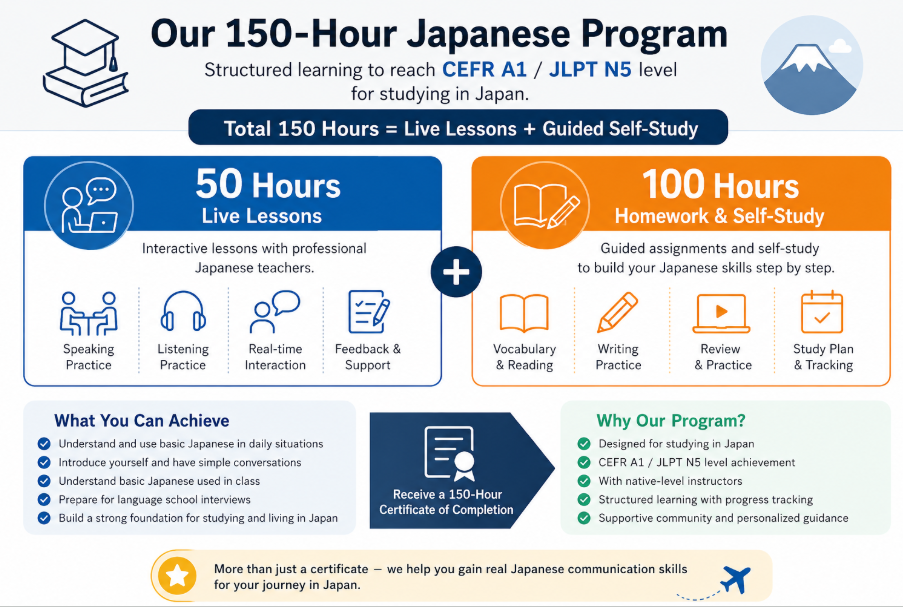
Nihongo Online School offer a unique curriculum that combines “Conversation Level Check”, “Lessons”, “Homework”, and “Motivation Management”. 150 hours course includes 50 hours of online lessons + 100 hours of Homework. This unique curriculum helps students get through their first 150 hours of learning Japanese in 3-6 month.

- Conversation Level Check: 10-step conversation level test to check your speaking ability
- Lesson: Conversation-oriented lessons given by qualified and experienced teachers
- Homework: Students are required to submit 2 hours of assignments for each lesson.
- Motivation management: Lessons are designed to keep students focused on their level and personality
By supporting students with these 4 features, students are able to efficiently improve Japanese language skills.
Please feel free to contact us for a free Japanese level check and trial lesson.
★Lesson Notes
He’s making an effort to speak actively using the words and grammar he knows. However, he makes noticeable mistakes in grammar and tenses, so I will provide appropriate guidance. Since he is a person who loves talking and would like to improve his speaking skills, we plan to use the first 20 minutes of the class as output time for free conversation. Also, if he cannot explain it in Japanese, he may end up speaking in English, so I encourage him to say something like, “Let’s try speaking in Japanese.
What Our Students Say
“I work at a Japanese company but often use English, so I don’t have many opportunities to practice Japanese. After 6 months, I went from complete beginner to N4 and feel much more comfortable holding conversations in Japanese.”
Bon-san, Hong Kong (Software Engineer based in Tokyo)
My dream has always been to work in Japan. I practiced for the interview with my teacher through mock interviews, which made me a lot more confident. The Japanese language interview went really well.”
Jackie-san, Hawaii (Marketing Specialist)
Conclusion: Learn Japanese From Zero by Following the Right Order
Learning Japanese from zero does not mean studying everything at the same time. The most important point is to follow the right order.
Start with vocabulary, then listen to the audio many times. After that, read the script, check grammar and expressions, practice sentence patterns, try short conversations, and move on to longer output activities.
Hiragana and katakana should be studied alongside your lesson content. Kanji should be learned by reading words first, rather than spending too much time on handwriting practice. A vocabulary notebook will also help you remember the words that are truly new to you.
Japanese learning becomes easier when input and output are connected. With the right curriculum, feedback, homework, and motivation support, beginners can build a strong foundation and continue their Japanese learning journey with confidence.
At Nihongo Online School, our programs combine vocabulary, grammar, and practical usage in a clear, structured way, designed to help you succeed on zero to hero. With our learning system giving you the confidence and preparation you need for speaking fluently. Discover your favorite courses at Nihongo Online School.