
 English
  Español

Tips for More Effective Studying
Nihongo Online School > Tips for More Effective Studying > Can I move to Japan for work with no Japanese?
Can I move to Japan for work with no Japanese?

2026/02/24

Director: Kotaro Muramoto
Principal of Nihongo Online School
In September 2019, he founded "Nihongo Online School". Since then, has been teaching Japanese online lessons, with a total of over 1,000 students.
He has designed an individualized curriculum based on student’s needs and study goal. And is conscious of making the classes speech-centered in order to improve students’ speaking skills.
The school asks students to submit homework assignments worth 2 hours per lesson to improve faster. By supporting students with these features, students are able to efficiently improve Japanese language skills.
Relocating to Japan for work is an exciting opportunity, whether your current company is transferring you or you plan to secure a job independently. But do you really need to speak Japanese to make the experience successful?
In this article, we explore how realistic it is to move to Japan for work without speaking Japanese, with advice on building a solid language foundation before or during your relocation.
Contents

Do you have to learn japanese to live in Japan

You don’t necessarily have to learn Japanese to live in Japan. Major cities like Tokyo have English signage in most public spaces, and many apps for transport, banking, or healthcare now offer English support.
That said, living in Japan without knowing Japanese means constant friction. Rental contracts, city hall paperwork, and official documents are almost exclusively in Japanese. And beyond the practical side, the mental fatigue adds up : feeling unable to connect with neighbors or simply not understanding a note from your landlord can quietly wear you down over time.
Do you have to know japanese to work in japan
You don’t need to know Japanese to work in Japan, and many roles in tech, engineering, finance, or education operate in English. Some companies also actively recruit international talent and offer English-speaking environments.
If you are relocated by your current employer, the transition is usually easier, as your company already knows your profile and can accommodate English for your core tasks.
That said, not speaking Japanese has limitations. Informal conversations, meeting side remarks, and internal documents are often in Japanese. Missing these daily exchanges can slow your integration and quietly limit your growth within the company.
The ideal Japanese level to have before moving to Japan

The ideal Japanese level to have before moving to Japan depends largely on who you’ll be working with every day.
International team
In international teams, the required Japanese level varies a lot depending on your role. Technical positions or finance roles often require no Japanese, English is simply the working language. However, if your role involves marketing or any work directly targeting the Japanese market, a level around JLPT N2 becomes important to create, review, and develop relevant content.
Even in the most English-friendly environments, having some basics in Japanese makes a real difference. Being able to exchange a few words with Japanese colleagues, follow the mood of a conversation, or navigate small daily interactions helps you feel less like an outsider and more like part of the team.
Japanese local team
In a local Japanese team, the bar is significantly higher. If your day-to-day involves working with Japanese colleagues with little to no English, a minimum of JLPT N3 and ideally N2 is strongly recommended. Written communication, meetings, internal tools, and informal exchanges will all be in Japanese. Without a solid foundation, even simple tasks can become dependent on others, and your ability to contribute fully will be limited.
The risk to move to Japan for work without speaking Japanese
Moving to Japan for work without speaking Japanese is manageable at first but the risks build up over time.
Professionally, your growth will hit a ceiling quickly. Without Japanese, you’ll struggle to build genuine relationships with colleagues and may get passed over for responsibilities that require local communication.
Psychologically, the daily effort of navigating everything in a foreign language is exhausting. Feeling unable to express yourself can quietly erode your confidence and lead to a real sense of isolation.
Prepare your relocation to Japan with basic Japanese
Before relocation
The goal before moving to Japan for work is not full fluency, but having enough Japanese to handle your first weeks with confidence: introducing yourself to colleagues, managing basic administrative procedures, and making a strong first impression at work.
At Nihongo Online School, our Japanese Online Lessons are built around real conversation. Our learners’ progress is tracked through a 10-level conversation scale that measures what you can actually do in real interactions, not just what you can read or recognize on a test.
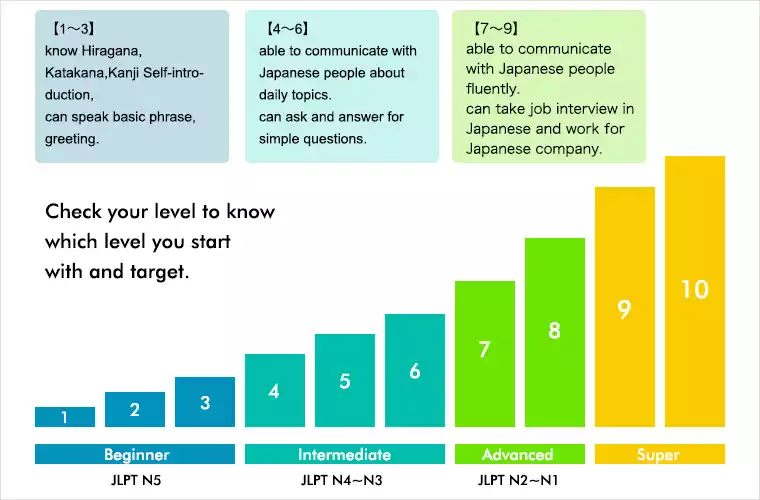
Concretely, if you plan to relocate to Japan and currently have no Japanese level, here is a realistic timeline and target level to aim for:
| Conversation Level | JLPT Equivalent | What you can do | Typical timeline from scratch |
| Level 3 | N5 | Answer basic daily questions, simple phrases | 6–12 months |
| Level 4 | N4 | Handle simple interactions, introduce yourself at work | +6 months |
| Level 5 | N3 | Follow basic workplace conversations, explain your role briefly | +4–6 months |
In as little as six months, you can progress from beginner level to approximately JLPT N5, giving you a solid foundation to manage your relocation to Japan more smoothly.
Book a trial lesson to assess your level and plan your relocation to Japan
During your stay
Once you are in Japan, your learning priorities naturally shift based on the situations you face day to day. Two main directions are worth considering, depending on your needs:
- Consolidate your level toward JLPT N3-N2 to follow meetings more naturally and handle daily life with less friction.
- Attend a Business Japanese course if your role involves client interactions, presentations, or internal reporting in Japanese.
The good news is that, depending on your company, Japanese lessons during your stay may be covered or reimbursed by your employer. Our Business Japanese Course is specifically designed for foreign employees and is fully company-supported and reimbursement-friendly making it a seamless investment in your career.