
 English
  Español

Tips for More Effective Studying
Nihongo Online School > Tips for More Effective Studying > How SMEs can train their overseas employees with Japanese language training
How SMEs can train their overseas employees with Japanese language training

2026/02/24

Director: Kotaro Muramoto
Principal of Nihongo Online School
In September 2019, he founded "Nihongo Online School". Since then, has been teaching Japanese online lessons, with a total of over 1,000 students.
He has designed an individualized curriculum based on student’s needs and study goal. And is conscious of making the classes speech-centered in order to improve students’ speaking skills.
The school asks students to submit homework assignments worth 2 hours per lesson to improve faster. By supporting students with these features, students are able to efficiently improve Japanese language skills.
Despite being the largest employers of foreign employees in Japan, SMEs are often the least equipped to provide Japanese language training. Economic and structural constraints hold them back, creating a growing workforce challenge in an increasingly globalized economy.
This guide offers solutions for SMEs looking to support their international employees through Japanese language training, in a way that is both cost-effective and adapted to their organizational structure.
Contents

Why training your overseas employees in Japanese is a priority
Japan is facing a well-documented talent shortage, and SMEs are on the front line. As a result, opening your organization to international employees is increasingly necessary. However, without adequate support in Japanese, the integration and full potential of overseas talent remain limited.
Investing in Japanese language training for foreign employees brings tangible benefits to your business:
- Stronger communication across all roles, including technical ones. Even IT engineers in Japan need to collaborate, report, and problem-solve in Japanese.
- Access to global talent pools, including high-demand profiles in fields like AI, where the best candidates may not yet speak Japanese.
- Better retention and career development : Employees who receive language support stay longer and can grow into leadership roles.
- Higher engagement and integration : Language confidence reduces workplace discrimination and improves job satisfaction, directly impacting performance.
- A stronger employer brand, signaling openness and ambition to future candidates.
In short, Japanese language training is not a nice-to-have. It is a concrete investment in your people and your competitiveness.
Key difficulties for small and mid-sized companies to train their foreign workforce

According to METI reports on foreign workforce utilization, Japanese SMEs consistently lack three things: specialized HR personnel, training budgets, and time. These structural barriers make Japanese language training genuinely difficult to implement.
Budget and ROI concerns
Large Japanese language programs are expensive, and the return on investment is not immediate. For SMEs operating on tighter margins and prioritizing day-to-day production, language training is often seen as a non-essential cost, especially when overseas employees are on temporary contracts or considered higher turnover profiles.
No dedicated international HR structure
Most SMEs do not have an international HR department or in-house language training expertise. Without specialists to design and manage a program, companies end up relying on untrained supervisors, resulting in informal or nonexistent Japanese language support for their overseas employees.
Time barriers
In Japanese SME environments, long working hours and productivity pressures leave little room for structured learning. Japanese lessons often end up scheduled outside working hours, become irregular, and are quickly abandoned.
The result is a cycle that is hard to break: limited resources lead to informal training, which leads to poor integration, which ultimately affects retention and performance.
Adopting a cost-effective approach for corporate Japanese training

The good news is that Japanese language training for foreign employees does not need to be expensive or complex to be effective. For SMEs, the key is to move away from heavy, one-size-fits-all programs and adopt a leaner, more targeted approach.
Keep it simple and prioritize conversation first
The main challenge for SMEs is often limited bandwidth and resources. Online, one-on-one lessons help remove logistical constraints while offering flexible scheduling that fits around busy workloads.
When paired with a conversation-first approach that prioritizes workplace communication, employees can apply what they learn immediately and achieve faster results.
Set a clear timeline and adapt to each profile
Open-ended training programs tend to fade. Defined milestones, regular level assessments, and completion certificates keep both the employee and the company accountable. Equally important: a developer, a factory worker, and a hotel manager do not need the same Japanese. Tailored lesson plans built around each employee’s role and level are simply more efficient than generic curricula.
Integrate training into the onboarding journey
Japanese Language learning is most effective when embedded into the broader integration process. It is also worth acknowledging that personal circumstances (family responsibilities, social isolation, limited exposure to Japanese outside of work) significantly affect learning speed. A good program offers flexible scheduling and a human approach that supports the employee.
Start training your overseas employees in Japanese today
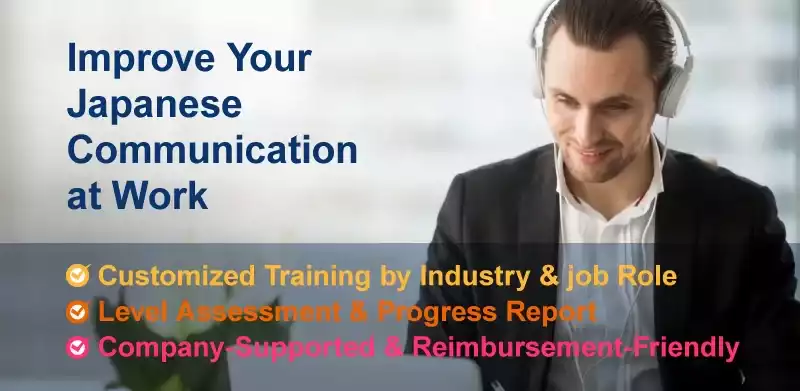
Japanese language training is only effective when it fits the reality of the people learning and the company supporting them. At Nihongo Online School, our business Japanese programs are built around the actual constraints SMEs face.
Full visibility for your HR team
With Nihongo Online School, your company has access to progress reports, level assessments, and defined milestones, making it straightforward to track results and justify the investment internally. Lessons are conducted online, one-on-one, which means they work equally well for employees already in Japan and for those still preparing for relocation abroad.
Adapted to every role and every level
Lesson content is built around each employee’s actual job, objectives, and starting level , whether they are a technical intern, an engineer, a factory worker, or a manager. This includes industry-specific vocabulary, technical Japanese, and keigo for example.
Experienced instructors
Our teachers do more than simply teach Japanese. Through consistent one-on-one follow-up, they build genuine relationships with each learner, creating a space where employees feel comfortable discussing real integration challenges, workplace difficulties, and cultural adjustment.
Language learning and cultural understanding go hand in hand, which is why our instructors are trained to support both. Beyond Business Japanese language acquisition, they help learners navigate professional communication, Japanese business culture, and everyday interactions in Japan.
Contact us to learn more about our Japanese language training services