
 English
  Español

Tips for More Effective Studying
Nihongo Online School > Tips for More Effective Studying > How companies can implement pre-hire Japanese training for foreign employees
How companies can implement pre-hire Japanese training for foreign employees

2026/02/23

Director: Kotaro Muramoto
Principal of Nihongo Online School
In September 2019, he founded "Nihongo Online School". Since then, has been teaching Japanese online lessons, with a total of over 1,000 students.
He has designed an individualized curriculum based on student’s needs and study goal. And is conscious of making the classes speech-centered in order to improve students’ speaking skills.
The school asks students to submit homework assignments worth 2 hours per lesson to improve faster. By supporting students with these features, students are able to efficiently improve Japanese language skills.
Hiring foreign talent is a long-term investment, and early preparation has a direct impact on adaptation, communication, and retention.
This article presents practical best practices for designing Japanese language training for foreign employees, and shows how Nihongo Online School supports companies from the pre-arrival stage.
Contents

Why pre-hire Japanese training is a strategic investment
For foreign employees
Without language preparation, foreign employees face a compounded challenge on arrival: performing in a new role while decoding an unfamiliar professional environment. Team meetings, internal tools, safety instructions, all in Japanese. The result is professional isolation which slows integration.
Employees who arrive with even a basic foundation in Japanese and workplace culture engage faster, build relationships sooner, and contribute meaningfully from the start.
For companies
Recruiting a foreign employee in Japan can cost several million yen when accounting for agency fees, visa sponsorship, and relocation. If the employee leaves within 18 months, that investment is largely lost. Language barriers are also consistently identified as a major factor in foreign employee attrition.
Pre-hire corporate Japanese training directly addresses this risk. For foreign hires in Japan, language training is one of the most concrete forms of that investment, often paying for itself simply by reducing turnover.
What to include in a pre-hire Japanese language training program

Japanese lessons for the corporate environment
The goal of pre-hire Japanese training is functional readiness rather than fluency. For most roles, a level around JLPT N3-N4 is enough to follow instructions, ask simple questions, and interact with colleagues.
Training programs generally focus on :
- Conversational skills: professional self-introductions, responding to colleagues, asking for clarification in meetings
- Listening comprehension: following instructions and understanding the flow of team discussions
- Workplace reading: internal documents, emails, safety notices, and digital tools
- Basic business writing: simple professional messages and routine correspondence
Business etiquette and workplace culture
Japan’s professional norms are specific. Getting them wrong damages relationships before an employee has had a chance to prove themselves.
Pre-hire Japanese training should cover:
- Keigo: formal and honorific Japanese used with superiors and clients
- Business meeting etiquette: seating hierarchy, when to speak, and consensus culture
- Meishi kōkan: the business card exchange ritual
- High-context communication: indirect disagreement and feedback styles
- Hōkoku-renraku-sōdan: the report–inform–consult framework central to Japanese teamwork
These etiquette elements are the operating norms of Japanese professional life, and covering them before arrival significantly reduces culture shock and early relationship missteps.
The right partner to implement Japanese language training for corporations
For companies hiring foreign employees in Japan, finding a training provider that can be deployed with minimal internal coordination is rarely straightforward.
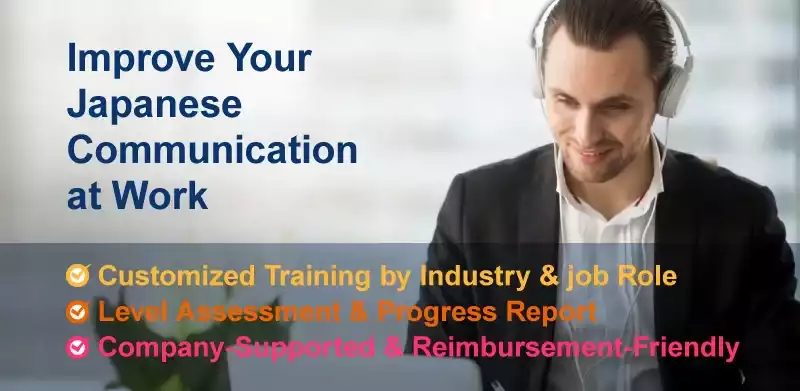
Nihongo Jinzai, which is affiliated with Nihongo Online School, offers an easy-to-set-up one-on-one corporate Japanese language training program.
Each training plan is designed from the ground up based on the learner’s role, industry, and workplace needs.
Two features define the program’s structure:
- OPI-based conversation tracking : Progress is measured through a 10-level oral proficiency assessment rather than JLPT scores, which do not reflect actual spoken ability. HR managers receive structured monthly reports throughout the program.
- Dedicated instructor : Each learner works with the same instructor from enrollment to completion, ensuring better progress tracking and a stronger relationship with both the employee and the company.
Employees begin training remotely as soon as an offer is accepted. The school handles level assessment, curriculum design, and reporting. Multiple employees can be enrolled simultaneously, each following an independent training path.
Japanese program fees
Nihongo Jinzai’s pricing reflects a commitment to cost-effectiveness without compromising training quality.
| Nihongo Jinzai | Market standard | |
| Fee per hour | From ¥4,500 | ¥5,400 – ¥7,500 |
| Lesson content | Tailored plan built from a pre-lesson assessment of conversation, reading and writing ability | Fixed curriculum |
| Available time slots | Weekday daytime, weekday evenings (5–9pm), weekends | Weekday daytime only |
| Progress tracking | Level assessment before and after training; full achievement reporting | Lesson completion report only |
| Homework per lesson | 2 hours | — |
| Pre-contract level assessment | ✓ | Rarely included |
Contact us for more information
Best practices for rolling out a pre-hire program

Cover the costs
Employer-funded training drives higher engagement and signals genuine commitment to the employee’s long-term integration. Formalizing it in the offer letter or employment contract with a stated participation requirement and proficiency target.
Set language goals
Define a specific conversation level target tied to the role before training begins. Nihongo Online School conducts an initial level assessment and provides monthly reports, making it easy for HR to track progress and adjust early if needed.
Start training before the employee arrives
The naitei period (between offer acceptance and start date) is consistently underused. Employees who begin training two to three months before arrival enter onboarding with a foundation that changes the experience for everyone.
Pair language training with a foreign-friendly onboarding plan
Language training works best inside a broader integration strategy:
- Assign a buddy or mentor for informal support in the first months
- Provide key onboarding materials in the employee’s language
- Brief Japanese teammates on communicating effectively with non-native speakers
Pre-hire corporate training in Japan is the first step, not a standalone solution. Companies that combine it with structured onboarding and inclusive team practices are the ones that successfully retain foreign talent long-term.