
 English
  Español

Tips for More Effective Studying
Nihongo Online School > Tips for More Effective Studying > Learning Japanese as a Strategic Investment A 3-Step Path to a Full-Time Job in Japan for Overseas Professionals
Learning Japanese as a Strategic Investment A 3-Step Path to a Full-Time Job in Japan for Overseas Professionals
2026/01/18

Director: Kotaro Muramoto
Principal of Nihongo Online School
In September 2019, he founded "Nihongo Online School". Since then, has been teaching Japanese online lessons, with a total of over 1,000 students.
He has designed an individualized curriculum based on student’s needs and study goal. And is conscious of making the classes speech-centered in order to improve students’ speaking skills.
The school asks students to submit homework assignments worth 2 hours per lesson to improve faster. By supporting students with these features, students are able to efficiently improve Japanese language skills.
Contents

From Learning Japanese to Building a Global Career:
How to Prove Your Japanese Skills Beyond JLPT Scores
Many professionals who consider learning Japanese ask the same question:
“Will this actually help my career?”
“At the moment, I am between jobs and actively looking for new professional opportunities with an international and Japan-related focus.
Investing in Japanese language skills is a strategic step for me toward building a long-term career path on the global market.”
This perspective reflects a growing trend.
For many learners today, Japanese is not just a language to study or a certificate to obtain —
it is a strategic investment in their long-term career.

Certificates and Proof of Completion: What They Are (and What They Are Not)
Many learners naturally ask whether a Japanese course provides a certificate that can be included on a CV.
At our school, we issue a Certificate of Completion that documents learning progress, including course content,
study hours, achieved level (such as JLPT N3 equivalent), and the study period.
You can view a sample certificate here:
https://nihongo-career.com/wp-content/uploads/2023/10/sample.pdf
This type of certificate is useful as a learning record and demonstrates commitment.
However, in real hiring situations in Japan, a certificate alone is rarely decisive.
Why JLPT Scores Alone Are Often Not Enough
While JLPT scores are widely recognized, they do not always reflect a candidate’s ability to explain their work experience,
communicate with colleagues, or participate in meetings and interviews in Japanese.
In practice, Japanese employers often care less about what level you passed and more about
what you can actually do in Japanese.
For a deeper explanation, see this article:
If You Want to Work in Japan, Your Japanese Conversation Skills Matter More Than JLPT
Practical Tip: Using Video to Demonstrate Your Japanese Skills
As a practical career tip, we often recommend using short Japanese-language videos
as supporting material for job applications.
- A 1–2 minute self-introduction video in Japanese
- A short conversation or role-play video
- A mock interview video for a Japanese company
These videos can be shared privately (for example, via an unlisted YouTube link or Google Drive)
and included in a CV or job application.
For employers, this provides an immediate and realistic understanding of a candidate’s real Japanese communication ability —
often more clearly than test scores alone.
Learning Japanese as a Career Strategy
Rather than treating Japanese learning as an isolated goal, we encourage learners to view it as a
step-by-step career strategy.
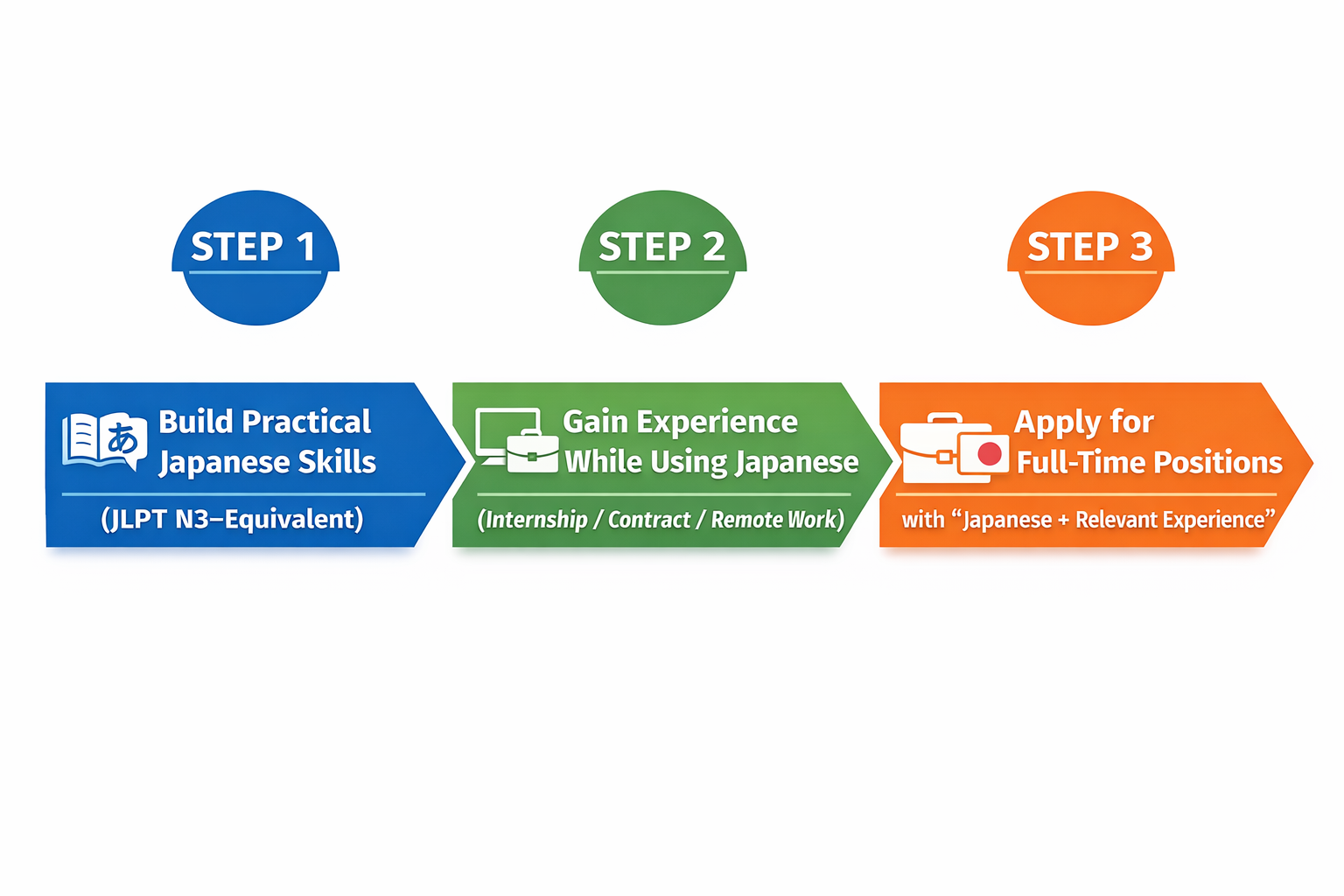
Step 1: Build Practical Japanese Skills (JLPT N3–Equivalent)
At this stage, learners focus on reaching a level where they can handle daily conversations
and basic work-related communication, with an emphasis on practical usage rather than exam preparation alone.
Step 2: Gain Experience While Using Japanese
While continuing Japanese study, learners gain real experience through internships,
part-time or contract work, or remote projects with Japanese companies.
This allows them to actively use Japanese in real work situations while building relevant experience.
Step 3: Apply for Full-Time Positions with “Japanese + Relevant Experience”
With practical Japanese skills and proven experience, learners are in a much stronger position
to apply for full-time roles at Japanese companies.
A Real Case Example
One example is a professional from Indonesia who had N3-equivalent Japanese at the time.
She worked remotely from Indonesia as a part-time contractor for a Japanese company,
later moved to Japan as a full-time employee, and successfully changed jobs afterward.
You can read the full case here:
Business Internship Program in Tokyo, Japan
Related Articles
If you would like to explore this topic further, you may also find the following articles helpful:
From Daily Conversation to Japanese for Work: What Changes and How Long It Takes
If you are in the IT field, this article may be especially helpful.
How to Move to Japan as a Software Engineer: What You Need to Know
What JLPT Level Do You Need to Work as an IT Engineer in Japan?
Conclusion: Japanese Is Not Just a Language — It’s a Career Tool
As the student comment at the beginning shows, more professionals are approaching Japanese learning
with a strategic mindset.
“Investing in Japanese language skills is a strategic step toward building a long-term career path on the global market.”
When Japanese is treated not merely as a qualification, but as a tool for communication,
experience-building, and career growth, it becomes a powerful asset — both in Japan and globally.