
 English
  Español

Tips for More Effective Studying
Nihongo Online School > Tips for More Effective Studying > From Daily Conversation to Japanese for Work What Changes — and How Long It Takes
From Daily Conversation to Japanese for Work What Changes — and How Long It Takes
2026/01/17

Director: Kotaro Muramoto
Principal of Nihongo Online School
In September 2019, he founded "Nihongo Online School". Since then, has been teaching Japanese online lessons, with a total of over 1,000 students.
He has designed an individualized curriculum based on student’s needs and study goal. And is conscious of making the classes speech-centered in order to improve students’ speaking skills.
The school asks students to submit homework assignments worth 2 hours per lesson to improve faster. By supporting students with these features, students are able to efficiently improve Japanese language skills.
Many Japanese learners ask the same question: “I study Japanese, but how long does it take to actually use it confidently—especially at work?”
The honest answer is that conversation ability does not improve randomly. When measured correctly, progress follows a relatively predictable pattern.
In this article, we explain what changes between daily conversation and Japanese for work, and how long it typically takes to move from Conversation Level 2–4 (roughly JLPT N5–N4) to Level 6–7 (roughly upper N3–N2), based on real learning data from 1,000+ learners using our 10-level conversation scale (OPI-style performance criteria).
Contents
- 1 Why JLPT Levels Don’t Reflect Conversation Ability (Especially at Work)
- 2 Daily Conversation vs. Japanese for Work: What Actually Changes
- 3 Our 10-Level Japanese Conversation Scale
- 4 How Long Does It Take to Reach Work-Ready Japanese?
- 5 Real Examples: What Changes at Level 4, 5, and 7
- 6 What This Means for Your Learning Plan

Why JLPT Levels Don’t Reflect Conversation Ability (Especially at Work)
JLPT is a useful benchmark for grammar, vocabulary, and reading. However, it does not measure speaking ability, interaction skills, or real-time listening in conversation—skills that matter most in meetings and real workplace communication.
That’s why it’s common to see learners who have passed JLPT N3 but struggle to hold a natural conversation, while others with lower test scores communicate more smoothly.
To solve this mismatch, we evaluate conversation ability separately, focusing on what learners can actually do in real interactions—both in daily life and at work.
Daily Conversation vs. Japanese for Work: What Actually Changes
Many learners at Conversation Level 2–4 can “get by” in daily life, but feel stuck in professional settings. This happens because work Japanese is a different communication game:
- Daily conversation: short answers are often OK, the listener helps, and context fills gaps.
- Work conversation: you must share background, speak logically, confirm details, and avoid misunderstandings.
In other words: the Japanese language hasn’t changed—but the communication responsibility has.
A Simple Example: Daily Japanese vs. Work Japanese (3 Work Situations)
The difference becomes clear when you compare how the same idea is expressed in daily conversation and in a work setting.
👉 swipe right to view the table
| Context | Situation | Daily conversation | Work Japanese (Lv6–7) |
|---|---|---|---|
| IT / Engineering | A task cannot be completed by the original deadline. |
JP
すみません、このタスク、 Sorry, I don’t think I can finish this task today. |
JP
結論からお伝えします。
To start with the conclusion: I won’t be able to make today’s release.
|
| Office | You cannot attend a scheduled meeting. |
JP
すみません、今日の会議、 Sorry, I can’t attend today’s meeting. |
JP
結論からお伝えします。
To start with the conclusion: I won’t be able to attend the 3:00 p.m. meeting.
|
| On-site | A problem has occurred on site. |
JP
すみません、ちょっと問題がありました。 ENSorry, there was a bit of a problem. |
JP
結論からお伝えします。
To start with the conclusion: Today’s work is on hold.
|
Key point: The grammar isn’t dramatically harder—but the structure and responsibility are completely different. This shift is a major reason many learners plateau between Conversation Level 4–5 and Level 6–7.
Our 10-Level Japanese Conversation Scale
Understanding your current level—and what you can realistically do in daily life—helps you set clear goals and stay motivated.
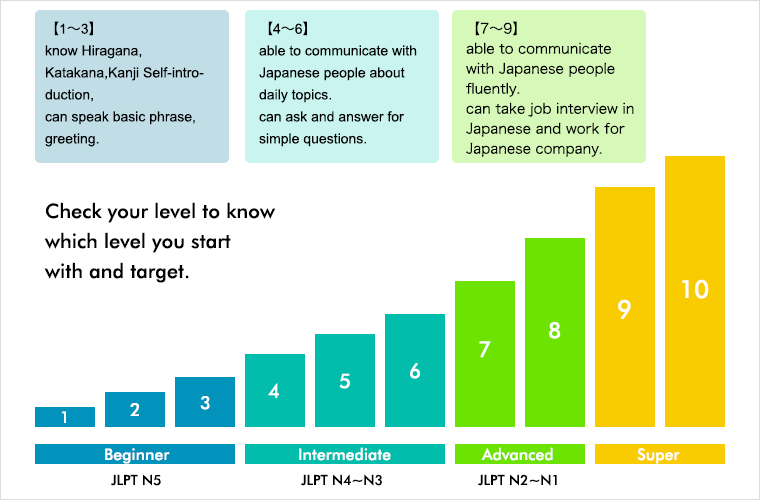
*Based on OPI-style performance criteria, we evaluate conversational ability on a scale of 10.
Conversation Level and What You Can Do (Based on 1,000+ Learners)
The table below shows our original 10-level conversation scale and what learners can typically do at each stage. This scale focuses on practical communication in daily life and work—not just test performance.
👉 Swipe right to view the full table
| JLPT level | Conversation skill level | What you can do in daily life | |
|---|---|---|---|
| Beginner Level | JLPT N5 or equivalent (Minimum level required for daily living) |
1 | Can use a few fixed phrases such as “Hello (Kon-nichiwa)” or “My name is XXX “ |
| 2 | Can use simple phrases about your daily routines, such as “My work starts at X o’clock” | ||
| 3 | Can give short answers to questions commonly used in daily life, such as “When is your day off?” | ||
| Intermediate Level | N4~N3 or equivalent (A level at which one can manage to have a conversation with Japanese colleagues ~ A level at which one can smoothly communicate with Japanese colleagues) |
4 | A level at which communication is somehow possible if a Japanese colleague speaks slowly. Can answer simple questions like, “What do you do?” or “Where do you work?” |
| 5 | A level at which communication is somehow possible if a Japanese colleague speaks slowly. Can understand about 30%-40% of the content of conversations during meetings. Can explain briefly about one’s own job duties. |
||
| 6 | A level where one can have a relatively smooth conversation with a Japanese colleague. Can understand about 60~70% or more of the content of conversations during meetings. Can explain one’s job duties in detail. |
||
| Advanced Level | N2~N1 or equivalent (A level at which one can smoothly communicate with Japanese colleagues ~ A level at which one can hold meetings with clients by oneself.) |
7 | Can communicate smoothly with Japanese employees without any problems. Can understand 80% or more of the content of conversations during meetings. Can convey one’s thoughts logically and persuade others. |
| 8 | Can explain clearly without getting stuck on words. Can keep up with social and professional topics. Can use honorific expressions (Keigo) well enough to handle client interactions on one’s own. |
||
| Super Level | Near native level of Japanese. | 9 | Near native level of Japanese. Can understand proverbs and other unique phrases but have difficulty using them. |
| 10 | Can communicate as well as a Japanese person with business experience. |
How Long Does It Take to Reach Work-Ready Japanese?
The chart below illustrates an average learning trajectory for learners progressing from Conversation Level 3 to Level 6. With consistent study (two 60-minute one-on-one lessons per week), many learners improve by one conversation level approximately every six months.
Please note: Individual progress may vary depending on lesson frequency, self-study and review time, and how often Japanese is used in daily work or life.
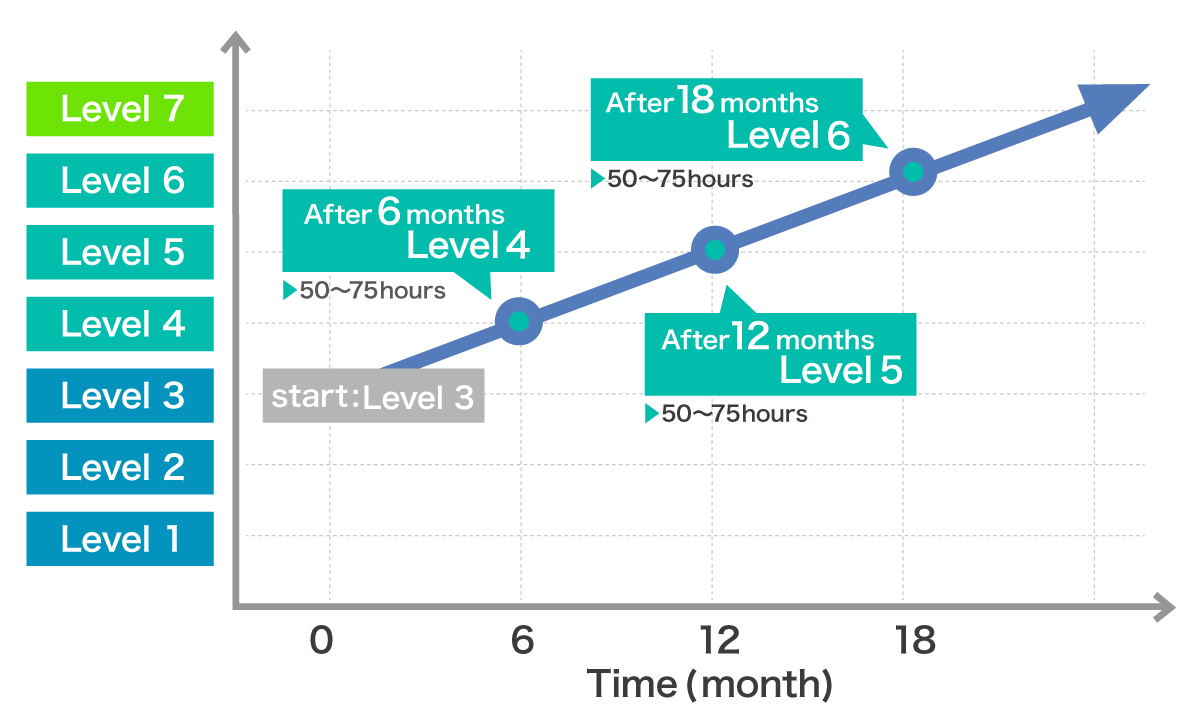
If your current level is Level 2–4 and your goal is Level 6–7, the timeline becomes more concrete when you look at level-by-level hours.
Below, we explain what learners studying at Nihongo Online School can realistically do at key conversation levels, how long it typically takes to reach each level, and how this looks in real one-on-one lessons.
👉On mobile, swipe right to view the full table →
| Current Level → Target Level | Lesson Hours | Homework | Duration |
|---|---|---|---|
| Level 1 → 3 | Approx. 100-150 hours (total) | about 2 hours per lesson hour | 6–12 months (total) |
| Level 3 → 4 | 50–75 hours | about 2 hours per lesson hour | 6 months |
| Level 4 → 5 | 50–75 hours | about 2 hours per lesson hour | 4–6 months |
| Level 5 → 6 | 50–75 hours | about 2 hours per lesson hour | 4–6 months |
| Level 6 → 7 | 50–75 hours | about 2 hours per lesson hour | 6–9 months |
In reality, the most effective learning plan depends on several factors:
- Your current Japanese level
- Your specific goals (what you want to do in Japanese at work)
- Your work environment and communication needs
There is no one-size-fits-all solution—but your progress becomes predictable when you measure the right skill and practice consistently.
Real Examples: What Changes at Level 4, 5, and 7
These videos show real lessons with real students. Individual progress varies, but they provide realistic reference points for each conversation level.
Conversation Level 4 (JLPT N4 Equivalent)
At Conversation Level 4, learners begin to participate in basic daily conversations. Communication is still limited, but meaningful interaction becomes possible when the listener speaks slowly and clearly.
Real lesson example (Level 4):
- Answer simple questions about daily life and work
- Use basic sentence patterns with frequent pauses
- Rely on teacher support to continue the conversation
Typical timeframe: Around 6 months of consistent study from Level 3 (with one-on-one lessons and regular review).
Conversation Level 5 (JLPT N3 Equivalent)
At Level 5, learners can maintain daily conversations more independently. While misunderstandings still happen, they are able to recover and continue the interaction without constant support.
Real lesson example (Level 5):
- Talk about experiences, routines, and simple opinions
- Ask basic follow-up questions
- Maintain a conversation for several minutes
Typical timeframe: About 12 months of total study from Level 3 (roughly 6 months from Level 4).
Conversation Level 7 (JLPT N2 Equivalent)
Conversation Level 7 is a major transition. Learners can explain ideas, provide background information, and handle unexpected questions in professional or semi-formal settings.
Real lesson example (Level 7):
- Explain opinions logically and with structure
- Handle misunderstandings and self-correct while speaking
- Participate actively in meetings and discussions
Typical timeframe: Around 18 months of consistent study from Level 3, depending on lesson frequency and real-world usage.
What This Means for Your Learning Plan
Improving Japanese conversation skills is not about shortcuts or “talent.” It depends on structured speaking practice, feedback, and measuring progress using conversation-based milestones.
Daily conversation and Japanese for work require different communication skills. Understanding this difference helps you set realistic expectations and avoid frustration.
If you want to know your current conversation level, a level check is included in our Free Trial Lesson. We’ll also propose a learning plan that fits your goals and situation.
If you have questions about your current level, lesson content, or pricing, please feel free to contact us through our Free Trial Lesson form.