
 English
  Español

Tips for More Effective Studying
Nihongo Online School > Tips for More Effective Studying > I Study Japanese with Apps but Can’t Speak — What’s Missing?
I Study Japanese with Apps but Can’t Speak — What’s Missing?
2026/01/15

Director: Kotaro Muramoto
Principal of Nihongo Online School
In September 2019, he founded "Nihongo Online School". Since then, has been teaching Japanese online lessons, with a total of over 1,000 students.
He has designed an individualized curriculum based on student’s needs and study goal. And is conscious of making the classes speech-centered in order to improve students’ speaking skills.
The school asks students to submit homework assignments worth 2 hours per lesson to improve faster. By supporting students with these features, students are able to efficiently improve Japanese language skills.
Contents
- 1 I Study Japanese with Apps but Can’t Speak — What’s Missing?
- 1.1 If this sounds familiar, you may be a false beginner
- 1.2 Japanese learning apps are useful — but only for part of the journey
- 1.3 Why you can’t speak yet: what’s missing from app-based study
- 1.4 When app learning reaches its limit
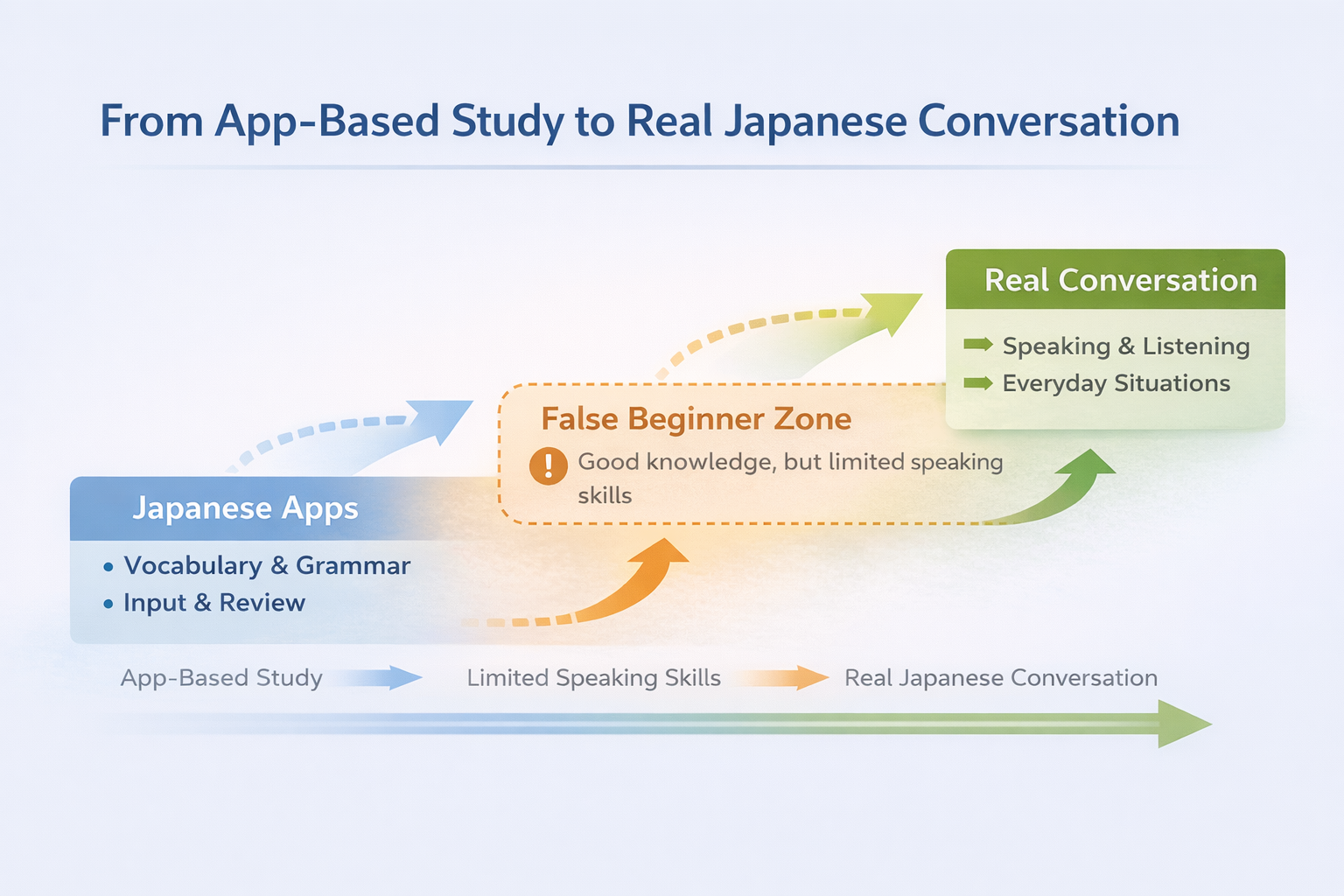
- 1.5 From app-based study to real Japanese conversation
- 1.6 Conversation levels: understanding your speaking progress
- 1.7 Why one-on-one conversation practice works
- 1.8 Quick self-check: is this your situation?
- 1.9 What to do next
I Study Japanese with Apps but Can’t Speak — What’s Missing?
Many Japanese learners study consistently with mobile apps like Duolingo. They build vocabulary, review grammar, and feel productive every day. Yet when it comes time to speak, they often freeze.
If you understand Japanese but struggle to respond in real conversations, you are not alone. This is a very common stage known as the false beginner.

If this sounds familiar, you may be a false beginner
- You recognize words and grammar, but can’t respond quickly
- You translate in your head before speaking
- You understand parts of conversations, but miss follow-up questions
- You feel nervous or slow when speaking Japanese
False beginners are not starting from zero. The problem is not effort or motivation — it is how the skills are trained.
Japanese learning apps are useful — but only for part of the journey
Japanese learning apps are excellent tools for building a foundation. They help you memorize vocabulary, understand grammar patterns, and get used to reading and listening at your own pace.
However, most apps focus on recognition and input. They train you to choose the correct answer, not to speak in real time.
Real conversation requires different skills: processing spoken Japanese quickly, choosing words under pressure, and responding naturally without translating in your head.
Why you can’t speak yet: what’s missing from app-based study
Many learners feel stuck because four key conversation skills are not trained enough through app-based study alone.
- Real-time listening: understanding spoken Japanese at natural speed
- Retrieval: pulling words and expressions from memory instantly
- Sentence building under pressure: forming responses while listening
- Interaction skills: asking back, using fillers, and keeping the conversation going
These skills can only be developed through actual speaking practice. This is why many motivated learners still struggle to speak, even after months of app-based study.
When app learning reaches its limit
There is a common point where learners benefit from adding conversation practice.
- You can read hiragana and katakana
- You understand basic grammar patterns
- You can make simple sentences
- But conversations don’t flow naturally
This is the stage where continuing with apps alone often leads to frustration. What is missing is not more study — but a shift in practice.
If you are wondering how long it typically takes to improve speaking ability, this article explains what realistic conversation progress looks like based on real learner data. How many hours does it take to improve Japanese conversation skills?
From app-based study to real Japanese conversation
Apps are best used as preparation tools. Conversation practice is where that knowledge becomes usable. Combining both allows learners to move forward efficiently and confidently.
Conversation levels: understanding your speaking progress
To help learners understand and track their speaking ability, we use a 10-level Japanese conversation scale. This scale focuses on what you can actually do in real-life situations, not just what you know.
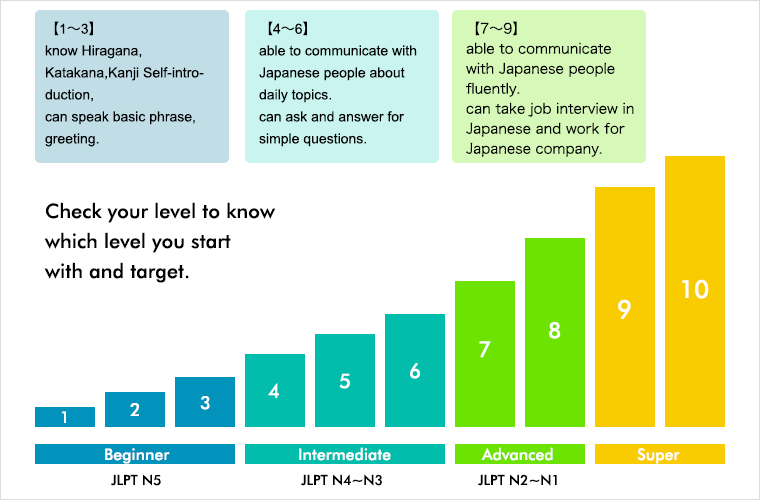
Our conversation levels are defined based on practical speaking ability, following OPI-style criteria such as comprehension, response accuracy, fluency, and the ability to sustain real-life conversations.
Why one-on-one conversation practice works
One-on-one lessons provide something apps cannot: real-time interaction, immediate feedback, and consistent speaking opportunities.
With structured conversation practice, learners can identify what is missing, practice targeted skills, and see measurable progress in their speaking ability.
Quick self-check: is this your situation?
- I understand Japanese but struggle to respond naturally
- I translate in my head before speaking
- I feel slow or unsure in conversations
- I rely heavily on apps but avoid speaking
If you relate to several of these points, you are likely a false beginner — and you may benefit most from conversation-focused practice.
What to do next
If you already use Japanese learning apps but want to improve your speaking skills, the next step is understanding your current conversation level.
Our free trial lesson includes a conversation level check and a personalized recommendation for your next step.