
 English
  Español

Tips for More Effective Studying
Nihongo Online School > Tips for More Effective Studying > Basic IT terms in Japanese you can use at work from day one
Basic IT terms in Japanese you can use at work from day one

2025/12/28
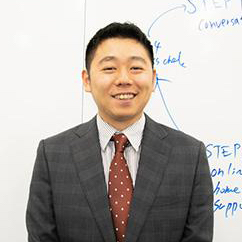
Director: Kotaro Muramoto
Principal of Nihongo Online School
In September 2019, he founded "Nihongo Online School". Since then, has been teaching Japanese online lessons, with a total of over 1,000 students.
He has designed an individualized curriculum based on student’s needs and study goal. And is conscious of making the classes speech-centered in order to improve students’ speaking skills.
The school asks students to submit homework assignments worth 2 hours per lesson to improve faster. By supporting students with these features, students are able to efficiently improve Japanese language skills.
This guide covers the most important IT terms in Japanese you’ll need in the workplace , from general tech vocabulary to programming concepts and project management terminology.
In Japan’s professional environment, where conversational skills are increasingly valued, mastering these technical terms will help you collaborate more effectively with Japanese teams and confidently build your career in the IT industry.
Contents
- 1 Why learning IT & technical terms in Japanese matters for your career
- 2 General Technology terms in Japanese for daily use
- 3 Basic computer & IT terms in Japanese
- 4 Programming terms in Japanese for developers
- 5 IT & Tech Jobs Vocabulary in Japanese
- 6 IT project management terms in Japanese
- 7 Practice exercises: Put your IT terms knowledge to the test

Why learning IT & technical terms in Japanese matters for your career
Even in English-speaking IT teams in Japan, Japanese constantly comes up : in meetings, documentation, and everyday workplace conversations.
That’s why learning Japanese for work, including industry-specific language such as IT terms in Japanese, is essential.
- Impress during job interviews : Vocabulary knowledge reassures recruiters about your communication ability and motivation to adapt.
- Follow internal communications better during Informal chat, meetings, etc.
- Build trust with colleagues, clients and partners : Proper technical vocabulary ensures smoother collaboration with internal and external stakeholders.
Because effective workplace communication is increasingly valued by companies in Japan, being able to demonstrate these skills is just as important as developing them.
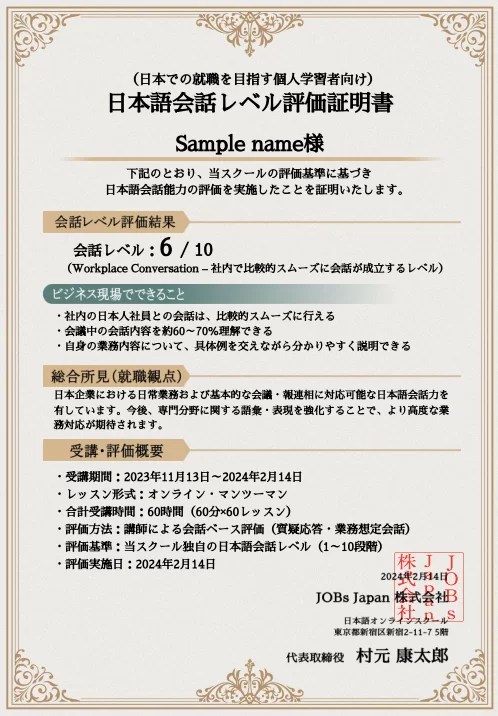
For this reason, Nihongo Online School developed the Japanese Conversation Skills Evaluation Certificate, an assessment that clearly demonstrates your practical workplace communication ability.
General Technology terms in Japanese for daily use
From discussing AI implementations to explaining cloud migrations, technology in Japanese comes up constantly in meetings and project discussions. These terms form the foundation of tech conversations in workplaces.
| Japanese | Romaji | English | Example (Japanese) | Example (English) |
| 技術 | Gijutsu | Technology | この新しいスマートフォンには最新の技術が使われています。 | This new smartphone uses the latest technology. |
| 革新 | Kakushin | Innovation | 我が社は産業の革新を目指しています。 | Our company aims for industry innovation. |
| 人工知能 | Jinkō chinō | Artificial Intelligence (AI) | 人工知能は未来の技術を形作る鍵となるでしょう。 | Artificial intelligence will be key to shaping future technology. |
| デジタル | Dejitaru | Digital | 当社はデジタル化を推進しています。 | Our company is promoting digitalization. |
| データ | Dēta | Data | 顧客データを分析する必要があります。 | We need to analyze customer data. |
| ビッグデータ | Biggu dēta | Big Data | ビッグデータの分析により、消費者の動向をより正確に予測できるようになりました。 | Through big data analysis, we can now predict consumer trends more accurately. |
| クラウドサービス | Kuraudo sābisu | Cloud services | 社内データをクラウドサービスに移行しました。 | We migrated internal data to cloud services. |
| ロボット | Robotto | Robot | この工場は生産効率を上げるためにロボットを多用しています。 | This factory uses many robots to improve production efficiency. |
| オートメーション | Ōtomēshon | Automation | 業務プロセスのオートメーション化を進めています。 | We are advancing the automation of business processes. |
| セキュリティ | Sekyuriti | Security | セキュリティ対策を見直す必要があります。 | We need to review security measures. |
| インターネット | Intānetto | Internet | インターネット接続に問題があります。 | There’s a problem with the Internet connection. |
| ネットワーク | Nettowāku | Network | 社内ネットワークのセキュリティを強化しました。 | We strengthened the security of our internal network. |
| システム | Shisutemu | System | 新しい勤怠管理システムを導入しました。 | We introduced a new attendance management system. |
| ソフトウェア | Sofutowea | Software | 新しいソフトウェアのライセンスを購入しました。 | We purchased a new software license. |
| ハードウェア | Hādowea | Hardware | このハードウェアは特に耐久性があります。 | This hardware is particularly durable. |
Basic computer & IT terms in Japanese

Whether you’re troubleshooting network issues or explaining infrastructure upgrades to colleagues, these computer & IT basic technical terms in Japanese language will help you communicate clearly about systems, servers, and security in the workplace.
| Japanese | Romaji | English | Example (Japanese) | Example (English) |
| コンピュータ | Konpyūta | Computer | オフィスの全てのコンピュータを更新しました。 | We updated all the computers in the office. |
| サーバー | Sābā | Server | サーバーの運用管理を改善しました。 | We improved server operations management. |
| データベース | Dētabēsu | Database | データベース管理の担当者を探しています。 | We are looking for someone in charge of database management. |
| ファイル | Fairu | File | 重要なファイルをバックアップしてください。 | Please back up important files. |
| フォルダ | Foruda | Folder | プロジェクトごとにフォルダを作成しました。 | We created folders for each project. |
| バックアップ | Bakkuappu | Backup | 毎日データのバックアップを取っています。 | We back up data every day. |
| セキュリティ対策 | Sekyuriti taisaku | Security measures | セキュリティ対策を強化する必要があります。 | We need to strengthen security measures. |
| ネットワーク設計 | Nettowāku sekkei | Network design | 新しいオフィスのネットワーク設計を依頼しました。 | We requested network design for the new office. |
| IPアドレス | AI pī adoresu | IP Address | サーバーのIPアドレスを確認してください。 | Please check the server’s IP address. |
| インフラストラクチャ管理 | Infurasutorakucha kanri | Infrastructure management | IT部門がインフラストラクチャ管理を担当しています。 | The IT department is responsible for infrastructure management. |
| アクセス制御 | Akusesu seigyo | Access control | 機密情報へのアクセス制御を設定しました。 | We set up access control for confidential information. |
| システム監査 | Shisutemu kansa | System auditing | 年次システム監査を実施します。 | We will conduct the annual system auditing. |
| ユーザーサポート | Yūzā sapōto | User support | ユーザーサポートチームに連絡してください。 | Please contact the user support team. |
| 情報処理 | Jōhō shori | Information processing | 情報処理システムの改善を提案しました。 | We proposed improvements to the information processing system. |
| インターネット接続 | Intānetto setsuzoku | Internet connectivity | オフィスのインターネット接続が安定しています。 | The office Internet connectivity is stable. |
Programming terms in Japanese for developers

Code reviews, debugging sessions, and technical discussions require specific programming terms in Japanese. These essential terms will help you communicate effectively as a software developer in Japan.
| Japanese | Romaji | English | Example (Japanese) | Example (English) |
| プログラミング | Puroguramingu | Programming | 彼はコンピュータサイエンスの学位を取得し、プログラミングを専門にしています。 | He obtained a computer science degree and specializes in programming. |
| 開発 | Kaihatsu | Development | 新しいシステムの開発を開始しました。 | We started the development of a new system. |
| コード | Kōdo | Code | コードレビューを実施してください。 | Please conduct a code review. |
| デバッグ | Debaggu | Debug/Debugging | このバグをデバッグする必要があります。 | We need to debug this bug. |
| バグ | Bagu | Bug | バグ修正を優先的に対応します。 | We will prioritize bug fixing. |
| 関数 | Kansū | Function | この関数の処理を最適化しました。 | We optimized the processing of this function. |
| 変数 | Hensū | Variable | 変数の名前をわかりやすく変更してください。 | Please change the variable names to be more understandable. |
| 配列 | Hairetsu | Array | データを配列に格納しました。 | We stored the data in an array. |
| アルゴリズム | Arugorizumu | Algorithm | より効率的なアルゴリズムを実装しました。 | We implemented a more efficient algorithm. |
| データ構造 | Dēta kōzō | Data structure | 適切なデータ構造を選択することが重要です。 | It is important to select the appropriate data structure. |
| オブジェクト指向 | Obujekuto shikō | Object-oriented | オブジェクト指向プログラミングの原則に従っています。 | We follow object-oriented programming principles. |
| コンパイル | Konpairu | Compile | プログラムをコンパイルしてエラーを確認してください。 | Please compile the program and check for errors. |
| 実装 | Jissō | Implementation | 新機能の実装が完了しました。 | The implementation of the new feature is complete. |
| テスト | Tesuto | Test | ソフトウェアテストを実施します。 | We will conduct software testing. |
| フレームワーク | Furēmuwāku | Framework | 新しいフレームワークを導入しました。 | We introduced a new framework. |
IT & Tech Jobs Vocabulary in Japanese
Job interviews, team introductions, and organizational charts all require knowledge of tech and IT role terminology.
| apanese | Romaji | English | Example (Japanese) | Example (English) |
| 開発者 | Kaihatsussha | Developer | 経験豊富な開発者を募集しています。 | We are recruiting experienced developers. |
| プログラマー | Puroguramā | Programmer | 新しいプログラマーが来月入社します。 | A new programmer will join next month. |
| エンジニア | Enjinia | Engineer | システムエンジニアのポジションが空いています。 | There is an open position for a system engineer. |
| ソフトウェア開発 | Sofutowea kaihatsu | Software development | ソフトウェア開発チームを拡大しています。 | We are expanding the software development team. |
| システム開発 | Shisutemu kaihatsu | System development | システム開発プロジェクトを担当しています。 | I am in charge of the system development project. |
| データサイエンティスト | Dēta saientisuto | Data Scientist | データサイエンティストの需要が高まっています。 | The demand for data scientists is increasing. |
| プロジェクトマネージャー | Purojekuto manējā | Project Manager | プロジェクトマネージャーが進捗を管理しています。 | The project manager is managing the progress. |
| ネットワークエンジニア | Nettowāku enjinia | Network Engineer | ネットワークエンジニアを採用しました。 | We hired a network engineer. |
| セキュリティエンジニア | Sekyuriti enjinia | Security Engineer | セキュリティエンジニアがシステムを監査しました。 | The security engineer audited the system. |
| データベース管理者 | Dētabēsu kanrisha | Database Administrator | データベース管理者が最適化を行いました。 | The database administrator performed optimization. |
| フロントエンド | Furontoendo | Frontend | フロントエンド開発の経験が必要です。 | Frontend development experience is required. |
| バックエンド | Bakkuendo | Backend | バックエンドエンジニアを探しています。 | We are looking for a backend engineer. |
| フルスタック | Furusutakku | Full Stack | フルスタック開発者が求められています。 | Full stack developers are in demand. |
| デザイナー | Dezainā | Designer | UIデザイナーと協力しています。 | We are collaborating with the UI designer. |
| 担当者 | Tantōsha | Person in charge | IT部門の担当者に連絡してください。 | Please contact the person in charge in the IT department. |
IT project management terms in Japanese

Managing IT projects in Japan means coordinating timelines, tracking KPIs, and communicating with stakeholders. These project management terms will help you run meetings, report progress, and keep your team aligned on deliverables and deadlines.
| Japanese | Romaji | English | Example (Japanese) | Example (English) |
| プロジェクト管理 | Purojekuto kanri | Project management | プロジェクト管理ツールを導入しました。 | We introduced a project management tool. |
| 進捗 | Shinchoku | Progress | プロジェクトの進捗を報告してください。 | Please report the project progress. |
| 納期 | Nōki | Deadline/Delivery date | 納期を守ることが重要です。 | It is important to meet the deadline. |
| スケジュール | Sukejūru | Schedule | プロジェクトのスケジュールを確認しました。 | We confirmed the project schedule. |
| マイルストーン | Mairusutōn | Milestone | 次のマイルストーンは来月です。 | The next milestone is next month. |
| タスク | Tasuku | Task | チームメンバーにタスクを割り当てました。 | We assigned tasks to team members. |
| 予算 | Yosan | Budget | プロジェクトの予算を承認しました。 | We approved the project budget. |
| リソース | Risōsu | Resources | リソースの配分を最適化しました。 | We optimized resource allocation. |
| KPI | Kē pī ai | KPI (Key Performance Indicator) | 月次KPIを設定しました。 | We set monthly KPIs. |
| 要件 | Yōken | Requirements | クライアントの要件を確認しています。 | We are confirming the client’s requirements. |
| 仕様 | Shiyō | Specification | システムの仕様書を作成しました。 | We created the system specification document. |
| 納品 | Nōhin | Delivery | 来週システムを納品します。 | We will deliver the system next week. |
| 会議 | Kaigi | Meeting | 明日プロジェクト会議を開催します。 | We will hold a project meeting tomorrow. |
| レビュー | Rebyū | Review | コードレビューを実施しました。 | We conducted a code review. |
| スプリント | Supurinto | Sprint | 次のスプリントは2週間です。 | The next sprint is two weeks. |
Practice exercises: Put your IT terms knowledge to the test
Put your knowledge of IT terms in Japanese to the test with these fill-in-the-blank exercises. Each sentence uses vocabulary from the categories above.
Exercise 1
____の分析により、消費者の動向をより正確に予測できるようになりました。
(Through _______ analysis, we can now predict consumer trends more accurately.)
A) ハードウェア
B) セキュリティ
C) ロボット
D) ビッグデータ
Exercise 2
IT部門が____を担当しています。
(The IT department is responsible for _______.)
A) インフラストラクチャ管理
B) フォルダ
C) ファイル
D) IPアドレス
Exercise 3
新機能の____が完了しました。
(The _______ of the new feature is complete.)
A) 変数
B) 配列
C) 実装
D) フレームワーク
Exercise 4
____開発の経験が必要です。
(_______ development experience is required.)
A) データサイエンティスト
B) フロントエンド
C) プロジェクトマネージャー
D) 担当者
Exercise 5
プロジェクトの____を承認しました。
(We approved the project _______.)
A) マイルストーン
B) レビュー
C) スプリント
D) 予算
Answer Key
- D | 2. A | 3. C | 4. B | 5. D