
 English
  Español

Tips for More Effective Studying
Nihongo Online School > Tips for More Effective Studying > How to Say “Accidentally / Regret doing …” in Japanese | 〜してしまいました (…shite shimaimashita – regret) | JLPT N4 Grammar
How to Say “Accidentally / Regret doing …” in Japanese | 〜してしまいました (…shite shimaimashita – regret) | JLPT N4 Grammar
2025/12/27

Director: Kotaro Muramoto
Principal of Nihongo Online School
In September 2019, he founded "Nihongo Online School". Since then, has been teaching Japanese online lessons, with a total of over 1,000 students.
He has designed an individualized curriculum based on student’s needs and study goal. And is conscious of making the classes speech-centered in order to improve students’ speaking skills.
The school asks students to submit homework assignments worth 2 hours per lesson to improve faster. By supporting students with these features, students are able to efficiently improve Japanese language skills.
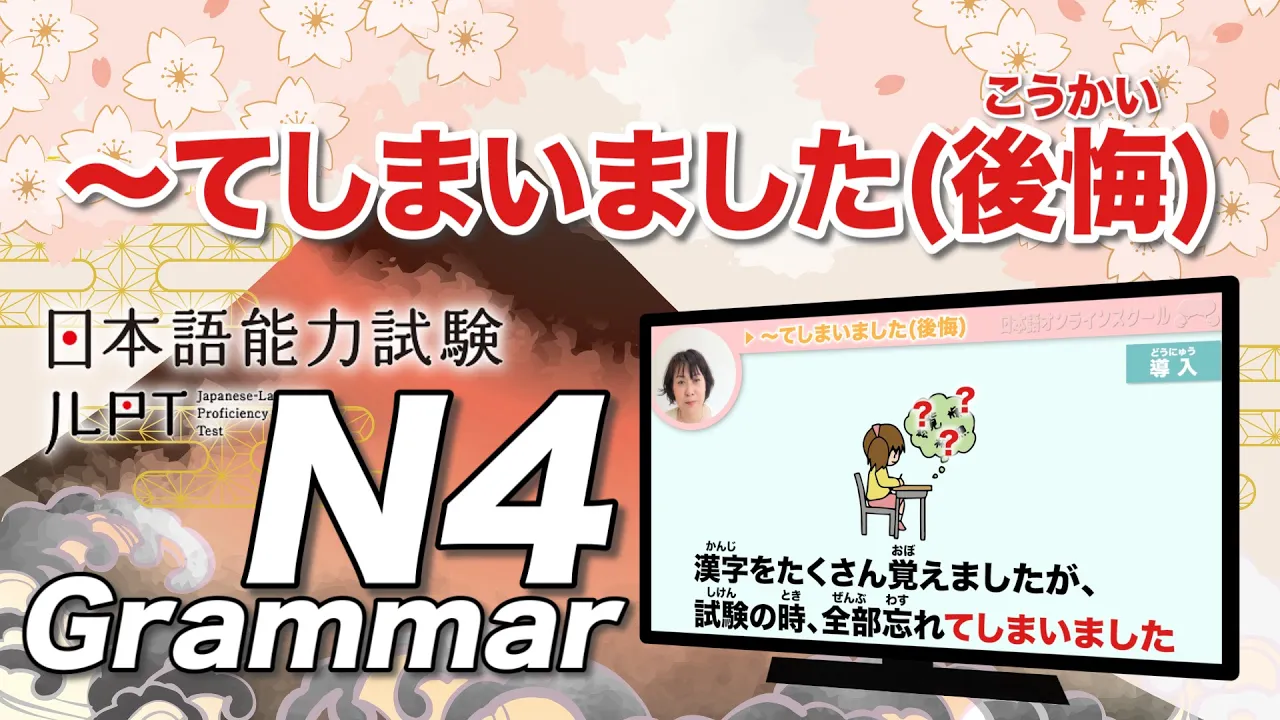
The Japanese expression 「~てしまいました」 is showing completion, and also it is very frequently used to express regret, disappointment, or an unwanted result in daily conversation.
In this column, we focus only on the “regret” meaning of 「~てしまいました」 and explain how it is used to reflect a speaker’s negative feelings about something they did (or something that happened).
Contents

When and How It’s Used
「~てしまいました」 is used when the speaker feels sorry, disappointed, or wishes an action had not happened.
The important point is that the speaker has a negative feeling toward the result, not just that the action is finished.
This expression is often used when:
- You made a mistake
- You acted carelessly
- You caused inconvenience to someone
- An unwanted result occurred
In English, it often corresponds to expressions like
“I shouldn’t have…”, “I accidentally…”, or “I regret that…”.
Because it naturally conveys reflection or apology, it is frequently used with 「すみません」 or 「ごめんなさい」, though it can be used alone as well.
See How it’s used in conversation
This video will help you understand how is used ~てしまいました in everyday Japanese conversations. Watch and repeat to improve your listening and speaking skills!
Sentence Pattern
The structure is simple:
Verb (て-form) + しまいました
This pattern is used with verbs only.
The sense of regret comes from context and speaker intention, not from a special grammatical change.
In casual conversation, 「~てしまいました」 is sometimes shortened to 「~ちゃいました」, but learners should first master the standard polite form.
Examples
- 財布を家に忘れてしまいました。
Saifu o ie ni wasurete shimaimashita.
I left my wallet at home (and I regret it).
- 大事なメールを消してしまいました。
Daiji na mēru o keshite shimaimashita.
I accidentally deleted an important email.
- 寝坊して、会議に遅れてしまいました。
Nebō shite, kaigi ni okurete shimaimashita.
I overslept and ended up being late for the meeting.
- バスは行ってしまいました。
Basu wa itte shimaimashita.
The bus has already left.
→ In all examples, the speaker feels regret or dissatisfaction about the outcome.
In Summary
「~てしまいました」 is an essential N4 grammar pattern for expressing regret over an unwanted action or result.
Using this form allows learners to communicate mistakes and negative outcomes politely and naturally, making their Japanese sound closer to native conversation.
Enhance your JLPT N4 with Nihongo Online School
Mastering the core grammar of JLPT N4 is just one step toward passing the exam. To build a solid foundation, you’ll also need to learn JLPT N4 Grammar List , and also Play List on Youtube for JLPT N4 helps you understand important grammar easily.
At Nihongo Online School, our programs combine vocabulary, grammar, and practical usage in a clear, structured way, designed to help you succeed on the JLPT N4. With our learning system giving you the confidence and preparation you need for the exam. Discover your favorite courses at Nihongo Online School.