
 English
  Español

Tips for More Effective Studying
Nihongo Online School > Tips for More Effective Studying > How complete beginners can start learning Japanese for work
How complete beginners can start learning Japanese for work

2025/12/27

Director: Kotaro Muramoto
Principal of Nihongo Online School
In September 2019, he founded "Nihongo Online School". Since then, has been teaching Japanese online lessons, with a total of over 1,000 students.
He has designed an individualized curriculum based on student’s needs and study goal. And is conscious of making the classes speech-centered in order to improve students’ speaking skills.
The school asks students to submit homework assignments worth 2 hours per lesson to improve faster. By supporting students with these features, students are able to efficiently improve Japanese language skills.
Learning Japanese for work isn’t only about learning words. It also means understanding workplace etiquette, how to address people correctly, and what’s expected in a Japanese work environment.
This guide helps beginners get started with practical steps, from basic Japanese phrases for work to everyday behaviors that matter in the workplace.
Contents

Is learning Japanese essential to work in Japan
Learning Japanese is not always essential to work in Japan. Many international companies and tech startups hire for roles where English is the primary working language. For example, digital marketing positions in Japan may have requirements ranging from basic to advanced, depending on the company.
That said, learning Japanese and developing conversational skills can significantly improve your work experience in Japan:
- Clear communication: Many informal exchanges and quick decisions still happen in Japanese, even in bilingual offices.
- Workplace awareness: Japanese work culture often relies on implicit communication. Conversational Japanese helps you understand nuances and unspoken expectations.
- Relationship building: Simple interactions, such as chatting during lunch or thanking coworkers in Japanese, help build trust and rapport.
- Professional credibility: Using Japanese, even at a basic level, shows commitment and is often appreciated by colleagues and supervisors.
From a job search perspective, conversational Japanese can also reduce recruiters’ uncertainty about your ability to operate in a Japanese work environment, making it easier for them to move your application forward.
Your first steps in learning Japanese for work
If you’re starting from zero, learning Japanese for work can feel overwhelming. Here’s a practical checklist to guide your learning:
- Start with basic workplace vocabulary: Focus on greetings, common office terms, and simple phrases. Beginner apps, YouTube channels, and online dictionaries are good starting points.
- Understand hierarchy and basic keigo: Japanese workplaces rely heavily on respect and hierarchy. Learning Japanese honorifics for coworkers, superiors and clients helps you communicate appropriately in professional settings
- Learn industry-specific terminology: Each industry has its own vocabulary. Knowing key terms in your field will help you follow meetings and internal documents.
- Focus on job-specific vocabulary: Adapt your learning to your role : negotiation phrases for sales, process-related terms for operations, programming or technical terms for IT, and so on.
- Get familiar with Japanese work customs: Understanding etiquette such as business card exchange, bowing, and meeting behavior helps you feel more confident and professional.
- Consider one-on-one business Japanese lessons: A tutor specialized in business Japanese can help you progress faster through practical, real-world scenarios.
Learning Japanese directly at work: One of the best ways to improve

Learning Japanese while working is not only possible, it’s one of the most effective ways to improve.Work puts you in constant contact with Japanese, through real situations you can immediately relate to. The key is combining active participation at work with structured learning outside of it.
- Talk with colleagues regularly: Create opportunities to speak Japanese : ask questions, join discussions, and engage during quieter moments.
- Participate actively in meetings: Even if you don’t understand everything, listen carefully and observe. Over time, you’ll start recognizing recurring Japanese phrases for work.
- Review meetings with transcription tools: With permission, record meetings and review transcripts afterward to identify frequently used phrases and expressions.
- Write emails in Japanese: Draft emails yourself and use AI tools only to check errors. Take time to understand corrections so each email becomes a learning opportunity.
- Ask colleagues for help: Find a coworker who wants to improve their English and suggest a language exchange.
Learning Japanese at work becomes especially effective when immersion is paired with dedicated study time. When done right, your job becomes your classroom.
Easy Japanese phrases for work to learn immediately

Arrival and departure greetings at work
Greetings are your first impression every day. In Japanese workplaces, saying hello isn’t just polite, it shows you’re present, engaged, and part of the team. Always greet first, regardless of hierarchy.
| Situation | Japanese | Meaning | Notes |
| Arriving in the morning | おはようございます | Good morning | Say brightly and clearly to everyone |
| Leaving the office | お先に失礼します | Excuse me for leaving first | Use even if leaving at normal hours |
| Someone leaves before you | お疲れ様です | Good work / Thank you for your effort | Never say ご苦労様 (Gokurōsama) to superiors |
| Entering a room | 失礼します | Excuse me | – |
| Leaving a room | 失礼しました | Excuse me (past tense) | – |
| Going out | 行ってきます | I’m leaving (and coming back) | – |
| Someone goes out | 行ってらっしゃい | See you later | – |
| Returning to office | ただいま戻りました | I’m back | Add brief report if relevant |
| Someone returns | お帰りなさい | Welcome back | – |
Adding a short comment after your greeting makes it warmer and shows you’re engaged. For example:
おはようございます。昨日はありがとうございました。
“Good morning. Thank you for yesterday.”
お疲れ様です。外はすごい雨でしたね。
“Good work. It was raining hard outside, wasn’t it?”
ただいま戻りました。商談、うまくいきました。
“I’m back. The meeting went well.”
Using Japanese honorifics with coworkers, superiors and clients
Japanese honorifics used with coworkers, superiors, and clients can feel confusing at first, but they follow a consistent logic. In the workplace, using the correct honorifics isn’t just about politeness, it’s about choosing the right form of address and verb form based on who you’re speaking to and who you’re talking about.
Two basic rules guide most situations:
- whether someone is senior or junior to you,
- whether the listener is inside or outside your company.
Hierarchy matters, but in business Japanese, the inside/outside distinction comes first.
Inside vs. Outside Rule
Your company is considered “inside” (うち): coworkers, managers, and executives.
Clients and partners from other companies are “outside” (そと).
When speaking to someone outside your company, everyone inside your company, including your boss, becomes part of your in-group. To show respect to the outsider, you use humble forms and simpler honorifics for your own side.
For example, when talking to a client, you would say:
山田が確認いたします。
(Yamada will check it.)
Rather than using a title or respectful language for your boss.
This is why Japanese uses different politeness levels and honorifics.
Respectful language and honorifics are used for superiors and external people, for example:
鈴木様がおっしゃいました。
(Mr. Suzuki said…)
Humble language is used for yourself or your company when speaking to clients, while polite です/ます forms remain a safe, professional default.
Addressing coworkers, superiors, and clients correctly
Once you understand the inside/outside and hierarchy rules, choosing the correct honorific becomes much simpler. The table below shows how to address coworkers, superiors, and clients at work.
| Situation | Who they are | How to address them | Example | Why |
| Coworker (same level) | Inside (うち) | Name + さん | 田中さん | Neutral and professional |
| Superior | Inside (うち) | Title or Name + さん | 部長 / 山田さん | Shows respect within the company |
| Client / Partner | Outside (そと) | Name + 様 | 鈴木様 | Higher respect for outsiders |
Key phrases and etiquette for meetings

Meetings in Japan follow structure and protocol. Even as a beginner, knowing easy Japanese words for work and etiquette helps you participate confidently.
| Situation | Japanese | Meaning |
| Acknowledging understanding | かしこまりました | Understood (very formal) |
| Acknowledging understanding | 承知しました | Understood (polite) |
| Asking for clarification | 恐れ入りますが、もう一度お願いします | Excuse me, could you repeat that? |
| Sharing an opinion | 私の意見ですが | This is my opinion, but… |
| Agreeing | おっしゃる通りです | As you say / I agree |
| Thanking someone | ありがとうございます | Thank you |
| End of meeting | お疲れ様でした | Thank you for your hard work |
Meeting etiquette in Japan is largely similar to what you may be used to in other countries. The key is preparation, attentiveness, and keeping discussions focused.
- Confirm the time, location, purpose, attendees, and any required materials in advance
- Review shared documents beforehand and prepare simple questions or comments if input is expected
- Arrive early, especially if you are helping with setup
- Silence your phone before the meeting starts
- Ask for permission before recording or taking photos, as this relates to information security
- Listen actively, even if you don’t understand everything
- Keep in mind that meetings always have a clear goal, and make sure your comments stay relevant
Adopting the right Japanese attitude for work
When you learn Japanese for work, vocabulary alone won’t be enough. Understanding Japanese business etiquette and workplace attitudes matters just as much as what you say.
How to bow properly

Bowing (お辞儀, ojigi) is fundamental to adopting the right attitude at work in Japan. The key is to bow from the waist, not just the neck, and to separate the spoken greeting from the bowing motion for a more polished impression.
Japanese business culture uses three types of bows, each with a different angle and purpose:
| Type | Angle | When to use |
| 会釈 (Eshaku) – Light bow | 15° | Casual greetings with colleagues, passing people in hallways |
| 敬礼 (Keirei) – Standard bow | 30° | Most common; greeting clients, receiving instructions from superiors |
| 最敬礼 (Saikeirei) – Deep bow | 45° | Apologies, expressing deep gratitude, very formal situations |
Executing a proper bow requires attention to posture and timing :
- Stop moving and make eye contact with the person
- Say your greeting (e.g., よろしくお願いします)
- Keep your back straight and bend from the waist (not just your neck)
- Men: hands along the sides of pants; Women: hands lightly clasped in front
- Lower your head quickly, pause briefly, then raise slowly
- Make eye contact again after raising your head
How to exchange Business Cards (名刺, meishi)
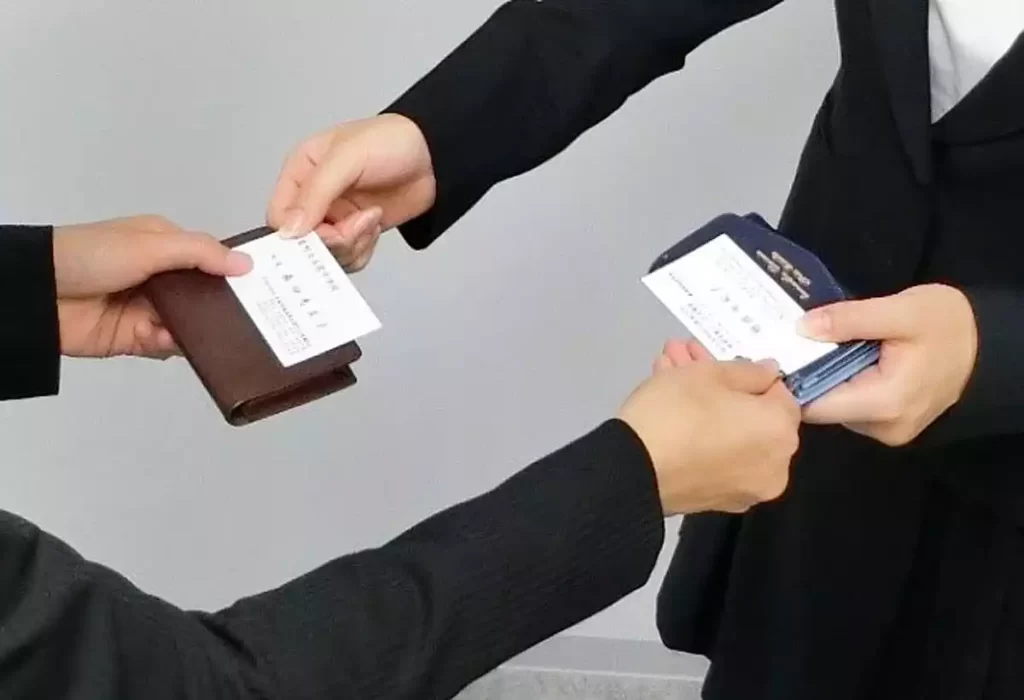
Exchanging business cards is also an important part of Japanese workplace etiquette. A business card is treated as an extension of the person, so handling it carefully shows respect and professionalism.
- Prepare your card: Stand facing the other person and hold your card at chest level with both hands, text facing them. The visiting party or the junior person usually presents their card first.
- Offer your card: Present it with your dominant hand while stating your name and company, for example: 〇〇会社の△△と申します (“I’m △△ from 〇〇 company”).
- Receive their card: Use your other hand to receive it, place your own card slightly lower as a sign of respect, and say 頂戴いたします (chōdai itashimasu). Once the exchange is complete, hold the received card with both hands.
- Confirm the name: Read the name aloud to confirm pronunciation, for example: 〇〇様ですね (“You’re Mr./Ms. 〇〇, correct?”). This is the right moment to ask if you’re unsure.