
 English
  Español

Tips for More Effective Studying
Nihongo Online School > Tips for More Effective Studying > If You Want to Work in Japan, Your Japanese Conversation Skills Matter More Than JLPT
If You Want to Work in Japan, Your Japanese Conversation Skills Matter More Than JLPT

2025/12/23

Director: Kotaro Muramoto
Principal of Nihongo Online School
In September 2019, he founded "Nihongo Online School". Since then, has been teaching Japanese online lessons, with a total of over 1,000 students.
He has designed an individualized curriculum based on student’s needs and study goal. And is conscious of making the classes speech-centered in order to improve students’ speaking skills.
The school asks students to submit homework assignments worth 2 hours per lesson to improve faster. By supporting students with these features, students are able to efficiently improve Japanese language skills.
Learners who aim to work in Japan often ask similar questions:
- “I have JLPT N3 (or N2). Is that enough to work in Japan?”
- “How good does my Japanese need to be?”
These are very natural questions.
However, the reality is that what Japanese companies look for is often slightly different from what learners expect.
Contents
- 1 Why JLPT Alone Is Often Not Enough
- 2 The Unspoken Concern in Document Screening
- 3 What Makes a Difference: Being Able to Describe Your Japanese Ability
- 4 Making Japanese Conversation Skills “Visible”
- 5 The Real Impact on Job Applications
- 6 The Biggest Benefit Is for Learners Themselves
- 7 Conclusion: It’s Not About Labels, It’s About Clarity

Why JLPT Alone Is Often Not Enough
JLPT is a well-established and useful exam that measures Japanese language knowledge.
That said, in actual hiring situations, decisions are rarely made based on JLPT level alone.
What hiring managers really want to know is:
- Can this person communicate in Japanese at work?
- Can they understand basic meetings and instructions?
- Can they explain their own job and experience in Japanese?
In other words,
“Can this person function in Japanese at work?”
is far more important than test scores.
The Unspoken Concern in Document Screening
Many Japanese companies—especially those not used to hiring foreign professionals—feel uncertainty when reviewing applications:
- “They say N3, but what does that mean in real conversation?”
- “Will communication be a problem after joining?”
- “Should we move forward or play it safe?”
When this uncertainty is not resolved, even skilled candidates may be screened out at the document stage.
As one candidate’s experience clearly shows in this article, Japanese proficiency in real work communication makes a significant difference in job hunting outcomes, beyond test scores alone:
What Makes a Difference: Being Able to Describe Your Japanese Ability
Candidates who move forward more smoothly often have one thing in common:
they can clearly explain what they can do in Japanese.
For example:
- “I can handle daily workplace communication in Japanese.”
- “I can understand basic meetings and instructions.”
- “I can explain my work experience in Japanese.”
This kind of action-based explanation makes it much easier for recruiters to imagine the candidate in a real work environment.
Making Japanese Conversation Skills “Visible”
This is why there is growing interest in evaluating and visualizing Japanese conversation ability, rather than relying only on exams or study hours.
Below is an example of a Japanese conversation level evaluation certificate designed to show practical workplace communication ability.
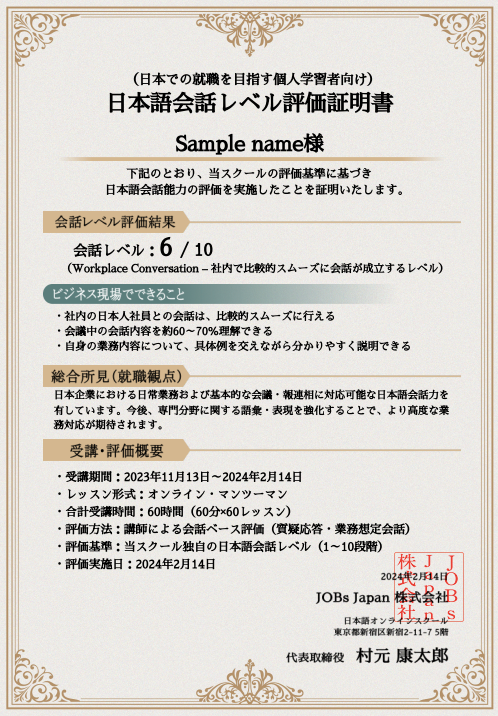
This does not mean:
- replacing JLPT
- guaranteeing employment
- creating another formal qualification
Instead, it serves as supplementary information that helps answer one simple question:
“How well can this person actually communicate in Japanese at work?”
The Real Impact on Job Applications
To be clear,
having a conversation-level evaluation does not automatically guarantee passing document screening.
However, it can:
- Reduce uncertainty about Japanese ability
- Make it easier for recruiters to move a candidate forward
- Provide a clear reason to invite the candidate to an interview
In other words, it is not a “pass ticket,” but a tool to avoid being filtered out due to uncertainty.
The Biggest Benefit Is for Learners Themselves
Perhaps the greatest value of this approach is for learners:
- You gain a clearer understanding of your current Japanese level
- You know what skills to focus on next
- You can explain your Japanese ability confidently in resumes and interviews
For many learners, this shifts Japanese study from
“learning for a test” to “learning for work.”
Conclusion: It’s Not About Labels, It’s About Clarity
When aiming to work in Japan, what matters most is not the label of a certificate, but:
being able to clearly explain what you can do in Japanese.
Conversation-level evaluations help bridge the gap between candidates and employers by making expectations more concrete and realistic.If you are preparing for a career in Japan, taking time to think about how to communicate your Japanese ability may be just as important as improving the ability itself.