
 English
  Español

Tips for More Effective Studying
Nihongo Online School > Tips for More Effective Studying > What is Required to Enroll in a Japanese Language School, including 150 hours of Study History and Many Other Prerequisites?
What is Required to Enroll in a Japanese Language School, including 150 hours of Study History and Many Other Prerequisites?

2023/11/18

Director: Kotaro Muramoto
Principal of Nihongo Online School
In September 2019, he founded "Nihongo Online School". Since then, has been teaching Japanese online lessons, with a total of over 1,000 students.
He has designed an individualized curriculum based on student’s needs and study goal. And is conscious of making the classes speech-centered in order to improve students’ speaking skills.
The school asks students to submit homework assignments worth 2 hours per lesson to improve faster. By supporting students with these features, students are able to efficiently improve Japanese language skills.
In this article, we will answer some of the questions that people who are considering enrolling in a Japanese language school in Japan may have.
Contents
- 1 Can someone who has never studied Japanese before enroll in a Japanese language school?
- 2 What is the “150 hours” Japanese language study requirement?
- 3 What replaces the 150-hour Japanese language requirement in 2026?
- 4 Why Japanese online lessons are the best way to build your 150-hour Japanese language foundation
- 5 Can I enroll in a Japanese language school even if I did not graduate from high school in my home country?
- 6 Can junior high school and elementary school students enroll?
- 7 What is a Certificate of Eligibility?

Can someone who has never studied Japanese before enroll in a Japanese language school?
To apply to a Japanese language school, you will need at the very least to have mastered basic everyday greetings, self-introductions, and simple Japanese language skills such as reading and writing hiragana and katakana.
This is because a basic level of Japanese, roughly JLPT N5, is required as a criterion for those who obtain a student visa.
What is the “150 hours” Japanese language study requirement?
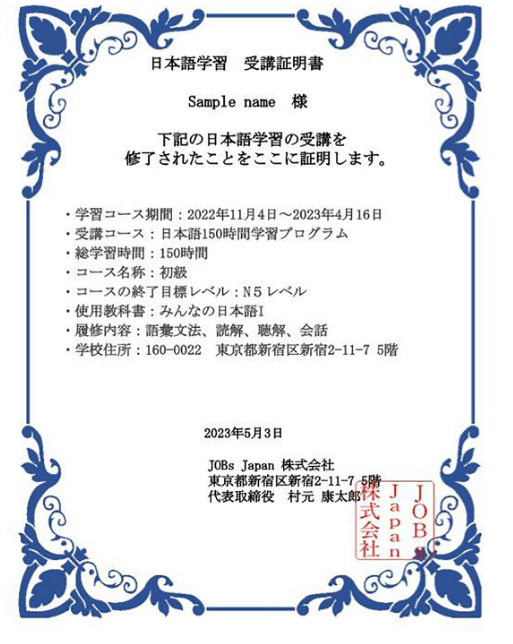
Applicants used to prove their Japanese level by submitting a 150 hours of Japanese study history, usually a certificate of course completion from a recognized program.
The figure was not arbitrary. Immigration measures beginner ability against A1 on the Japanese Language Education Reference Framework, which it describes as the level reached after roughly 150 hours of study. That is also, on average, what it takes to pass the JLPT N5.
Under the stricter rules introduced in 2026, a 150-hour Japanese study certificate is no longer enough on its own. The level expected, roughly N5, has not changed, only the way you prove it.
What replaces the 150-hour Japanese language requirement in 2026?
In 2026, the Immigration Services Agency changed how Japanese language schools check your Japanese level.
A 150-hour study history shows how long you studied, not what you can do. Study hours alone are no longer accepted as proof.
To enroll in a Japanese language school, you now need to prove your level in one of two ways.
A recognized exam certificate
You may obtain a certificate of passing the JLPT N5 or higher, or present another certificate the Japanese Immigration Bureau deems equivalent to JLPT N5 level.
Twelve Japanese language proficiency tests are currently accepted:
| Exam | Level required |
|---|---|
| JLPT | N5 or higher |
| NAT-TEST | Level 5 or higher |
| J.TEST | Grade F or higher (250+ at FG level) |
| BJT Business Japanese Proficiency Test | 300 points or higher |
| STBJ Standard Test of Business Japanese | 350 points or higher |
| TOPJ Practical Japanese Language Test | Elementary A or higher |
| J-cert Daily Life and Vocational Japanese Test | Elementary or higher |
| JLCT Japanese Language Certification Test | JCT5 or higher |
| PJC Bridge | C- or higher |
| JPT Japanese Proficiency Test | 315 points, or 68 on the Elementary Test |
| JT5 | Pass (online test) |
| S-JEP Sundai Japanese Proficiency Test | 300 points or higher |
An interview or level check conducted by the school
Schools can also check your level themselves, including online. Each school sets its own format, but the results are documented in detail for immigration, typically how many questions you answered correctly from JLPT N5 practice material. Expect a conversation in Japanese combined with N5-style questions.
Requirements vary from school to school. Some ask for both an exam certificate and an interview, and some still request supporting records of previous Japanese study alongside them.
Why Japanese online lessons are the best way to build your 150-hour Japanese language foundation
While there are ways to take Japanese language classes within your home country prior to studying in Japan, planning your Japanese studies before applying to a school is a crucial step. Online Japanese lessons are the best option considering the time and location constraints.
Not every online course, however, is designed with a school application in mind.
That is exactly what Nihongo Online School‘s 150-hour Foundation Program does. It brings complete beginners to approximately JLPT N5 level in about 6 months, combining 50 hours of one-to-one lessons with 100 hours of guided self-study and homework. Because every lesson is speech-centered, you also build the communication skills a school interview calls for.
Throughout the program, JLPT-style mock exams give you a clear picture of your level, so you know where you stand before you commit to a JLPT test date or a school interview slot.
The new 2026 application rules are not a reason to give up on studying in Japan. The level expected is the same as before, and six months of guided preparation with Nihongo Online School is enough to reach it.
Read one of our students’ experiences: https://aayush.io/posts/studying-japanese/
Can I enroll in a Japanese language school even if I did not graduate from high school in my home country?
In most cases, if you are staying in Japan for the sole purpose of studying Japanese, you can enroll in a Japanese language school. However, if you wish to enter a university or vocational school in Japan, you must have graduated from high school (completed 12 years of education) to apply.
However, if you enroll in (or transfer to) a high school in Japan and graduate from that high school, you will of course be eligible for higher education. Once you have confirmed that you meet the necessary criteria, choosing the right language school in Japan becomes your next important step toward building a successful academic journey.
Can junior high school and elementary school students enroll?
In principle, most schools require students to be at least 17 years old to enroll in a Japanese language school. However, exceptions may be made if the student is 14 years of age or older, lives with his/her parent or guardian, has no problems with personal security on or off campus, and the Japanese language school conducts an interview in person and determines that there are no problems. However, even in such cases, there are often conditions, such as the applicant must plan to continue his/her studies at a Japanese school after studying Japanese.
What is a Certificate of Eligibility?
If you wish to study in Japan, you must first obtain a Certificate of Eligibility. This certificate is issued by the Ministry of Justice (Tokyo Immigration Bureau). Since the applicant cannot apply directly, a Japanese language school or other institution will apply to the Immigration Bureau on your behalf. With the certificate, you can apply for a student visa at the nearest embassy. The student visa will be issued in about 4 days, depending on your nationality.