
 English
  Español

Tips for More Effective Studying
Nihongo Online School > Tips for More Effective Studying > Lesson 2 こそあど This/That/That+N, Here/There/Over there
Lesson 2 こそあど This/That/That+N, Here/There/Over there
2023/09/17

Director: Kotaro Muramoto
Principal of Nihongo Online School
In September 2019, he founded "Nihongo Online School". Since then, has been teaching Japanese online lessons, with a total of over 1,000 students.
He has designed an individualized curriculum based on student’s needs and study goal. And is conscious of making the classes speech-centered in order to improve students’ speaking skills.
The school asks students to submit homework assignments worth 2 hours per lesson to improve faster. By supporting students with these features, students are able to efficiently improve Japanese language skills.
Contents

■これ、それ、あれ、どれ
This article, you can study kore, sore, are, dore. “これ/それ/あれ/どれ”(kore/sore/are/dore) are demonstrative words used when referring to a particular noun. In English, they are “this (is…)”, “that(is…)”,“that…over there(is…)” and “Which one(is…)?”.
Let’s study with illustrations!

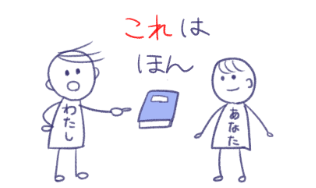
①Kore
Something is very close to [Speaker], we call it “kore”.
これはです。
Korewa hon desu.
This is a book.

②Sore
Something is very close to [Listener], we call it “sore”.
それはです。
Sorewa hon desu.
That is a book.

③Are
Something is not close for both [speaker] and [listener], we call it “are”. It means “over there”
あれはです。
Arewa hon desu.
That over there is a book.

④Dore
Dore is used when you point to an object and want to ask something. It means “which”.
あなたのはどれですか?
Anatano hon wa dore desuka?
Which book is yours?
■この、その、あの、どの
This article, you can study kono, sono, ano, dono. “この/その/あの/どの”(kono/sono/ano/dono) are demonstrative words used when referring to a particular noun. In English, they are “this”, “that”,“that…over there”and “which… ?”.
Difference with “kore,sore,are,dore ” is, “この/その/あの/どの”(kono/sono/ano/dono)
can immediately be followed by a noun.

①Kono
Something is very close to [Speaker], we call it “kono”.
このくるま
Kono kuruma
This car

②Sono
Something is very close to [Listener], we call it “sono”.
そのくるま
Sono kuruma
That car

③Ano
Something is not close for both [speaker] and [listener], we call it “ano”. It means “over there”
あのくるま
Ano kuruma
That car

④Dono
Dono is used when you point to an object and want to ask something. It means “which”.
どのくるま
dono kuruma
Which car
■ここ、そこ、あそこ、どこ
“ここ”(koko), “そこ”(soko),“あそこ” (asoko), どこ(doko) are demonstrative words that indicate specific locations. They mean “here, there, over there, where? ” in English.

1: ここは、かいぎしつです。
Kokowa, kaigishitsu desu.
Here is a meeting room.

2: そこは、かいぎしつです。
Sokowa, kaigishitsu desu.
There is meeting room.

3: あそこは、かいぎしつです。
Asokowa, kaigishitsu desu.
Over there is meeting room.

4: かいぎしつはどこですか?
Kaigishitsuwa, doko desuka?
Where is meeting room?
See you next lesson!