
 English
  Español

JLPT N3 Online Course – Advance Your Japanese to the Intermediate Level
Build your N3-level Japanese through structured video lessons focused on grammar, vocabulary, listening, and practical communication.
Designed for learners who have already completed approximately JLPT N4-level Japanese, this self-paced course helps you move toward N3 while learning Japanese entirely through Japanese.
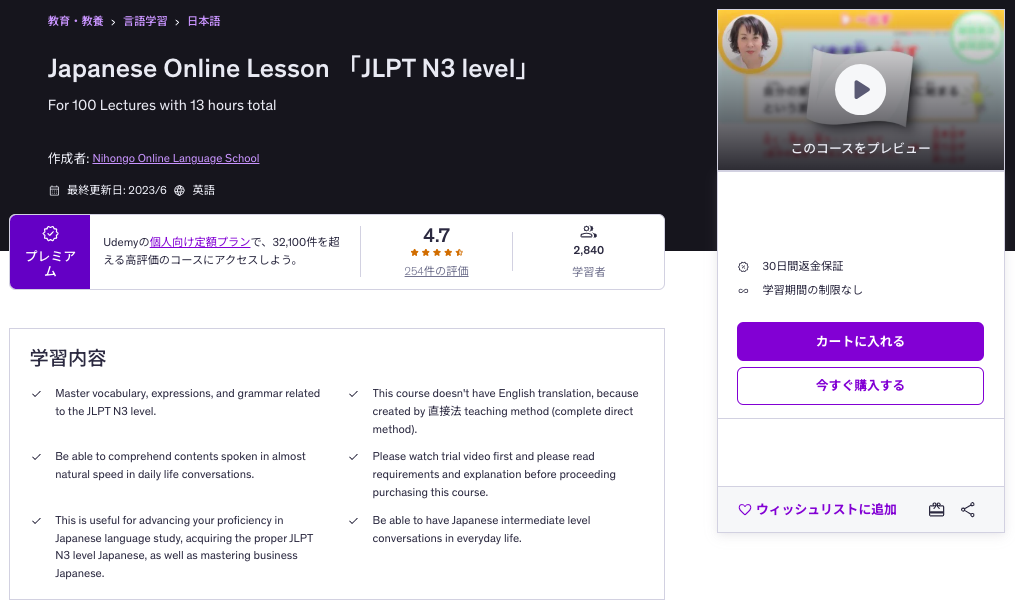
About This JLPT N3 Online Course
This course is designed for learners who have already developed an elementary Japanese foundation and are ready to progress from N4 toward the JLPT N3 level.
The lessons focus on N3-level grammar, vocabulary, expressions, and listening, while also helping you improve your ability to understand Japanese used in everyday conversations.
All lessons are taught entirely in Japanese using the Direct Method. Explanations are given using grammar and vocabulary that learners have already studied at approximately the N4 level.
The curriculum follows the grammar and topics covered in TRY! 日本語能力試験 N3 文法から伸ばす. The textbook is recommended but not required. If you already have it, using it alongside the video lessons can make your study more effective.
You can study at your own pace and review difficult grammar points whenever you need.
Watch Sample Lessons
See how our instructors explain N3 grammar entirely in Japanese. These sample lessons give you a real look at the teaching style used throughout the course.
~による
~ように言う
What You Will Learn
Develop the grammar, vocabulary, listening, and communication skills you need to progress from N4 toward intermediate-level Japanese.
Master Essential N3 Grammar
Learn important N3 grammar patterns step by step through explanations, examples, and practical exercises.
Expand Your Vocabulary and Expressions
Learn vocabulary and expressions in context so that you can understand how they are naturally used in real Japanese.
Strengthen Your Listening Comprehension
Because the course is taught entirely in Japanese, you can develop your ability to understand spoken Japanese while studying new grammar.
Build Intermediate Communication Skills
Learn Japanese that can be used in everyday conversations as well as more formal and business-related situations.
JLPT N3 Course Curriculum
The course covers N3-level grammar and expressions through 11 structured chapters based on TRY! 日本語能力試験 N3 文法から伸ばす.
Each chapter contains several focused video lessons so that you can understand individual grammar patterns and learn how they are used in context.
11 Chapters | 100 Lectures | 20 Lesson Tests
| TRY! N3 | Topic | Grammar Focus |
|---|---|---|
| Chapter 1 | サンタクロースが来た!? Did Santa Claus Come!? | ~始める・~終わる / ~ように言う / ~という — Talking about when actions begin or end, giving instructions, and reporting what someone says ~だろうと思う / ~なさそうだ — Expressing expectations, predictions, and impressions ~と / ~ほど — Describing conditions and degrees or comparisons ~ていく / ~続ける / ~なら — Talking about continuing actions, changes over time, and conditions |
| Chapter 2 | 練習させられた思い出 Memories of Being Made to Practice | ~って / ~(さ)せてもらう / ~(さ)せてくれる — Referring to topics or quotes and talking about receiving permission or being allowed to do something ~がる — Describing another person’s feelings or reactions ~たとたん / ~だす — Describing sudden actions or changes ~ろうとする / ~ことがある — Talking about attempts and occasional experiences |
| Chapter 3 | ボランティア活動に誘われて… Being Invited to Volunteer… | ~による / ~に対して — Describing causes, methods, targets, and relationships ~ため / ~につき / ~とおり — Explaining reasons or circumstances and describing something according to instructions or expectations ~を通して・~を通じて / ~のような・~のように — Talking about means or experiences and giving examples or comparisons ~によれば / ~ということです — Reporting information from other sources |
| Chapter 4 | 陳さんの家族写真 Mr. Chen’s Family Photo | ~てる / ~なきゃ — Using common contractions in casual spoken Japanese ~っけ / ~たりして — Recalling information and making casual suggestions or guesses ~たって / ~に決まってる — Expressing strong assumptions and saying that something remains true even under a condition ~じゃない / ~って / ~みたい — Confirming, quoting, and expressing impressions in casual conversation ~ばよかった / ~ばかり — Expressing regret and talking about repeated actions or situations |
| Chapter 5 | おすすめのラーメン屋 A Recommended Ramen Shop | ~ように / ~はもちろん、~も — Expressing purpose or goals and emphasizing additional information ~ほど~ない / ~かわりに — Making comparisons and talking about alternatives or exchanges ~ずに / ~まま / ~入れ、~ — Describing doing something without another action, leaving a state unchanged, and giving written-style instructions ~ところへ / ~きる — Describing something happening at a particular moment and completing an action fully |
| Chapter 6 | ヒロキさんの大学生活 Hiroki’s University Life | ~おかげで / ~を通じて / ~ませんか — Expressing positive causes, talking about experiences or means, and making invitations ~というと / ~べき / ~にとって — Introducing related ideas, giving opinions about what should be done, and expressing viewpoints ~ば~ほど / ~による / ~ばかりでなく~も — Describing proportional changes, causes or methods, and adding information ~たびに / ~はず — Talking about repeated occasions and expressing logical expectations |
| Chapter 7 | ワンさんの職場 Mr. Wang’s Workplace | ~ものですから / ~ているうちに — Giving explanations or excuses and describing changes that happen while doing something ~ばいいのに / ~てもらってもいいですか — Expressing wishes or advice and politely asking someone to do something |
| Chapter 8 | ビジネスの場面で使う敬語 Honorific Japanese for Business Situations | ご紹介いただきました / 存じ上げて — Using humble and polite expressions when referring to people and actions お~です / ~でしょうか — Speaking respectfully and asking questions politely ~でいらっしゃる / ~させていただきます — Using respectful and humble language in formal or business situations |
| Chapter 9 | 秋の京都 Kyoto in Autumn | ~てからでなければ / ~かのように — Expressing necessary sequence and describing something as if it were something else ~うちに / ~向け / ~によって — Talking about doing something within a period, intended audiences, and causes or methods ~最中(に) / ~かけ / ~ずにはいられない — Describing actions in progress, incomplete actions, and feelings or actions that are hard to resist |
| Chapter 10 | ヒロキさんとユカさんの関係は? What Is the Relationship Between Hiroki and Yuka? | ~わけがない / ~っこない / ~しかない — Expressing strong impossibility and saying there is no other choice ~からこそ / ~なんか — Emphasizing reasons and referring to something dismissively or casually ~からといって / ~とは限らない — Explaining that one reason does not necessarily lead to a conclusion ~ことといったら / ~くせに / ~っぽい — Emphasizing qualities, expressing criticism or contrast, and describing tendencies ~せい / ~のことだから / ~気味 — Explaining negative causes, making assumptions based on someone’s character, and describing slight tendencies or conditions |
| Chapter 11 | 動かない陳さん Mr. Chen Won’t Move | ~なんかいない / ~さえ / ~くらい — Emphasizing absence, giving extreme examples, and expressing degree ~っぱなし / ~だらけ / ~らしく — Describing something left unchanged, being full of something, and acting in a characteristic way ~かと思った / ~とか~とか — Talking about mistaken expectations and giving examples ~ついでに / ~に違いない / ~ほど~(は)ない — Talking about doing something while already doing another task, expressing strong certainty, and making comparisons ~ぬきで / ~てしょうがない — Talking about doing something without something else and expressing uncontrollable feelings or states |
Who Is This Course For?
This course is designed for learners who already have an N4-level Japanese foundation and want to progress toward intermediate-level Japanese and JLPT N3.
- Learners who have completed JLPT N4 or an equivalent level
- Learners who want to progress from N4 to N3
- Learners who want to strengthen their Japanese grammar, vocabulary, and expressions
- Learners who want to improve their ability to understand natural spoken Japanese
- Learners who want to improve their everyday Japanese conversation skills
- Learners who need Japanese for study, work, or communication in Japan
- Learners who want to become more comfortable learning Japanese through Japanese
This course is not designed for beginners. We recommend completing approximately JLPT N4-level Japanese before starting this course.
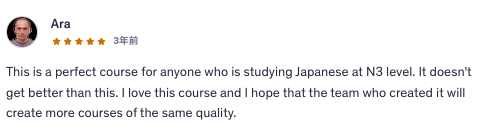
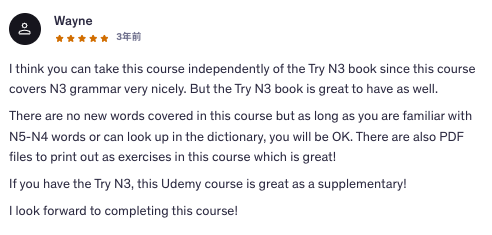
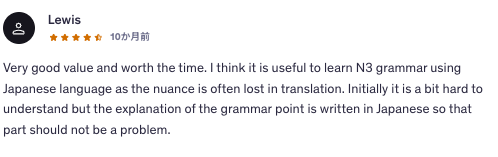
What Our Students Say
See what learners who have studied with our Japanese video courses say about their learning experience.
Learn with Experienced Japanese Instructors
The course was created by experienced, qualified Japanese instructors who have taught learners from a wide range of international backgrounds.

After obtaining a Japanese language teaching qualification, Tsuchiya began teaching Japanese to international students in 2008, primarily at Japanese language schools in Fukuoka Prefecture. She has experience in homeroom management, academic counseling, and interview preparation. As a Japanese instructor, she has taught Japanese to over 800 students from 15 different countries.

After earning her Japanese language teaching qualification in 2007, Mori has been engaged in teaching Japanese to international students for over 10 years, mainly at Japanese language schools in Fukuoka Prefecture. She also provides online instruction for technical intern trainees aiming to work in Japan, covering essential daily conversation skills and etiquette necessary for living in Japan.

After obtaining a Japanese language teaching qualification in 2014, Hoshino has been teaching Japanese to corporate employees and technical intern trainees at Japanese language schools in Fukuoka Prefecture. She has taught Japanese to over 1,000 students. Leveraging her practical experience in Japanese companies, she also provides training on business etiquette unique to Japanese culture.
Frequently Asked Questions
What Japanese level do I need before taking this course?
This course is designed for learners who have completed approximately JLPT N4-level Japanese or an equivalent elementary level and are ready to progress toward N3.
Is this course taught entirely in Japanese?
Yes. The video lessons are taught entirely in Japanese. The instructors explain new N3 grammar using vocabulary and grammar that learners have already studied at approximately the N4 level.
Is this course specifically for JLPT N3 exam preparation?
The course covers vocabulary, expressions, and grammar at approximately the JLPT N3 level and can support your JLPT preparation. However, the course also focuses on improving practical Japanese communication and listening skills rather than only teaching test strategies.
Do I need the TRY! JLPT N3 textbook?
No. The textbook is not required. However, if you already have TRY! 日本語能力試験 N3 文法から伸ばす, we recommend using it alongside the videos to make your study more effective.
What does the course include?
The course includes 100 lectures with approximately 13 hours of video content and 20 lesson tests to help you check your understanding as you progress.
Can this course help me improve conversational Japanese?
Yes. In addition to N3 grammar and vocabulary, the course helps you understand Japanese used in everyday conversations and become more comfortable processing spoken Japanese without relying on English translation.
Can I study at my own pace?
Yes. The course is available on Udemy, so you can progress through the lessons at your own pace and review difficult sections whenever needed.
Not sure whether the N4 or N3 course is right for you? Compare our Japanese courses on Udemy →
Take Your Japanese from N4 to N3
Build stronger grammar, vocabulary, listening, and communication skills through structured Japanese-only video lessons designed for intermediate learners.
